
← All posts
FrancisAI & Technology
Will AI Replace Doctors? The Better Role for Healthcare AI
A recent JAMA Perspective argues autonomous AI may outperform physicians. Our position: clinicians decide, patients review, and AI helps people follow through.
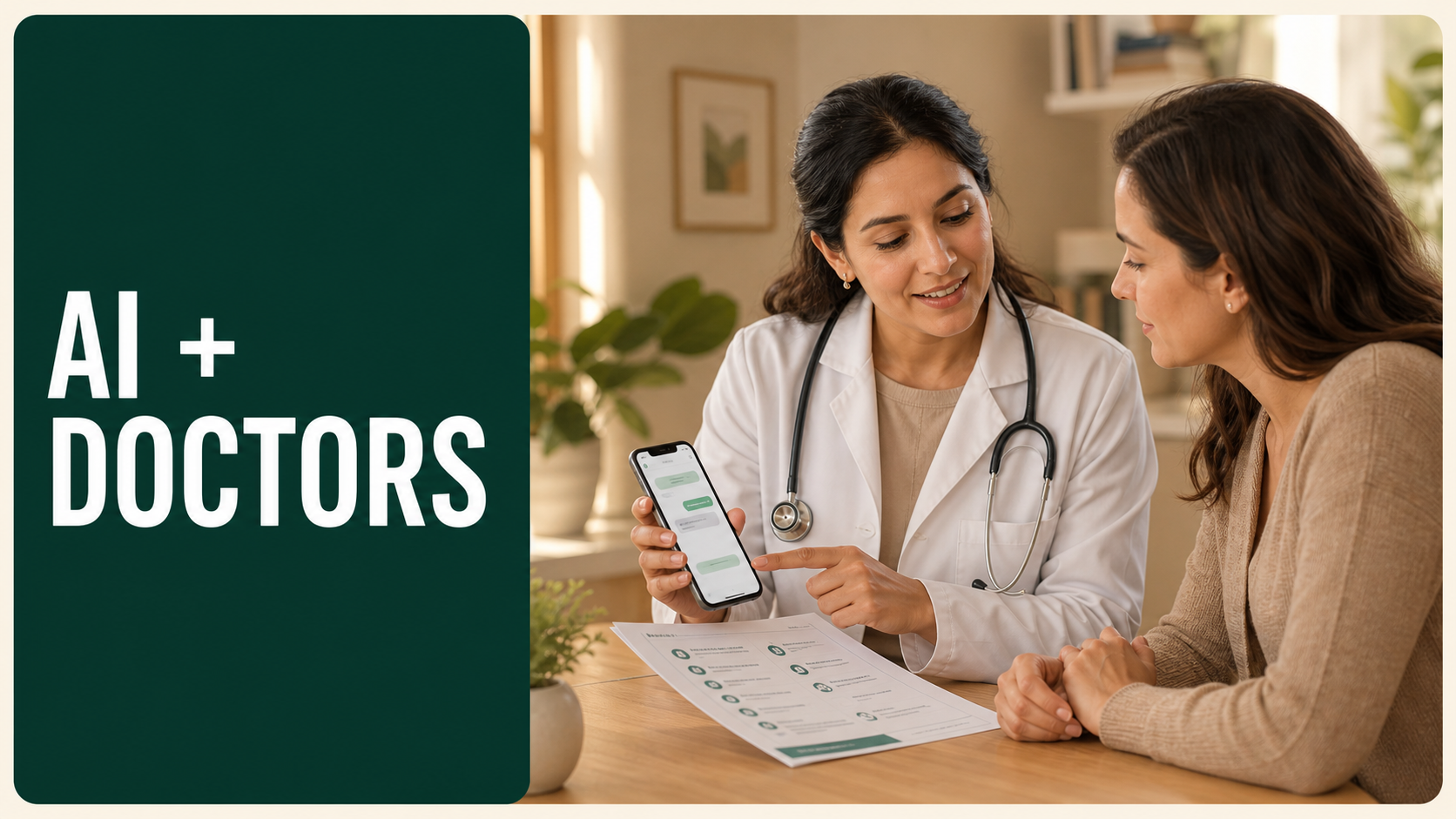
The argument that artificial intelligence will replace doctors has moved from a Silicon Valley provocation into mainstream medicine.
On August 17, 2026, JAMA published a Perspective by Ezekiel Emanuel, Abe Baker-Butler, Neal Khosla of Curai Health, and Vinod Khosla. The authors ask whether autonomous AI could eventually deliver better care than physicians who use AI as an assistant.
That is a serious question. It is also important to describe the article accurately. It is a Perspective, not a clinical trial showing that an autonomous AI doctor already produces better outcomes for patients.
The public reaction accelerated when coauthor and Curai Health CEO Neal Khosla wrote that Curai was founded to prove AI could outperform people at the core cognitive work of medicine. He argued that this future had arrived.
Our position is straightforward:
AI should make excellent professional care easier to understand and follow. It should not quietly replace the professional who is responsible for the care.
At BodyBuddy, we want AI to help doctors help people. We are building for the doctor of tomorrow. We are not trying to replace them.
The most useful role for AI is not to push doctors out of medicine. It is to connect the appointment, the plan, and the patient's actual life.
What the recent JAMA Perspective argues
The JAMA authors challenge the common idea that the best future will always be a doctor working with AI. They argue that autonomous systems may eventually outperform that partnership across parts of medical reasoning and care delivery.
There are fair points inside that argument.
- Medical knowledge is too large for any one person to hold.
- Access to clinicians is uneven and often expensive.
- Human decisions are not perfectly consistent.
- AI systems are improving quickly on medical questions and structured reasoning tasks.
- Some routine work may be safer, faster, or more available when software can handle it.
This debate did not begin with the JAMA article. In May, health-tech journalist Christina Farr moderated a full episode of Heidi Health's Care Beyond Barriers called “AI, Accountability & the Future of Doctors: Will AI Replace Doctors?”. The discussion covered diagnostic automation, liability, judgment under uncertainty, empathy, and the problem of deciding who remains accountable when an AI system acts.
AI already performs meaningful medical work. The harder question is which work should be delegated, under what conditions, and who answers when the result is wrong.
A correct medical answer is not the whole of medical care
AI can be excellent at a bounded task. That does not mean it has reproduced the full job of a doctor.
Today's AI usually works with a much thinner view of the patient. It can read what was typed, uploaded, measured, or recorded. It is usually not in the room. It does not see how the patient walks in, where they hesitate, how their expression changes, or what a physical examination reveals. It can miss the clue that makes the next question worth asking because that clue never entered its context.
A human clinician is often reasoning from dramatically more real-time context. The clinician decides which information matters, notices when the story does not fit, examines the patient, manages uncertainty, explains tradeoffs, performs procedures, and takes responsibility for the plan. The patient brings values, preferences, lived experience, and the right to accept or refuse it.
Closing that gap would require AI that can perceive and interact with the physical world in real time. That would be dramatically different from the systems we have today. Strong performance on written cases does not erase the present gap.
Even the evidence that makes AI look strongest shows why implementation matters.
In a randomized clinical trial published in JAMA Network Open, 50 physicians worked through challenging clinical vignettes. Physicians who had access to a large language model did not score significantly better than physicians using conventional resources. In an exploratory analysis, the model alone scored higher than the conventional-resources group.
That result is impressive for the model. It is not proof of an autonomous healthcare system. The study used six written cases, not physical examinations, procedures, longitudinal relationships, or real-world responsibility for what happened next. It also showed that simply placing a powerful model next to a clinician does not automatically create a better team.
The interface, workflow, training, incentives, and accountability all matter.
Doctors still carry responsibilities that cannot be reduced to a score
One day after the JAMA Perspective appeared, the American Medical Association and the Digital Medicine Society published a framework for the physician's role in the digital and AI era.
It identifies five enduring responsibilities:
- Preserve trust through human connection and shared decisions.
- Apply clinical judgment and remain accountable.
- Lead the evolution of medical practice.
- Steward the responsible use of technology.
- Preserve and advance clinical expertise and ethics.
Those are not sentimental extras. They are part of safe care.
Regulators are still working through the same boundary. On August 18, the FDA released a discussion paper on generative AI-enabled medical devices. It asks how these systems should be assessed before release, confirmed clinically, and monitored after deployment.
That is the right posture: take the capability seriously, test it in the setting where it will be used, and keep responsibility legible.
The largest gap may begin after the appointment
The replacement debate focuses on the moment of diagnosis. Many patients struggle with a different problem: what happens after a good plan has already been made.
The patient leaves the appointment with a medication change, a referral, a home exercise, a follow-up date, a nutrition target, and a warning sign to watch. Then ordinary life resumes.
Good instructions can still break down during the handoff. Following a plan becomes difficult when it is complex, expensive, unclear, easy to forget, hard to fit around work or caregiving, or split across several portals and professionals.
The Agency for Healthcare Research and Quality recommends structured follow-up because it can identify misunderstandings, answer questions, reinforce knowledge, and check action plans. A systematic review of 21 randomized trials also found that timely smartphone education and notifications often improved knowledge, satisfaction, adherence, and clinical outcomes, although the interventions and results were too varied for a single pooled estimate.
Healthcare does not only need better answers. It needs better continuity.
BodyBuddy's position: AI should remove friction around professional care
That work has two sides.
1. Make it easier to reach the right professional
AI should help a person triage the first signs of a problem without pretending to diagnose it. It can organize symptoms, prepare useful questions, prompt the person to book or attend an appointment, and help them recognize when a new or changing concern belongs with a doctor or another qualified professional.
It should lower the friction around getting care. It should not become a reason to avoid care.
2. Integrate the doctor's advice into daily life
The doctor makes the plan. AI should help the patient carry it out.
The appointment is only the beginning. A person still has to remember each step, fit it around ordinary life, notice what is unclear, and make it to the next visit.
BodyBuddy can connect those moments:
- Before the visit: organize questions and the information the person wants to bring.
- During the visit: with permission and where lawful, record the conversation or save notes.
- After the visit: turn the source into a plain-language summary and proposed next steps.
- Before anything becomes a plan: the person reviews the output against the professional's actual instructions.
- Between visits: BodyBuddy follows up by text, brings the next step back at a useful moment, and keeps the plan alongside meals, movement, sleep, and other health goals.
- When something is unclear or changes: the question goes back to the doctor, pharmacist, therapist, dietitian, physical therapist, or other qualified professional.
BodyBuddy can support plans from more than one kind of professional. A person may be following instructions from a primary care doctor, a physical therapist, a dietitian, a specialist, and a trainer at the same time. The real problem is often not a shortage of plans. It is carrying all of them without dropping the rest of life.
The clinician still diagnoses, prescribes, and decides the medical plan. The person reviews the instructions and decides what to follow. BodyBuddy helps integrate that reviewed advice into daily life and close the gap between visits.
BodyBuddy does not diagnose conditions, prescribe treatment, change medication instructions, resolve new symptoms, or replace a qualified professional. It is an AI accountability coach delivered by text message.
AI doctors and AI coaches are different products
An AI doctor uses medical knowledge to diagnose, recommend treatment, and make decisions in the clinician's place. It tries to function as the doctor.
An AI coach has a different job. It works from an agreed agenda and proactively helps the person follow through. Instead of waiting for the next question, it checks in, brings the next step back at a useful moment, helps the person reach the right professional, and carries reviewed recommendations into daily life. It supports the relationship instead of taking responsibility for the care.
Replacement model | Follow-through model |
Acts as the medical decision-maker | Preserves the professional's decision as the source of truth |
Diagnoses or prescribes on its own | Organizes reviewed instructions and practical next steps |
Tries to resolve uncertainty itself | Surfaces uncertainty and sends the question back to the right professional |
Competes with the clinician relationship | Helps the patient arrive prepared and follow through afterward |
Claims clinical authority, requiring clear liability and an exceptionally low margin for error | Works from the provider's reviewed plan and helps the patient carry it out |
Optimizes the encounter | Connects the encounter to the days and weeks that follow |
The distinction matters. An AI system can be useful without pretending to be a doctor. It can remove friction, preserve context, and make it easier for a patient to do what they already agreed to do.
A simple rule for healthcare AI
AI should remove friction between needing care, receiving it, and following through.
That rule does not deny that AI will become more capable. It gives capability a responsible place to land.
Some medical tasks will become heavily automated. Some may eventually become autonomous after strong evidence, clear regulation, and appropriate oversight. Doctors will also change how they work. The AMA's own framework says the profession must evolve with the technology.
But “AI can perform this task” and “AI should replace the person responsible for care” are different claims.
The future worth building is not a chatbot practicing medicine in isolation. It is a system in which clinicians can spend more time on judgment and human care, patients can understand what happens next, and AI carries useful context across the gaps that currently swallow good plans.
Frequently asked questions
Will AI replace doctors?
AI will automate and reshape many tasks currently performed by doctors. Some narrow workflows may become autonomous. Current evidence does not show that a general autonomous AI system can replace the full work, relationship, examination, procedures, and accountability of a physician across real-world care.
Did JAMA publish a study showing AI is better than doctors?
No. The August 17, 2026 article was a Perspective. It argues that autonomous AI may eventually outperform AI-aided physicians. It is an expert argument, not a clinical trial demonstrating that result in patients.
Can AI diagnose medical conditions?
AI systems can generate diagnostic suggestions and perform well on some medical benchmarks. A consumer chatbot should not be treated as a substitute for evaluation by a qualified clinician, especially when symptoms are new, severe, worsening, or urgent.
What is the safest useful role for AI after a doctor visit?
AI can help organize the source material, explain plain-language terms, preserve questions, and support reviewed next steps. It should not invent instructions, change a dose, dismiss a symptom, or decide that professional follow-up is unnecessary.
How does BodyBuddy work with a doctor's plan?
With permission and where lawful, a user can record an appointment in the BodyBuddy app or send an existing Voice Memo to BodyBuddy by text. BodyBuddy can create a summary and proposed plan for the user to review. Once reviewed, BodyBuddy can follow up by text as the person carries the plan into daily life.
Is BodyBuddy medical care?
No. BodyBuddy is an AI accountability coach. It does not provide medical care and does not replace a doctor, pharmacist, therapist, dietitian, physical therapist, or other qualified professional.
The missing layer is follow-through
AI may become one of the most important tools ever added to medicine. We should demand strong evidence when it crosses into diagnosis and treatment. We should also use it now where the need is already obvious.
Doctors give patients plans. Patients leave the room and carry those plans alone.
BodyBuddy is building the layer in between.
If you want to see the workflow in practice, read how to prepare for a doctor appointment, compare the best apps for following doctor instructions after a visit, or learn how to import a professional plan into the BodyBuddy app.
Disclosure: This article was published by the creators of BodyBuddy. BodyBuddy is an AI accountability coach, not medical care. The discussion of research and policy is educational and does not replace advice from a qualified healthcare professional.
Sources
Next steps
Everyone gives you a plan.BodyBuddy texts you until it happens.
BodyBuddy keeps you on track—from meals to doctor's appointments and everything in between.