
← All posts
FrancisAI & Technology
Can AI Analyze Your Fitbit Data? Insights Are Not the Bottleneck
Claude, ChatGPT, and BodyBuddy can analyze wearable health data. The harder problem is turning another insight into a plan you actually follow.
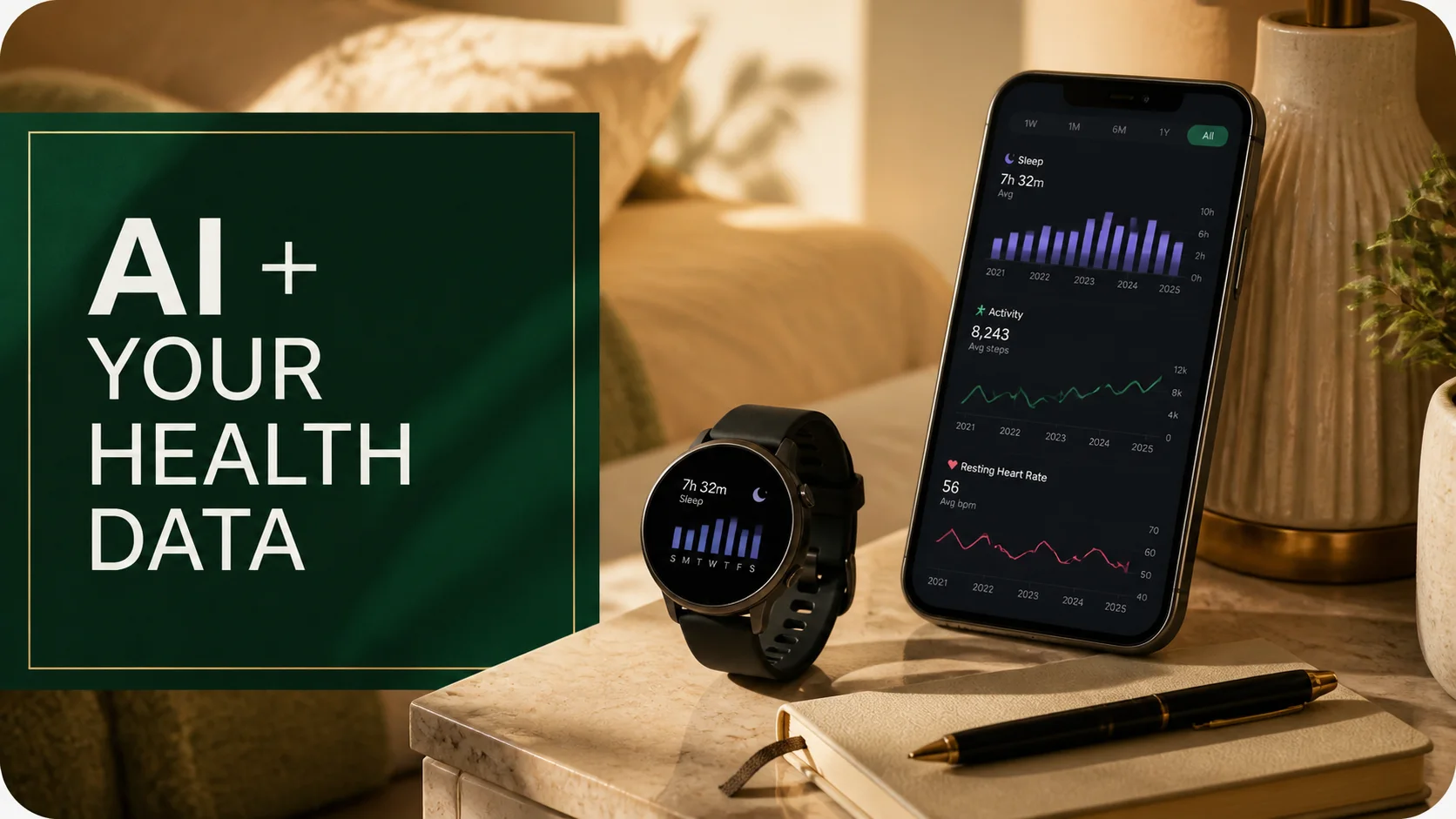
A viral post made the case for AI health analysis in one sentence:
“I put eight years of Fitbit data into Claude… What it found: When I stay up late, I don't get as much sleep.”
The joke works because the conclusion is obvious. It also captures BodyBuddy's position on personal health AI: knowledge is usually not the bottleneck.
Most people already know when they sleep too little, move less, or eat in ways that pull them away from their goals. AI can make the pattern easier to see. The harder problem is helping someone act when real life gets in the way.
So the more useful question is: What should an AI actually do with years of wearable data?
💡
Short answer: Claude, ChatGPT, Fitbit's own AI tools, and BodyBuddy can analyze personal health data. They can summarize trends, compare time periods, and surface correlations. But another insight is rarely enough. The useful system is the one that helps turn the pattern into a realistic action and stays with you while you try it.
Can Claude analyze Fitbit data?
Yes, with an important qualification.
Claude on Android can read health and fitness data through Health Connect. If Fitbit writes the relevant data to Health Connect, Claude can use it in a conversation. Claude can also read Apple Health data on iPhone for eligible Pro and Max users in the United States.
That means Claude can help with questions such as:
- How has my sleep duration changed over the past six months?
- Do my activity levels look different on weekdays and weekends?
- Which weeks had the most consistent bedtime?
- What patterns should I discuss with my doctor?
This is useful. It is still analysis of recorded data. Claude is not observing your life directly, and the available data does not contain every relevant part of the story.
Can ChatGPT analyze Fitbit data?
ChatGPT can analyze personal health data through Health in ChatGPT. OpenAI says the product can connect Apple Health and supported medical records, compare changes over time, analyze sleep and activity, and help prepare for appointments.
A direct Fitbit connection is not the same thing as an Apple Health connection. The result depends on which Fitbit data reaches the health platform that ChatGPT can access. Confirm the source and date range before treating an answer as complete.
OpenAI also says connected health data is not used to train its foundation models or target ads. Health data is sensitive, so read the privacy terms of every service before connecting an account or uploading an export.
Can BodyBuddy analyze health data too?
Yes. BodyBuddy can analyze the health information it tracks and, on iPhone, recent data from a connected Apple Health account. That can include steps, workouts, sleep, weight, and optional nutrition information.
BodyBuddy is not currently a direct tool for uploading eight years of raw Fitbit data. Claude or ChatGPT may be better suited to that kind of one-time historical exploration.
BodyBuddy is built for a different loop. It can interpret the data it has, connect it with your goals and plans, and then follow up by text as your day unfolds. Analysis and accountability live in the same ongoing relationship.
What AI does well with wearable data
AI is good at making a large dataset easier to inspect.
It can:
- summarize years of daily records
- compare one period with another
- find recurring associations
- create charts and plain-language explanations
- identify missing data
- suggest questions for a professional
- turn a pattern into a simple experiment
Those are meaningful capabilities. Most people will never open a raw Fitbit export, clean the timestamps, group the rows, and calculate trends on their own.
The value depends on the question. “Tell me something interesting” gives the model enormous freedom. It may return a true statement that is not useful. A narrower question gives it a better job.
Why eight years of data can still produce an obvious answer
More data does not automatically create a better insight.
Wearable data mostly records what the device can measure. It may include sleep estimates, heart rate, steps, workouts, and timestamps. It usually does not explain why a person stayed up late, whether they were sick, how stressed they felt, what changed at work, or whether the device was worn consistently.
Researchers have documented several challenges in large wearable datasets, including measurement error, missing data, selection bias, and difficulty moving from correlation to causation. A widely cited review in npj Digital Medicine recommends treating these limitations as part of the analysis, not as a footnote.[1]
The model may also choose an easy correlation because it is statistically clear. A late bedtime and shorter sleep can be closely related by definition when the wake time stays fixed.
That does not mean the analysis failed. It means the first result should begin a better conversation.
Correlation does not explain the cause
Suppose your data shows that you sleep less on days when you exercise late.
Several explanations are possible:
- late workouts may delay bedtime
- busy days may push both exercise and sleep later
- you may log late workouts more consistently than early ones
- the device may classify sleep differently after intense exercise
- another factor may affect both behaviors
The data can surface the pattern. It cannot settle the explanation by itself.
This is why health AI should use language such as “associated with,” “appears in your records,” and “worth testing.” A confident causal claim requires stronger evidence.
The three layers of useful health AI
Layer | Main job | Example |
Measurement | Record what happened | A wearable estimates sleep and activity. |
Analysis | Find and explain patterns | An AI compares bedtime consistency with next-day activity. |
Action | Help the person follow through | A coach checks in before bedtime and helps adjust the plan. |
Most of the recent excitement is about the analysis layer. That makes sense. New integrations have made personal health data easier to query.
The action layer is where a promising observation becomes part of real life. That is also where knowledge stops being the main constraint.
Google describes a similar direction for its Fitbit personal health coach. The system is designed to answer questions, create plans, adapt to changing circumstances, and provide proactive guidance. Google later added weekly plans and messages throughout the day.
The distinction matters. A dashboard can tell you what happened last month. A coach can help before tonight becomes another data point.
Better questions to ask about your Fitbit data
You will usually get more value from a sequence of focused questions than one broad request.
- Check the data quality first. “Before analyzing this export, show me which dates are missing and which metrics are recorded consistently.”
- Separate weekdays from weekends. “Compare my bedtime, sleep duration, and activity on weekdays and weekends.”
- Look for stable patterns. “Which associations appear across at least three different months instead of one unusual week?”
- Ask for competing explanations. “Give me three plausible explanations for this pattern and say what additional context would help distinguish them.”
- Use plain language. “Explain this pattern without treating correlation as causation.”
- Choose one experiment. “Turn the strongest low-risk pattern into a two-week experiment with one behavior to change.”
- Define success before starting. “What should I measure during the experiment, and what result would count as meaningful?”
- Prepare for professional care. “Create a short summary of the pattern, dates, and questions I can bring to my clinician.”
For health concerns, ask the model to help organize the evidence and prepare questions. Do not ask it to turn wearable data into a diagnosis.
BodyBuddy analyzes the data, then stays for the hard part
The viral post is funny because the analysis stops at recognition.
You already knew that a late night could shorten your sleep. The harder problem is getting to bed when the day runs long, the phone is still in your hand, and tomorrow feels far away.
BodyBuddy can analyze tracked meals, weight, sleep, movement, plan progress, and recent connected Apple Health data. It can help you notice what is changing and what may be getting in the way.
But BodyBuddy is not built on the idea that one more insight will change your life. It is an AI health accountability coach that texts you every day. It remembers the plan, checks in before the difficult moment, adapts when the day changes, and helps you choose a realistic next step.
If an analysis suggests that bedtime consistency matters, the next step could be simple:
- choose a wind-down time
- decide what “good enough” looks like
- ask for a check-in before that time
- review the result after two weeks
- adjust the plan without turning one missed night into failure
The model does not need to discover a surprising biological truth every day. It needs to help a useful plan survive real life.
Health data needs context
Longer datasets can improve some analyses. A large longitudinal Fitbit study from the NIH All of Us Research Program found that longer monitoring windows produced more stable associations for several health measures.[2]
More history also creates more opportunities for missing context.
A move, a new job, pregnancy, illness, medication changes, device changes, travel, or caregiving can alter the meaning of the same number. The AI should ask what changed. The person should be able to correct the story.
Google's research on personal health agents explicitly combines a data scientist, a health expert, and a coaching role. The design reflects the fact that numerical analysis alone is not enough.[3]
A practical way to use AI with wearable data
- Start with one question. Pick sleep consistency, activity, recovery, or another specific behavior.
- Verify the dataset. Confirm date ranges, missing periods, time zones, and device changes.
- Ask for associations, not causes. Treat the output as a set of hypotheses.
- Add personal context. Note travel, illness, work changes, medications, and unusual weeks.
- Choose one low-risk experiment. Change one behavior for a defined period.
- Track the result. Decide what you will measure before the experiment begins.
- Bring concerning patterns to a professional. AI can help prepare the summary. A qualified professional remains responsible for medical care.
- Build follow-through into the plan. Use reminders, environmental changes, or proactive coaching so the insight reaches the moment when it matters.
Frequently asked questions
Can Claude read Fitbit data directly?
On Android, Claude can read health and fitness data through Health Connect. Fitbit can contribute data to Health Connect, depending on your settings and the metric. On iPhone, Claude reads Apple Health data for eligible users. Check which Fitbit fields have actually synced before asking for an analysis.
Can ChatGPT analyze Apple Health data?
Yes. Health in ChatGPT supports Apple Health connections and can analyze trends in sleep, activity, workouts, and other available data. Availability and supported connections can vary by region and account.
Can AI diagnose a condition from Fitbit data?
A consumer AI should not diagnose a condition from wearable data. Wearables can produce useful signals, but measurements can be incomplete or inaccurate. Use AI to organize information and prepare questions for a qualified professional.
Is eight years of Fitbit data better than one month?
It depends on the question and the data quality. A longer window can reveal stable patterns and seasonal changes. It can also combine several life stages, devices, and missing periods. The right analysis should account for those changes.
What is the best first question to ask?
Start with data quality: “Which metrics are complete enough to analyze, and where are the gaps?” Then ask one focused question about a behavior you could realistically change.
Knowledge is useful. Follow-through is the bottleneck.
AI can make personal health data more understandable. BodyBuddy can analyze that data too.
But knowledge is rarely the scarce resource. The harder problem is turning a pattern into a decision tonight, then making another useful decision tomorrow.
Measure what happened. Analyze the pattern carefully. Then build a small plan and a system that can reach you before the pattern repeats.
Disclosure: This article was published by the creators of BodyBuddy. BodyBuddy is an AI health accountability coach, not medical care, and does not replace a qualified professional.
Sources
Next steps
Everyone gives you a plan.BodyBuddy texts you until it happens.
BodyBuddy keeps you on track—from meals to doctor's appointments and everything in between.