All posts
What to eat the week you start a GLP-1: the first-dose plan for nausea, protein, and fullness
A day-by-day eating plan for your first semaglutide or tirzepatide dose: the week before, injection day, the nausea days, and the protein-first plate.
The pen is in the fridge, the first injection is on the calendar, and the prescriber's sheet says a lot about dosing and nothing about dinner. People search "what to eat before starting Ozempic" expecting a prep diet, the way there is one before a colonoscopy. There is none. What you eat this week matters because your appetite is about to drop, and the habits you walk in with are the ones that carry you through.
This post is part of a series on what to eat before a specific event, after the one on what to eat before a blood test. Your prescriber's instructions override anything on this page.
The short version
- The week before: there is no pre-drug diet. Build the habits that matter once appetite falls: protein at every meal, a fluid routine, one fiber source a day, and a kitchen cleared of greasy food.
- The day of the first dose: a normal day, lighter and lower in fat, with a bland dinner planned.
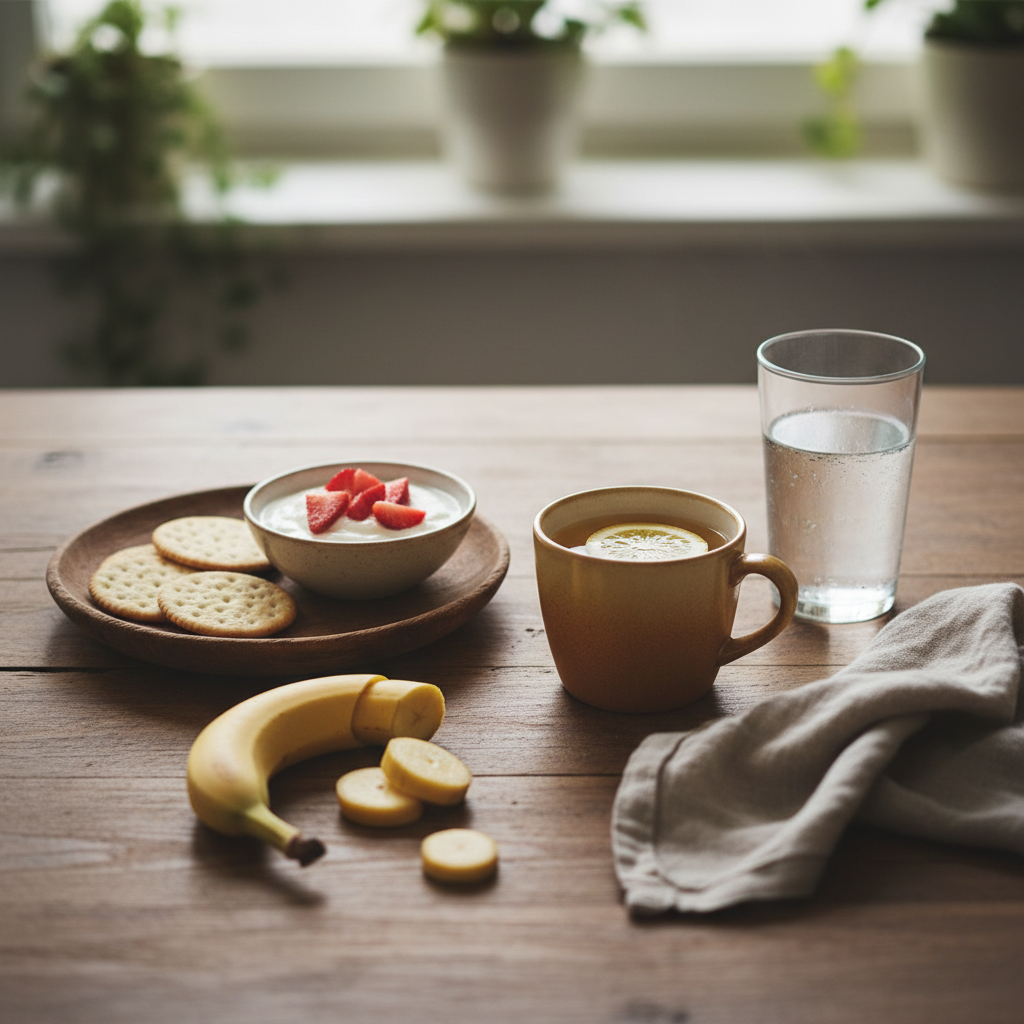
- Days 1 to 3: nausea is most likely now. Small, bland, low-fat meals every 3 to 4 hours, ginger tea, cold food, and sips of fluid between meals.
- Days 4 to 7: appetite returns a little. Build the protein-first plate: 80 to 120 g of protein a day, fiber brought up slowly toward 25 g, and 2 to 3 liters of fluid.
- Call the prescriber for vomiting you cannot stop, severe stomach pain, or yellowing skin or eyes.
Why the first week feels the way it does
Semaglutide and tirzepatide slow stomach emptying. The Wegovy medication guide on fda.gov says so plainly: "WEGOVY slows stomach emptying and can affect medicines that need to pass through the stomach quickly." A meal that used to leave the stomach in a couple of hours now sits there longer. That is where the fullness comes from, and the nausea the guide lists first among the most common side effects.
The numbers are large. The 2025 joint advisory from the Obesity Medicine Association, The Obesity Society, and two other societies, published in Obesity and in Obesity Pillars, pools the trials: nausea in 25% to 44% of people, diarrhea in 19% to 30%, vomiting in 8% to 24%. Side effects cluster in the first weeks and at each dose increase, then fade on a stable dose, so the labels start low. Wegovy begins at 0.25 mg a week and steps up monthly. The Zepbound label starts tirzepatide at 2.5 mg and raises it after at least 4 weeks on each dose.
The sentence I keep coming back to is about timing: nausea "often occurs in the morning or after longer periods without eating." An empty stomach makes it worse. People then skip meals because they feel sick, which the advisory calls a cycle that feeds itself. The week below is built to break that cycle before it starts.
The week before: set the habits before appetite drops
There is no diet to follow this week. The clearest hospital guidance I found, a Cleveland Clinic page with endocrinologist Keren Zhou, says to eat lighter in the 24 hours before the first dose and to skip the "last hurrah" meal. The week is for rehearsal.
- Put protein on every plate now, while you still want to eat. The AACE counseling sheet says to prioritize protein at every meal because early fullness cuts meals short, and whatever you eat first is what you get.
- Build a fluid routine. A University of Virginia dietitian deck puts the target at about 30 mL per kg of body weight a day, which is 2 to 3 liters for most adults, and notes that these drugs often suppress thirst. Put a bottle on the desk and one by the bed.
- Pick one fiber source and eat it daily. Stanford's GLP-1 nutrition toolkit sets 25 to 38 g a day as the target and says to increase gradually. Oats, beans, or berries.
- Clear the kitchen. Cleveland Clinic dietitian Beth Czerwony explains that fat takes longer to digest, so greasy food "will sit in your stomach and cause nausea and vomiting." Fried food and pizza go out. Crackers, broth, yogurt, eggs, and ginger tea come in.
- Get the prescriber's instructions on paper: the injection day, the dose schedule, and what to do with every other medication. The Wegovy guide says to tell your provider about all medicines and supplements, and names insulin and sulfonylureas as the ones that can cause low blood sugar.
The day of the first dose
Both labels say the injection can be given at any time of day, with or without food. The food rules on injection day are comfort rules, and they are short.
- Eat a normal breakfast and lunch, a bit smaller and lower in fat than usual, which is Dr. Zhou's advice for the day.
- Avoid injecting on an empty stomach or after a huge meal. The advisory says nausea is worse after long gaps without food and that "vomiting is more likely to occur with large meals." A small meal an hour or two before is the middle path.
- Plan a bland dinner before you feel anything. Rice, a poached egg, broth, a banana. Have ginger or peppermint tea in the house, with no sweetener, which Dr. Zhou says can make things worse.
- Note the day. Wegovy is taken on the same day each week, and the missed-dose rule depends on it: take a missed dose as soon as possible if the next one is more than 2 days away, and skip it if it is less than 2 days away. Zepbound's window is 4 days.
Days 1 to 3: the nausea plan
The goal for these three days is simple. Keep something small in the stomach, keep fluids going, and stop early.
- Eat small meals every 3 to 4 hours. The advisory's exact counsel is "a small breakfast and then additional small meals every 3-4 h while drinking adequate fluids." Skipping meals is the mistake, because the empty stomach brings the nausea back.
- Keep it bland and low in fat. The advisory says to avoid fatty or high-fiber foods during the first few days of treatment. Fiber comes back on day four.
- Go cold. The Virginia deck's nausea list is "ginger, ice beverages, low fat foods, bland foods, smaller portions." Cold yogurt and iced water go down when a hot plate does not.
- Stop at the first sign of fullness. Dr. Zhou's page says the brain can take up to 30 minutes to register it, so eat slowly, leave food on the plate, and stay upright for 30 minutes after.
- Drink between meals rather than with them. The AACE sheet says to avoid large fluid intake with meals, and Cleveland Clinic says to sip water through the day instead. Skip alcohol, which the advisory says worsens nausea and reflux.
If you cannot keep fluids down, that is a same-day call to the prescriber. The Wegovy guide says vomiting can cause dehydration that worsens kidney problems, and the advisory says it can cause acute kidney injury even with healthy kidneys. A provider can prescribe ondansetron, per Cleveland Clinic, or hold the dose longer. Nobody expects you to tough it out.

Days 4 to 7: the protein-first plate
By the end of the first week the nausea usually eases and a little appetite returns. Meals will still be small. The advisory reports that people on these drugs cut calories by 16% to 39%, and when the plate shrinks that much, protein falls short first.
In the STEP 1 trial, per the advisory's summary, people lost an average of 13.6 kg, and 5.3 kg of that, 38%, was lean body mass. The DXA substudy behind that figure, 140 people over 68 weeks, found lean mass fell 9.7% against a 15.0% drop in body weight. Muscle is about half of lean mass, so roughly a fifth of the weight lost was muscle, and the advisory says protein alone will not hold onto it without strength training at least three times a week. Week one is early for a program. It is a fine week to book one.
The targets, with the sources:
- Protein: the advisory cites 1.2 to 1.6 g per kg of body weight a day during active weight loss, or a flat 80 to 120 g a day. Stanford's patient toolkit simplifies it to 60 to 80 g a day for women and 80 to 100 g for men. Across three small meals and a snack, that is roughly 25 to 30 g a sitting.
- What 25 to 30 g looks like, from Stanford's list: 3 oz of chicken breast, 3 oz of fish (20 to 25 g), or three-quarters of a cup of Greek yogurt (15 to 20 g) plus an egg (6 g).
- Fiber: bring it back slowly. Stanford says 25 to 38 g a day, the Virginia deck says 20 to 30 g, and both say to increase gradually, because too much too soon means a stomach too full for the protein.
- Fluids: 2 to 3 liters, counting tea, broth, and soup. Stanford's dehydration checklist is dark urine, dry mouth, dizziness, and fatigue that does not improve.
I have an opinion here. Most first-week advice stops at "eat bland food," and a week of crackers and broth is how people arrive at week two underfed and tired. The bland rule covers three days. The protein rule covers the whole course of the drug, and there is a longer piece on how much protein to eat on a GLP-1.
What to tell your prescriber
Call the office for any of these, which both labels list.
- Severe pain in the stomach area that will not go away, which may spread to the back. The guide says to stop the drug and call right away, because this can be pancreatitis.
- Pain in the upper stomach, fever, yellowing of the skin or eyes, or clay-colored stools, which are the guide's gallbladder signs.
- Vomiting that keeps you from holding down fluids, or signs of dehydration: dark urine, dry mouth, dizziness.
- Sweating, shakiness, or confusion if you have type 2 diabetes and take insulin or a sulfonylurea. The guide calls low blood sugar both serious and common in that group.
How BodyBuddy helps
A starting sheet for a GLP-1 gets read once at the pharmacy counter and then lives in a drawer. BodyBuddy is an AI coach that texts you every day over iMessage, with an iPhone app, built for the gap between a dose schedule on paper and a week of small meals.
Upload a photo or PDF of your prescriber's starting instructions in the BodyBuddy app and it turns them into a daily plan: the injection day, the dates the dose steps up, the protein and fluid targets they set, and the rules about your other medications. Then it texts you each day so the two of you get it done together, on the days you feel fine and the days you do not. Ask it what your sheet says about a missed dose and it answers from your own sheet.
Text it a photo of a tiny meal and it tells you the calories, protein, and carbs. A cup of yogurt, half a chicken breast, or a mug of broth all count. That running count is how you see whether the week is adding up to enough when your appetite has stopped telling you.
There is a full GLP-1 diet plan for the months after week one.
BodyBuddy is not medical care and does not replace your prescriber or a registered dietitian. It helps you follow their instructions. If you cannot keep fluids down, call them.
FAQ
What should I eat the day I take my first dose of Ozempic or Wegovy?
A normal, slightly smaller, lower-fat day. The label says the injection works with or without food. Cleveland Clinic suggests eating lighter in the 24 hours around the first dose and skipping any "last hurrah" meal.
Should I take Ozempic on an empty stomach or after eating?
Either is allowed by the medication guide. The joint advisory says nausea is worse after long stretches without food and vomiting is more likely after large meals, so eat a small meal an hour or two before the shot.
What foods help with nausea from semaglutide or tirzepatide?
Small, bland, low-fat meals every 3 to 4 hours, ginger or peppermint tea without sweetener, and cold food. Sip fluids between meals, stay upright for 30 minutes after eating, and stop at the first sign of fullness.
How much protein should I eat on a GLP-1?
The joint advisory cites 1.2 to 1.6 g per kg of body weight a day during active weight loss, or 80 to 120 g a day. That means 25 to 30 g at each small meal, eaten first.
What happens if I miss a dose of Wegovy or Zepbound?
The Wegovy guide says to take it as soon as possible if the next dose is more than 2 days away, and to skip it if the next dose is less than 2 days away. The Zepbound label gives a 4-day window. After more than 2 weeks of missed doses, call the prescriber about how to restart.
What to do this week
Write down the injection day and the date of the first dose increase. Do one shop for the bland days (crackers, broth, eggs, yogurt, bananas, rice, ginger tea) and one for the protein days (chicken, fish, cottage cheese, protein powder). Fill a water bottle tonight and put it where you will see it in the morning. Then ask the prescriber, in writing, what to do with every other medication you take, and keep the answer with the pen.
If you would rather have the dose schedule and the protein count carried by daily texts, upload the sheet to BodyBuddy and let it carry the week.
Related BodyBuddy guides
- How Much Protein on GLP-1? What Current Guidance Actually Says
- What to eat the week before your wedding: a 7-day plan with no crash diet
- What to eat the week before a marathon: a 7-day carb-loading plan
- What to eat before a glucose test in pregnancy: the 1-hour and 3-hour tests explained
- What to eat before a HYROX race: race week, the night before, and race morning
Everyone gives you a plan.BodyBuddy texts you until it happens.
BodyBuddy keeps you on track—from meals to doctor's appointments and everything in between.