
All posts
What to eat the week before a marathon: a 7-day carb-loading plan
A day-by-day marathon week plan: taper eating, the 2-day carb load at 10 g/kg, the night-before dinner, race morning breakfast, and fueling on the course.
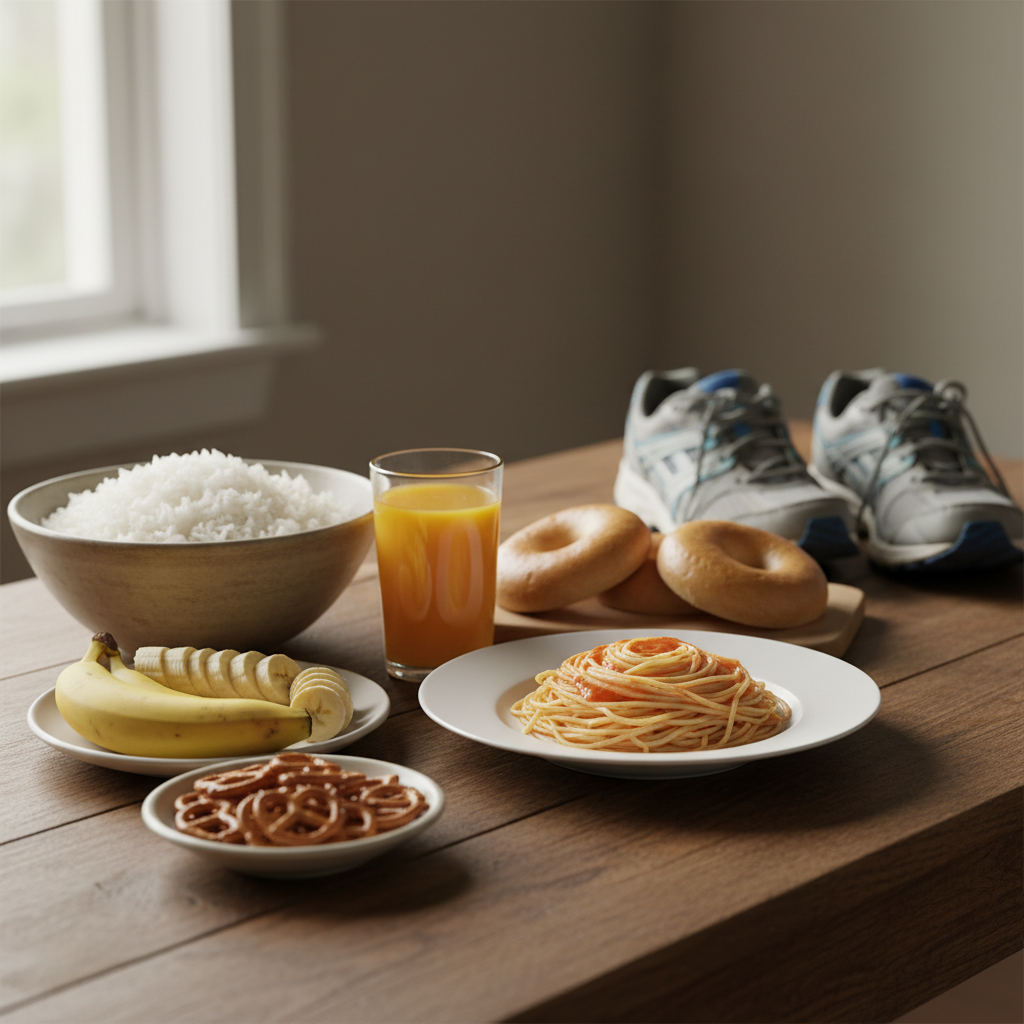
Your race is on the calendar and the long runs are done. The week before a marathon is when you fill the fuel tank you will spend over 26.2 miles, and how you fill it matters nearly as much as the mileage did.
This post is part of a series on what to eat before a specific event (the first was what to eat before surgery). One rule sits above everything here: if your race, your coach, or a sports dietitian gave you a plan, that plan wins. Everything below is the published consensus, with a worked example for a 70 kg (154 lb) runner.
The short version
- Seven to four days out: eat the way you normally do, keep protein at every meal, and try nothing new. The taper is doing the work.
- Three and two days out: carb load at roughly 8 to 12 grams of carbohydrate per kilogram of body weight per day, spread across the day, with less fiber and fat. Expect to gain a kilogram or two of water.
- The day before: a familiar, moderate dinner, eaten early, with salt in it and water through the day.
- Race morning: a carbohydrate breakfast two to four hours before the gun, rehearsed on a long run, with coffee only if you always run on coffee.
- During and after: 30 to 90 grams of carbohydrate an hour from a plan you practiced, then carbs plus protein within a couple of hours of finishing.
Why the old deplete-then-load protocol is dead
If you have read that you need to starve your muscles of carbohydrate for three days before you can load them, you can stop. That was the 1960s protocol: ride to exhaustion, eat almost no carbohydrate for 72 hours, then eat a lot of it for another 72. A 2026 paper in the Scandinavian Journal of Medicine and Science in Sports walks through how that protocol was modified, updated, and finally replaced by the current guideline of 10 to 12 grams of carbohydrate per kilogram per day for 36 to 48 hours.
The International Society of Sports Nutrition's position stand on nutrient timing says it in plainer words: later studies showed athletes can skip the depletion phase, reduce training volume for three to four days, and eat a very high carbohydrate diet of 8 to 10 grams per kilogram per day for one to three days.
It works because of muscle glycogen, the stored carbohydrate your legs burn at marathon pace. The joint position paper from the Academy of Nutrition and Dietetics, Dietitians of Canada, and the American College of Sports Medicine says glycogen depletion is associated with fatigue and a drop in sustained intensity, and that events over 90 minutes benefit from higher stores.
I find this oddly comforting. The replacement protocol involves eating more bread.
Seven to four days out: normal eating, less running
The first half of race week is the taper. Your mileage drops, your appetite probably does not, and the temptation is to eat less to match. Do not. The position paper's daily carbohydrate guideline for an endurance program is 6 to 10 grams per kilogram per day, and the taper is a time to sit comfortably inside that range while your legs repair.
What to keep steady:
- Protein at every meal. The position paper recommends about 0.3 grams per kilogram of body weight per serving, roughly 20 grams for a 70 kg runner.
- Your usual carbohydrate foods in their usual amounts.
- Fluids. Keep urine pale yellow.
And one thing to stop doing: experimenting. The clearest hospital handout I found is Houston Methodist's race-week page, written by their director of sports nutrition, and its line on new foods, drinks, and supplements is short: "This is not the time to try anything new."
Three and two days out: the carb load
This is the part that moves the needle, and the part most people do halfway. The position paper's loading guideline for events over 90 minutes is 36 to 48 hours at 10 to 12 grams of carbohydrate per kilogram per day. The ISSN stand puts its range at 8 to 10 grams per kilogram for one to three days.
For a 70 kg runner, 10 grams per kilogram is 700 grams a day. Houston Methodist's worked example for a 150 pound (68 kg) athlete is 680 grams, split into three meals of about 200 grams and two snacks of 30 grams. Their example 200 gram meal is one cup of pasta, one large sweet potato, two rolls, one and a half ounces of pretzels, a banana, an apple, and three ounces of ground turkey.
How to make it fit:
- Spread it across the whole day. The position paper notes there may be benefits in small regular snacks.
- Drop the fiber and the fat. The position paper says to choose carbohydrate sources low in fiber and residue, because choices high in fat, protein, or fiber raise the risk of gut trouble. This is the one week of the year when white rice, white bread, and plain pasta are the better choice.
- Use liquid carbohydrate for the last stretch. Juice, sports drink, and chocolate milk add carbohydrate without filling you up.
- Keep protein modest. Houston Methodist's meals carry 15 to 25 grams each, enough to protect muscle without crowding out the carbohydrate.
Expect the scale to go up. A muscle biopsy study in the European Journal of Applied Physiology found that each gram of glycogen is stored with at least 3 grams of water, and the 2026 Scandinavian paper puts the net effect at about 1 to 2 percent of body mass, which for most adults is 1 to 2 kilograms. That gain is the tank filling. It leaves on the course.

The day before: familiar, moderate, early
The loading days did the work. The day before is about protecting it.
- Breakfast and lunch carry most of the day's carbohydrate. The biggest meal of race eve should be lunch.
- Dinner is a dish you have eaten before a long run. Plain pasta with a simple tomato sauce and white bread is the classic for a reason. Houston Methodist's advice is to eat early and choose easy-to-digest carbohydrate your stomach already knows.
- Skip the things that misbehave the next morning: salad and raw vegetables, beans, bran, spicy food, heavy cream sauces, a second beer.
- Salt your food. The position paper notes that sodium in pre-exercise fluids and foods helps the body hold on to fluid. A salty dinner with a glass of water does more than a liter of plain water at bedtime.
Race morning: the breakfast you rehearsed
The position paper's pre-event guideline is 1 to 4 grams of carbohydrate per kilogram of body weight, eaten one to four hours before exercise, from foods low in fat and fiber with low to moderate protein. For a 70 kg runner that is 70 to 280 grams.
A few breakfasts in that range:
- A plain bagel with jam and a banana, plus a glass of juice
- A bowl of white rice or instant oatmeal with honey and a sliced banana
- A liquid meal or carbohydrate shake if nerves kill your appetite. The position paper suggests liquid options for exactly this.
Whatever you choose, it has to be something you ate before at least one long run.
The position paper says athletes can start exercise well hydrated by drinking 5 to 10 milliliters per kilogram of body weight in the two to four hours beforehand, enough for pale yellow urine with time to pee the excess. For a 70 kg runner that is 350 to 700 milliliters, so one or two large glasses with breakfast and a pinch of salt in the food.
Coffee is fine if coffee is normal for you. The position paper notes the old warning about caffeine as a diuretic is overstated at moderate habitual doses, and caffeine is on its short list of supplements with real evidence. If you never run on it, race morning is the wrong day to start.
During the race
The position paper's guidance for endurance exercise of one to two and a half hours is 30 to 60 grams of carbohydrate per hour, rising to as much as 90 grams per hour for events over two and a half to three hours.
Above about 60 grams an hour the type of sugar matters. Asker Jeukendrup's review of carbohydrate during exercise explains that a single sugar is absorbed at only around 60 grams per hour, so higher intakes need a mix of glucose and fructose, which most race gels and drinks now use. His other point is the one people skip: the gut can be trained, and the race-day fueling plan should be practiced in training to cut stomach trouble and raise how much you can absorb. Know the gel on the course and start eating in the first 30 to 45 minutes.
After: refill within a couple of hours
The position paper's recovery guideline is 1 to 1.2 grams of carbohydrate per kilogram per hour for the first four hours, plus 0.25 to 0.3 grams per kilogram of protein (about 15 to 25 grams) within two hours. In food, that is chocolate milk and a banana at the finish, then a real meal with rice or potatoes and a palm of protein within two hours.
How BodyBuddy helps
A race-week plan is only useful if it survives contact with Wednesday. BodyBuddy is an AI coach that texts you every day over iMessage, and it was built for the gap between a plan on paper and what you eat at lunch.
Upload a photo or PDF of your training plan or race-week fueling sheet in the BodyBuddy app and it turns it into a daily plan: the loading days, the carbohydrate target, the day-before dinner, the breakfast time. Then it texts you each morning to help you stick to it, in the voice of a partner ("700 grams today, we'll get this in every day"). Ask it whether tomorrow is a loading day and it answers from your own sheet.
The carbohydrate math is the part people give up on. Text BodyBuddy a photo of dinner and it tells you the carbohydrate, calories, and protein on the plate, so hitting 10 grams per kilogram becomes a running count through the day instead of a spreadsheet.
BodyBuddy is not medical care and does not replace a sports dietitian or your doctor. It helps you follow their instructions. If you have diabetes or anything else that changes how you handle a high carbohydrate diet, build this week with a professional and use BodyBuddy to carry it out.
FAQ
How many days before a marathon should I carb load?
Two to three days. The joint position paper gives 36 to 48 hours at 10 to 12 grams of carbohydrate per kilogram per day, and the ISSN stand gives one to three days at 8 to 10 grams. For a Sunday race, start Thursday and go lighter on Saturday evening.
Should I eat pasta the night before a marathon?
If pasta is what you eat before long runs, yes. Keep it familiar, moderate in size, and early. The heavy lifting happened on the two loading days, so a huge plate on Saturday night mostly leaves you heavy on Sunday morning.
What should I not eat the week before a marathon?
In the last three days, cut back on high fiber foods (bran, beans, large salads, raw vegetables), high fat meals, spicy food, and alcohol. The position paper's reasoning is gut comfort: fat, protein, and fiber slow digestion and raise the risk of trouble on the course.
Is it normal to gain weight when carb loading?
Yes, and it is the point. Glycogen is stored with at least 3 grams of water per gram, so a full load adds roughly 1 to 2 percent of body weight, about 1 to 2 kilograms. That water is fuel and hydration you carry to the start line.
What should I eat the morning of a marathon?
Carbohydrate you have rehearsed, two to four hours before the start, in the range of 1 to 4 grams per kilogram of body weight. A bagel with jam and a banana is the typical shape. Keep fat, fiber, and protein low, and drink 5 to 10 milliliters per kilogram of fluid with it.
What to do this week
Write your body weight in kilograms on a sticky note and multiply by 10. That is your carbohydrate target in grams for each of the two loading days. Then put the loading days and the breakfast time in your calendar, buy the white rice, bread, juice, and pretzels now, and test the race-day gel on your last easy run.
If you want the plan to follow you from the fridge to the finish line, upload it to BodyBuddy and let the daily texts and the photo carb counts carry it through the week.
Related BodyBuddy guides
- Cristiano Ronaldo's Daily Routine: Diet, Workout, Sleep & Recovery
- What to eat before a blood test: which labs need fasting and what breaks it
- What to eat before a colonoscopy: the 3-day countdown
- What to eat before wisdom teeth removal (and what to stock for the week after)
- What to eat before surgery: a two-week pre-op nutrition plan
Everyone gives you a plan.BodyBuddy texts you until it happens.
BodyBuddy keeps you on track—from meals to doctor's appointments and everything in between.