
All posts
What to eat before a HYROX race: race week, the night before, and race morning
HYROX race nutrition countdown: the short carb load, the night-before dinner, pre-race meal timing for morning and evening waves, caffeine, and gels.
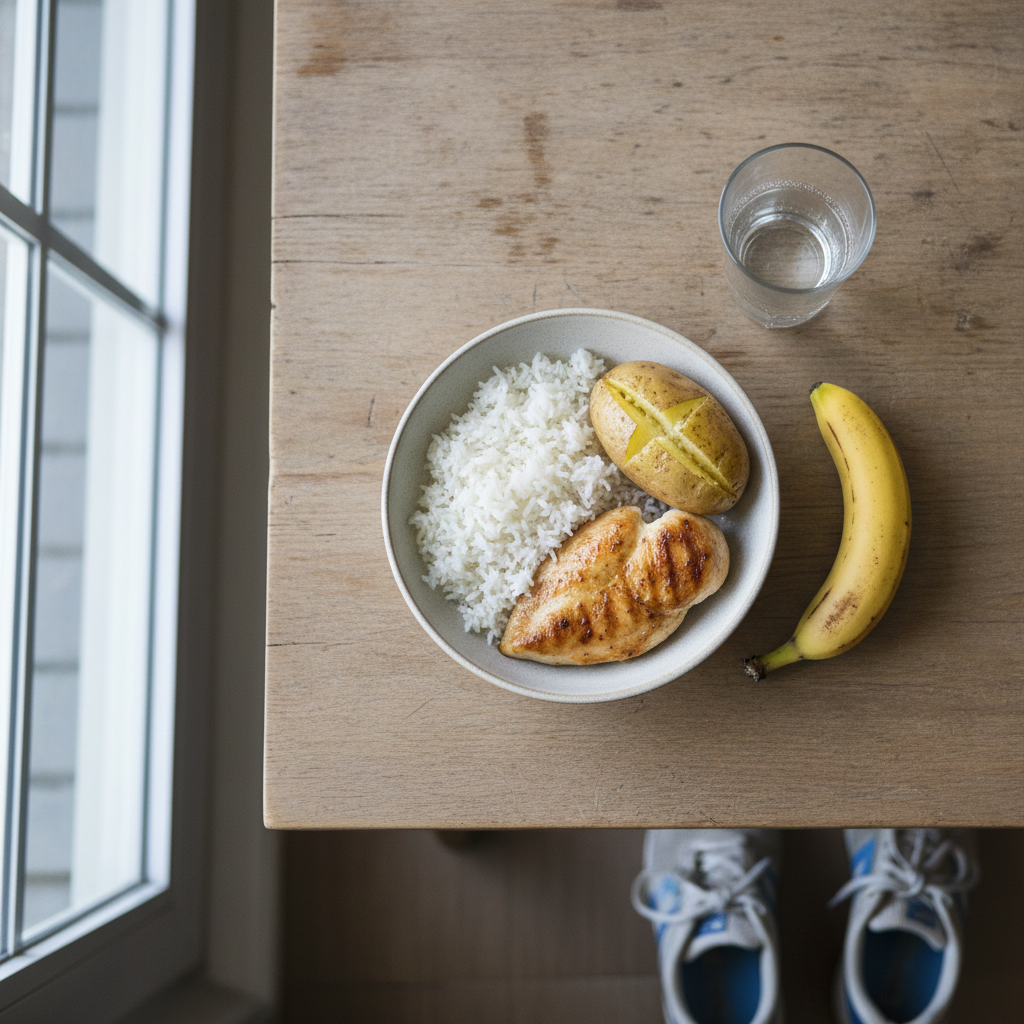
Your HYROX start time is on the calendar and the training block is done. The last thing still in your control is what goes on the plate this week. A HYROX race takes most people between an hour and an hour and forty minutes, and it empties the carbohydrate tank the way a hard half marathon does, then asks your legs to push a sled on top of it.
This post is part of a series on what to eat before a specific event. The previous one covered what to eat the week before a marathon, and most of that plan shrinks to fit here. One rule sits above everything below: if your coach, your race's athlete guide, or a sports dietitian gave you a plan, that plan wins.
The short version
- Seven to three days out: train less, eat normally, and rehearse the exact pre-race meal on one hard session.
- Two days out and the day before: a short carb load, one or two days at 7 to 12 grams of carbohydrate per kilogram, with less fiber and fat.
- The night before: a familiar dinner, eaten early, no alcohol, and the gel packed in the bag.
- Race day: a carbohydrate meal three to four hours before your wave, a small carb snack 60 to 90 minutes before, caffeine an hour out only if you train on it, and nothing new.
- During and after: fuel on the course is optional under 90 minutes, then carbs and protein within two hours of the finish.
Why a HYROX race is fueled differently from a marathon
The format sets the rules. HYROX's own race page describes a 1 km run followed by one workout station, repeated eight times, from the SkiErg through sleds and a rower to 100 wall balls, indoors in an exhibition hall. The US HYROX FAQ says the average finisher in the 2024/2025 season took about an hour and a half, and compares the effort to a sprint triathlon or a fast half marathon. Your division's weights are in our HYROX stations in order post.
That duration lands on the line the sports nutrition bodies draw. The 2016 joint position paper from the Academy of Nutrition and Dietetics, Dietitians of Canada, and the American College of Sports Medicine says glycogen depletion is associated with fatigue, that events over 90 minutes may benefit from a carbohydrate load, and that for shorter events glycogen can be normalised with 24 hours of reduced training and adequate fuel. A marathon needs the full 36 to 48 hour load. A HYROX needs a day or two of eating well above normal, and that is it.
I think HYROX athletes train like lifters, eat like lifters, and then race something that drains carbohydrate like a runner. The protein is fine. The carbohydrate is usually short.
Seven to three days out: taper, normal eating, and a rehearsal
The first half of race week is the taper, and the appetite does not taper with it. Keep eating. The position paper's daily carbohydrate range for a program of about an hour a day is 5 to 7 grams per kilogram, which for a 75 kg (165 lb) athlete is 375 to 525 grams. Protein stays at the paper's 0.25 to 0.3 grams per kilogram per meal, about 20 grams.
The job that matters most this week is the rehearsal. Asker Jeukendrup's review of carbohydrate during exercise says it is highly recommended that athletes test their nutrition strategy in training. Eat the race-day meal before your last hard session, at the race-day gap, and see how the sled feels. If you are on our 8-week HYROX training plan, that session is already in the schedule.
What to do this week:
- Find your wave. The US FAQ says division wave times come out about two weeks before the event, and the event pages link your individual start time about three days out. A 9 am start and a 6:50 pm start are two different eating days.
- Note how your stomach felt at the wall balls after that rehearsal.
- Decide on caffeine now. If you do not train on it, the race is the wrong day to begin.
- Try nothing new this week.
Two days out and the day before: the short carb load
This is the part most HYROX athletes skip. The position paper's table gives two targets. For events under 90 minutes it suggests 7 to 12 grams of carbohydrate per kilogram over the 24 hours before. For events over 90 minutes of sustained or intermittent exercise it moves to 36 to 48 hours at 10 to 12 grams per kilogram. The ISSN position stand on nutrient timing describes the same idea: reduce training for three to four days and eat 8 to 10 grams per kilogram for one to three days.
So the answer depends on your expected time. Under 90 minutes, one day at the lower end is plenty. If you expect an hour and forty, give it two days. For a 75 kg athlete, 7 grams per kilogram is 525 grams of carbohydrate a day, and 10 grams per kilogram is 750. How to make it fit:
- Spread it across the day: three meals built around white rice, pasta, potatoes, or bread, plus two snacks.
- Drop the fiber and the fat. The position paper says to choose carbohydrate sources low in fibre and residue to hit the target and keep the gut comfortable. White rice beats brown rice this week.
- Salt your food. The position paper notes that sodium in pre-exercise fluids and foods helps the body hold on to fluid.
The night before: familiar, early, and packed
The loading days did the work. The night before protects it.
- Dinner is early, and it is something you have eaten before a hard session. Pasta with a simple tomato sauce, or white rice with chicken, both work.
- Skip the things that misbehave the next day: raw vegetables, beans, cream sauces, spicy food, and alcohol.
- Pack the race bag tonight. The US FAQ says athletes may not accept drinks or nutrition from anyone during the race, including spectators, and may only use water or gels they carried from the start. The gel goes in the bag now.

Race day with a morning wave
A 9 am wave is the simpler day. The position paper's pre-event guideline is 1 to 4 grams of carbohydrate per kilogram, eaten one to four hours before exercise, from foods low in fat and fiber with low to moderate protein. For our 75 kg athlete the sensible middle is about 150 grams, three hours out.
- 6 am: breakfast. A plain bagel with jam, a banana, and a glass of juice gets close, and the paper suggests a liquid meal if nerves kill your appetite.
- 6 to 7:30 am: fluid. The position paper says 5 to 10 milliliters per kilogram in the two to four hours before exercise, enough for pale yellow urine with time to pee the excess. That is 375 to 750 milliliters for 75 kg.
- 7:30 am: arrive. The US FAQ recommends 90 minutes before your start to register, warm up, and attend the briefing.
- 8 am: caffeine, if it is part of your training. The ISSN position stand on caffeine says 3 to 6 milligrams per kilogram improves performance, that 60 minutes before is the most common timing, and that doses around 9 milligrams per kilogram bring a high rate of side effects. For 75 kg that is 225 to 450 milligrams. I would start at the bottom.
- 8 to 8:30 am: a banana or half a sports drink if breakfast was small.
Race day with an afternoon or evening wave
Most individual waves are late. On the provisional Las Vegas schedule, the Men's wave runs from 6:50 pm to 8:30 pm on Friday and the Women's from 2:40 pm to 5:10 pm on Sunday. The two ways to ruin the wait are grazing at the venue for six hours or eating nothing after lunch out of nerves.
- Morning: a regular breakfast, nothing bigger.
- Three to four hours before the wave: the real pre-race meal, at 1 to 4 grams of carbohydrate per kilogram and low in fat and fiber. For a 7 pm wave that is lunch at 3 pm, rice with a little chicken or pasta with tomato sauce. The position paper notes that carbohydrate in this window tops up liver glycogen, the store an all-day wait runs down.
- Two to four hours before: the same fluid as the morning plan, with salt in the meal.
- 60 to 90 minutes before: a snack of about 1 gram of carbohydrate per kilogram, the floor the position paper gives for a pre-event feed. A banana and a sports drink covers it. Then stop eating.
- 60 minutes before: caffeine at 3 to 6 milligrams per kilogram if you have practiced it. The ISSN stand says genetic variation changes both the performance effect and the effect on sleep and anxiety, so a 7 pm dose that keeps you up until 3 am is a real trade.
Nothing new on race day, in either timeline.
During and after: optional, and only what you practiced
The research is kinder than the gel marketing. Jeukendrup's review says that during exercise lasting approximately one hour, a mouth rinse or small amounts of carbohydrate can produce a performance benefit, and that large amounts are not needed for efforts of 30 minutes to an hour. His higher figure, up to about 60 grams an hour, is for exercise of two to three hours.
So the plan is modest. Under 75 minutes, a sports drink in the Roxzone is plenty. Longer than that, one gel around the halfway rower, carried from the start and tested in training, is the common move and a reasonable one.
Afterwards, eat carbohydrate and protein within two hours. The ISSN stand says a 20 to 40 gram dose of high-quality protein, immediately to two hours after exercise, drives muscle protein synthesis. Chocolate milk and a banana at the finish, then a real meal, covers it.
How BodyBuddy helps
A race-week plan is easy to read once and hard to follow across six days and a nervous stomach. BodyBuddy is an AI coach that texts you every day over iMessage, built for the gap between a plan on a PDF and the plate in front of you.
Upload a photo or PDF of your race-week plan or your coach's taper in the BodyBuddy app, and it turns the sheet into a daily plan: the taper days, the carb-load target, the night-before dinner, and the meal clock counted back from your wave. Then it texts you each day so the two of you get it done together. Ask it what your plan says to eat before a 7 pm wave and it answers from your own sheet.
The carbohydrate count is where it earns its keep. Text it a photo of dinner on the loading days and it tells you the calories, protein, and carbs on the plate, so you know whether that bowl of rice got you to 525 grams or stalled at 300. If you are on our 8-week training plan, you can import that too, and there is a short guide to importing a coach's plan if your sheet is a photo of a whiteboard.
BodyBuddy is not a sports dietitian and does not replace one. It is not medical care. It helps you follow their instructions.
FAQ
Should I carb load before HYROX?
A short one, yes. The joint position paper suggests 7 to 12 grams of carbohydrate per kilogram over the 24 hours before events under 90 minutes, and 36 to 48 hours at 10 to 12 grams per kilogram for events over 90 minutes. Most HYROX finishers fall near that line, so one day is the floor and two is the ceiling.
What should I eat the morning of a HYROX race?
A low-fat, low-fiber carbohydrate meal of 1 to 4 grams per kilogram, one to four hours before your wave, per the position paper. For a morning wave that is a bagel with jam, a banana, and juice about three hours out. For an evening wave, breakfast is just breakfast, and the pre-race meal is a carbohydrate lunch three to four hours before the start.
Should I take a gel during HYROX?
Only if you practiced it and expect to be out there more than about 75 minutes. Jeukendrup's review says a mouth rinse or small amounts of carbohydrate are enough for an effort around an hour. Carry any gel from the start, since the US FAQ says you cannot take nutrition from spectators mid-race.
Is coffee good before a HYROX race?
If you train on it, yes. The ISSN position stand says 3 to 6 milligrams of caffeine per kilogram, taken about 60 minutes before, improves endurance and muscular endurance. If you do not use caffeine in training, or your wave is at 7 pm and you value sleep, skip it.
What to do this week
Find your wave time today, then count back. Put the pre-race meal three to four hours before it, the snack 60 to 90 minutes before it, and the carb-load day (or two) on the calendar in front of that. Multiply your weight in kilograms by 7 and by 10, write both numbers on the fridge, and eat the race-day meal before tomorrow's hard session. Pack the gel tonight.
If you would rather have all of that texted to you each morning instead of re-reading this page, upload your plan to BodyBuddy and let the daily texts carry it to the start line.
Related BodyBuddy guides
- What to eat before a long hike: the week before, the night before, and the trail
- What to eat the week before a marathon: a 7-day carb-loading plan
- Cristiano Ronaldo's Daily Routine: Diet, Workout, Sleep & Recovery
- What to eat before a glucose test in pregnancy: the 1-hour and 3-hour tests explained
- What to eat before a knee replacement: the 4-week prehab plan
Everyone gives you a plan.BodyBuddy texts you until it happens.
BodyBuddy keeps you on track—from meals to doctor's appointments and everything in between.