All posts
What to eat the week before your wedding: a 7-day plan with no crash diet
A 7-day countdown for the week before your wedding: steady protein, carbs, salt and water, a rehearsal dinner plan, and the morning of. No crash diet.
The date is circled, the dress or suit was fitted weeks ago, and somewhere in the last seven days a voice suggests a juice cleanse. It is a bad idea. What you eat this week decides whether you feel steady through a 14-hour day of photographs, speeches, and a dance floor. A week cannot change how your body is built. It can change how your body feels.
This post is part of a series on what to eat before a specific event, after the one on what to eat the week before a marathon, which a wedding day resembles more than people expect. If a dietitian or doctor gave you a plan for this month, their plan overrides anything on this page.
The short version
- Seven to four days out: eat the way you normally eat, keep protein and fiber steady, skip any cleanse or cut, drink water, drink less alcohol, and protect your sleep.
- Three to two days out: keep salt and carbs at their usual level. Sudden changes in either one move water around, and that is what people feel as bloat. Nothing new on the plate.
- The day before: a real dinner at the rehearsal, a cap on drinks, water between them, and an early night.
- The morning of: breakfast with protein even if you are nervous, your normal amount of caffeine, fluids with some salt, and a snack bag for the getting-ready room.
- The day itself: something to eat before the first drink, a glass of water per drink, and your own dinner at your own reception.
Why a week cannot change your body, and what it can change
Fat loss over seven days is measured in grams. Water moves by the kilogram, and water is what every last-week diet is playing with.
Carbohydrate is the clearest example. Your muscles and liver store carbohydrate as glycogen, and a 2018 review in Nutrition Reviews explains that each gram of glycogen is stored with at least 3 grams of water. Cut carbs hard and the glycogen goes, the water leaves in your urine, and the scale drops. The same review says the loss subsides after a few days and the weight returns as glycogen refills. A carb cut that starts on Monday has you lighter on Wednesday and back where you started on Saturday, with a headache.
Water does the same trick on its own. A 2015 study in Extreme Physiology and Medicine had people go a working day on about 300 mL of water instead of 1.4 litres. They lost 1.2 kg, or 1.4% of body mass, in a single day, and every mood measure got worse along with working memory. A kilogram up or down in a week is water, and you feel it in your face and your waistband.
Salt is the third lever. The 2025 to 2030 Dietary Guidelines for Americans call sodium and electrolytes essential for hydration, which is a dry way of saying that where salt goes, water follows. A salty week holds a little more water and a sudden salt cut lets it go. Either direction is a change your fitting did not account for.
I find that reassuring. The scale this week is mostly a water reading, so the plan is to keep water, salt, and carbs steady and let the fitting stand.
Seven to four days out: eat the way you eat
The plan for the early part of the week is your normal plate. The NHS Eatwell Guide describes it: at least 5 portions of fruit and vegetables a day, meals based on potatoes, bread, rice, pasta, or other starchy carbohydrates, some beans, fish, eggs, or meat, some dairy, and 6 to 8 glasses of fluid. If that is roughly what you ate last month, keep eating it.
- Protein at each meal. The Dietary Guidelines set a serving goal of 1.2 to 1.6 grams of protein per kilogram of body weight per day, which for a 70 kg person is roughly 85 to 110 grams. Eggs at breakfast, yogurt or beans at lunch, and a palm of fish or chicken at dinner get most people there.
- Fiber steady. Keep vegetables and whole grains at their usual amount. Doubling them "to be healthy" this week is the fastest route to the gas you were trying to avoid.
- Do not start anything. No cleanse, no new supplement, no fasting protocol you read about on Tuesday. Each one is a change, and changes move water.
- Alcohol down. From here to the day, drink less than you have been.
- Sleep. The CDC puts the adult target at 7 or more hours and lists avoiding large meals and alcohol before bed among the habits that help. Short sleep also changes what you eat the next day: a review in the Journal of Clinical Sleep Medicine cites a study where one night of restricted sleep pushed intake up by 22.5%, about 559 kcal. The seating-chart nights are the ones to watch.
Three to two days out: keep salt, carbs, and fiber where they are
The temptation 72 hours out is to drop carbs and salt so you "lean out" for the photos. I have watched friends do it, and it backfires for the reason above: the water that leaves on Thursday is back by Saturday, and the fitting was done at your normal weight anyway.
So the rule for these two days is dull. Same bread, same rice, same salt shaker. The Dietary Guidelines put sodium under 2,300 mg a day for most people, and your usual cooking is the baseline to hold.
- Eat the carbs you usually eat. Your glycogen stores and the water they carry are part of the body the tailor measured.
- Keep salt normal. Skip the extra-salty takeout, and also skip the no-salt experiment.
- Nothing new. No restaurant you have never been to, no new fiber bar. A 2022 review in Frontiers in Nutrition lists the foods most often cut for bloating: onions, legumes, cauliflower, celery, bananas, apricots, prunes, broccoli, and wheat bran. Poorly absorbed carbohydrates in them pull water into the gut and feed bacteria that make hydrogen and methane. If you eat them every week, keep eating them. Skip a sudden pile of them.
- Keep drinking water, 6 to 8 glasses, spread through the day. A dry Thursday and a flood on Friday is another swing.
- Taper alcohol to one or none, so that the day before is easy.

The day before: the rehearsal dinner
The rehearsal dinner is where most plans fall apart, because it is a party and everyone you love is there with a bottle.
Alcohol before bed is the part that matters. A 2025 meta-analysis in Sleep Medicine Reviews pooled 27 studies and found that about two standard drinks in the three hours before bed delays REM sleep and shortens it, with worse disruption at higher doses. Large doses get you to sleep faster, and the authors still call alcohol a poor sleep aid because the later disruption outweighs it. A standard US drink is 12 ounces of beer, 5 ounces of wine, or a 1.5-ounce shot, about 14 grams of alcohol.
- Eat a real dinner, with protein and carbs and vegetables, before the toasts start.
- Set a number before you arrive. Two drinks is a reasonable cap, with a glass of water between them, and the last one three hours before bed.
- Drink a big glass of water before bed and leave one on the nightstand.
- Go to bed early. You will wake early either way.
The morning of: breakfast, caffeine, salt, and a snack bag
Nerves kill appetite, and a wedding morning with no breakfast is how people end up lightheaded in the ceremony line.
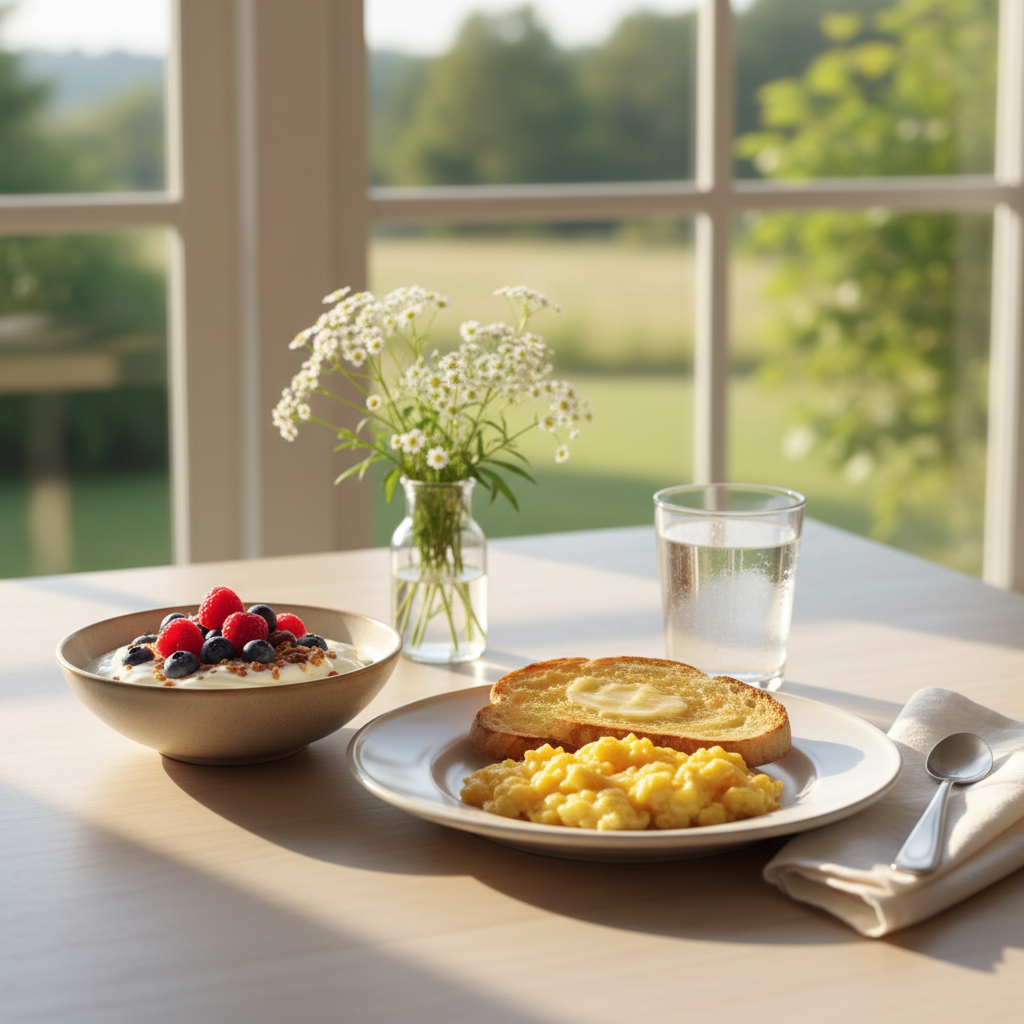
- Breakfast with protein, within an hour of waking. Eggs and toast, Greek yogurt with granola, or a smoothie with protein powder if chewing feels impossible.
- Caffeine at your normal amount. Skipping it gets you a withdrawal headache during the vows, and doubling it gets you the shakes in the photos.
- Fluids with some salt. The Cleveland Clinic's page on orthostatic hypotension lists standing for a long time and heat among the things that bring on lightheadedness, and fluids and salt among the fixes. A salted breakfast, broth, or a sports drink covers it. The same page says to avoid heavy, high-carbohydrate meals, so a big pasta brunch is the wrong call.
- Pack a snack bag for the getting-ready room. Nuts, cheese, crackers, a banana, a bottle of water. Hair and makeup take hours and nobody thinks to feed the people in the chair. Eat something small from it an hour before the ceremony.
The day itself: eat at your own wedding
Couples famously miss their own dinner. You are pulled to tables, the photographer wants the sunset, and the plate goes cold. Ask your planner or a friend to guard twenty minutes for you to sit and eat.
- Eat before the first drink. Cocktail hour on an empty stomach after a 6 a.m. start is where the night goes sideways.
- A glass of water for every drink. It is the simplest way to hold a line on a day when "less" gets measured against the room.
- Eat the dinner. You chose it months ago.
- Late-night food is a good idea. The pizza at 11 p.m. is there for the reason you think.
How BodyBuddy helps
Many couples make a plan with a trainer or a dietitian months out, and it holds right up to the last week, when the calendar fills with vendors and relatives and the plan becomes a PDF nobody opens. BodyBuddy is an AI coach that texts you every day over iMessage, and it was built for that last week.
Upload a photo or PDF of your plan in the BodyBuddy app, from a dietitian, a trainer, or your own notes, and it turns the plan into a daily schedule. Then it texts you each day so the two of you get it done together: today's protein target, the water, the early night before the rehearsal dinner. Ask it a question about your plan and it answers from your sheet. Text it a photo of lunch and it tells you the calories, protein, and carbs on the plate, which is the fastest way to check your protein when your head is full of seating charts.
If you have no plan, screenshot the short version at the top of this page and upload that. Steady meals, steady water, less alcohol, and sleep then stay in view until the day. The guide to importing a plan into BodyBuddy covers the upload step.
BodyBuddy is not medical care and does not replace a registered dietitian. It helps you follow their instructions. If an eating disorder is part of your history, talk to a professional before changing anything about how you eat this week.
FAQ
What should I eat the week before my wedding?
Eat what you usually eat, with protein at every meal, your normal amount of fiber and salt, and 6 to 8 glasses of water a day. The main work this week is avoiding sudden changes, because sudden changes move water and that is what feels like bloat.
How do I avoid bloating on my wedding day?
Keep carbs, salt, and fiber steady for the last three days instead of cutting them, drink water evenly through each day, and skip any new food or restaurant in the final 72 hours. Foods that commonly cause gas, like onions, beans, and broccoli, are fine if they are already part of your diet. A sudden large serving is the problem.
Should I cut carbs before my wedding to look leaner?
No. Each gram of stored carbohydrate holds at least 3 grams of water, so a carb cut drops water weight for a few days and it returns as soon as you eat normally again. The timing usually puts the rebound on the wedding weekend, with a headache. Your outfit was fitted at your normal weight.
What should I eat the morning of my wedding?
A breakfast with protein and some carbs within an hour of waking, your usual coffee or tea, and fluids with a bit of salt. Eggs and toast, yogurt and granola, or a protein smoothie all work. Then pack snacks and water for the getting-ready room.
Can I drink alcohol the night before my wedding?
A drink or two with dinner is fine for most people. About two standard drinks within three hours of bed delays and shortens REM sleep, so keep to a small number, finish early, and drink water before bed. Your doctor's advice comes first if you take any medication.
What to do this week
Write the next seven days on one page tonight. Put "normal plate, protein each meal" on every day, "no new foods" on the last three, "two drinks, water between, early night" on the rehearsal dinner, and "breakfast, snack bag, salt in the water" on the morning of. Give the snack bag job to one person in the wedding party and the "make them eat dinner" job to another. Then stop reading diet advice, including this.
If you want the page carried to your phone each morning without re-reading it, upload it to BodyBuddy and let the daily texts do the carrying.
Related BodyBuddy guides
- What to eat before a knee replacement: the 4-week prehab plan
- What to eat before a blood test: which labs need fasting and what breaks it
- What to eat before a colonoscopy: the 3-day countdown
- What to eat before wisdom teeth removal (and what to stock for the week after)
- What to eat before surgery: a two-week pre-op nutrition plan
Everyone gives you a plan.BodyBuddy texts you until it happens.
BodyBuddy keeps you on track—from meals to doctor's appointments and everything in between.