All posts
What to eat before a long hike: the week before, the night before, and the trail
A countdown for a long day hike: the week before, the night before, breakfast, an hourly calorie and salt budget on the trail, and a packed food list.
The permit came through, the group chat has a start time, and the route is 25 km with 1,200 m of climbing. Eight hours on your feet, maybe ten. Most people train the legs for weeks and leave the food to the night before and a grab at the gas station on the drive in.
This is the next post in a series on what to eat before a specific event, after the one on what to eat the week before a marathon. If a guide service, a park, or your doctor gave you instructions for this trip, those override anything on this page.
The short version
- The week before: eat normally, keep protein and iron steady, and eat your trail food on a training walk.
- The day before: a familiar dinner heavier on carbs, moderate fiber, no alcohol, and pack the food tonight.
- The morning of: a carb and protein breakfast one to two hours out, fluid in the two to four hours before, and your usual coffee.
- On the trail: about 200 to 300 calories an hour, a ten minute break every hour to eat, salty snacks, and water to thirst.
- After: carbs and protein within a couple of hours, and drink until your urine runs pale.
Why a hike is a fueling problem and a marathon is a storage problem
A marathoner cannot eat much while running, so the plan is to arrive at the start with full glycogen stores and ration them. A hiker can eat all day, and that changes the week before.
The 2016 joint position paper from the American College of Sports Medicine and two dietetics bodies reserves carbohydrate loading (36 to 48 hours at 10 to 12 g of carbs per kilo of body weight) for events longer than 90 minutes of sustained hard effort, and it says that eating carbohydrate during exercise "dampens any effects of pre-exercise carbohydrate intake." A long hike is many hours of moderate effort with a pack full of food. So the week-before plan is short, and the pack is the real work.
One week out: eat normally and rehearse the trail food
There is no special diet this week. The ACSM paper's daily carbohydrate target for someone training about an hour a day is 5 to 7 g per kilo, which for a 70 kg person is 350 to 490 g, and a normal diet already delivers that. Protein sits at 1.2 to 2.0 g per kilo per day. Keep both where they are.
Iron deserves one check. The same paper puts iron needs for people in training above the RDA (more than 18 mg a day for women and 8 mg for men) and calls sufficient iron stores before altitude "essential." If you have ever been told you run low, ask your doctor this week.
What to do this week:
- Walk a long training loop and eat the actual trail food on it. The ACSM paper says to practice until you find a refuelling plan that suits your gut. Hour six of the real thing is a bad time to learn you hate the bar.
- Buy the food now, and buy more than feels right. The NPS hiking tips page says to eat about twice as much as you normally would.
- Two days out, start drinking properly. Hydration in the ACSM paper is a days-long state tracked by morning weight and urine color.
- If the trip goes high, read the ascent plan. The AAFP summary of the Wilderness Medical Society guideline recommends sleeping no more than 500 m higher than the night before once above 2,800 m.
The day before: carbs up a notch, fiber down a notch, no alcohol
Dinner should be a meal you have eaten many times, with the plate tilted toward carbs. The ACSM paper's advice for the pre-event menu is low fat, low fiber, and low to moderate protein, because those choices "are less prone to cause gastrointestinal problems and promote gastric emptying." That is a polite way of saying a trailhead has no bathroom. Keep the beans, the big salad, and the bran cereal for Sunday.
Alcohol comes off the table tonight. The paper warns that alcohol before exercise hurts thermoregulation and concentration, and that it slows rehydration. One beer at dinner is fine. Three beers before a hot ridge walk is a dehydration head start.
Pack the food tonight. The ACSM during-exercise target is 30 to 60 g of carbs an hour for one to two and a half hours, and up to 90 g past that. Most hikers land in the lower band because the pace is moderate.
- Fill the bottles and put them in the fridge.
- Portion the trail food into hourly bags, with two or three salty items and one treat.
- Lay out breakfast so the morning needs no decisions.
The morning of: breakfast, fluid, and your usual coffee
The ACSM pre-event target is 1 to 4 g of carbs per kilo, eaten one to four hours before. For a 70 kg hiker and a 7 am start, that is roughly 70 to 140 g of carbs at 5 or 6 am: oatmeal and a banana, or two bagels with peanut butter. Add a modest protein, and keep fat and fiber low for the same gut reason as dinner.
Fluid is on a clock too. The paper says to drink 5 to 10 mL per kilo of body weight in the two to four hours before exercise, enough to make urine pale yellow while leaving time for the excess to be voided. For 70 kg that is 350 to 700 mL, with breakfast. Sodium in the meal helps you hold the fluid, which is an argument for salted peanut butter over plain.
Coffee is fine if coffee is normal for you. The paper says the old warnings about caffeine as a diuretic "appear to be overstated when it is habitually consumed in moderate (e.g., < 180 mg) amounts."
On the trail: a calorie budget, a clock, and salt
Here is the number I plan around, with the arithmetic. The ACSM target of 30 to 60 g of carbs an hour is 120 to 240 calories from carbohydrate alone. Real trail food brings fat and protein with it, so a pack built to hit the carb number lands around 200 to 300 calories an hour. For an eight hour day that is 1,600 to 2,400 calories on the move.
The clock beats appetite. The NPS hiking tips page says to take a ten minute break at least once every hour, sit with your legs up, and eat and drink during it. The hike smart page gives the reason: "Drink and eat even if you're not feeling thirsty or hungry," because the body does not reliably signal when it is time to refuel.
Water is where hikers get this wrong in both directions. The NPS heading is "Don't force fluids, drink when you are thirsty," and the Wilderness Medical Society's heat illness guideline says the same: drink to thirst. A 2024 review in the Clinical Journal of the American Society of Nephrology explains why: over six years in the Grand Canyon, hyponatremia from over-drinking, dehydration, and heat exhaustion occurred at nearly the same rate, and the hyponatremia cases were hikers who drank past thirst and "have not eaten much food or salt during their activity." The ACSM paper's 0.4 to 0.8 L an hour covers a mild day. In heat you drink more, to thirst, and you eat salt with it. The ACSM paper wants sodium during any exercise past two hours.
Altitude takes appetite away just when you need it. A 2018 study at 4,300 m found appetite was lower on the first two days up, the hunger hormone acylated ghrelin was suppressed throughout, and people shifted toward "sweet- and low-protein foods." The authors cite a 31% drop in voluntary energy intake in a single seven hour exposure simulating 4,000 m. So above about 2,500 m, pack the sweet, soft things you would normally skip and eat on the clock.
I find it helps to think of the day as eight small meals you already packed. The hike is the gap between them.

A day of trail food that works
Here is a pack for a seven to eight hour day. The per-item numbers are from USDA FoodData Central SR Legacy entries, scaled from per 100 g, so your product label wins where it differs.
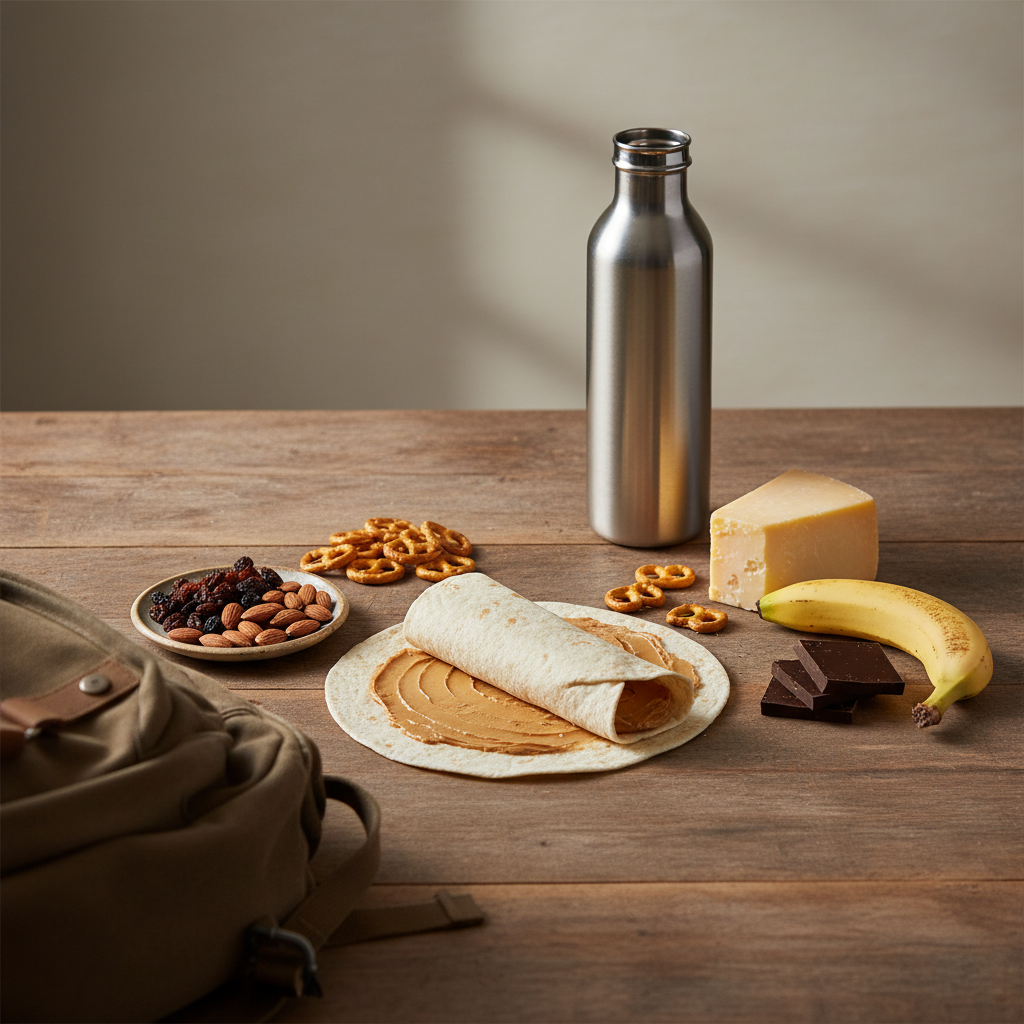
- Two flour tortillas (90 g) spread with 2 tablespoons of salted peanut butter (32 g): about 467 calories, 52 g carbs, 14 g protein.
- Almonds, 30 g: 174 calories.
- Sharp cheddar, 40 g: 164 calories and about 260 mg of sodium.
- Beef jerky, 30 g: 123 calories, 10 g protein, and about 530 mg of sodium.
- Salted pretzels, 40 g: 154 calories and about 500 mg of sodium.
- Trail mix with nuts and dried fruit, 50 g: 231 calories.
- Dark chocolate (70 to 85%), 30 g: 179 calories. The treat.
- One banana (118 g): 105 calories and 27 g carbs.
- Cheese crackers, 30 g: 147 calories and about 290 mg of sodium.
That is about 1,750 calories in roughly half a kilo of food, close to 250 calories an hour over seven hours, with about 2,500 mg of sodium across the day. Heavier hikers, colder days, and bigger climbs push the total up. A NOLS backpacking nutrition page makes the morale point: fats and sweets make food tastier, and tasty food gets eaten on a hard day.
After: eat within two hours and drink until pale
The ACSM recovery target is 0.25 to 0.3 g of protein per kilo, or 15 to 25 g, soon after exercise, with carbs alongside to refill glycogen. A burger and fries in the trailhead town is fine. For fluid, the paper says losses continue after you stop, so full rehydration takes 125% to 150% of the deficit, about 1.25 to 1.5 L for every kilo of body weight lost. Keep drinking through the evening until your urine is pale.
How BodyBuddy helps
Most hiking food plans live in a group chat and a half-remembered article. BodyBuddy is an AI coach that texts you every day over iMessage, built for the weeks between booking the trip and the trailhead.
Upload a photo or PDF of your training plan or the trip's food plan in the BodyBuddy app and it turns it into a daily plan: the long walks where you rehearse the trail food, the two-days-out hydration start, the alcohol-off night, the breakfast timing for your start. Then it texts you each day so the two of you get it done together. Ask it what the plan says about the day before and it answers from your own sheet. There is a walkthrough of how to import a plan.
The calorie budget on this page is only useful if you know what your pack holds. Text BodyBuddy a photo of the food laid out on the counter the night before and it tells you the calories, protein, and carbs, so "about 250 an hour" is a number you packed rather than a guess.
BodyBuddy is not medical care and does not replace a doctor or a wilderness guide. It helps you follow the plan you made.
FAQ
What should I eat the night before a long hike?
A familiar dinner with more carbs than usual: pasta, rice, or potatoes with a normal portion of protein. The ACSM paper's pre-event advice is low fat, low fiber, and moderate protein to keep the gut calm. Skip alcohol.
Should I eat breakfast before a long hike?
Yes. The ACSM target is 1 to 4 g of carbs per kilo one to four hours before, so oatmeal or bagels with a little protein one to two hours before you start walking. Drink 5 to 10 mL per kilo across the same window.
How much food should I bring on a 10 mile hike?
Plan on 200 to 300 calories an hour of walking, so a four to five hour hike needs roughly 1,000 to 1,500 calories in the pack, eaten in hourly stops. A couple of peanut butter wraps, nuts, jerky, and pretzels get you there.
How much water should I drink on a long hike?
Drink to thirst, which is the NPS rule and the Wilderness Medical Society's. The ACSM paper's typical plan is 0.4 to 0.8 L an hour, more in heat. Pair the water with salty food on any hike past two hours, because over-drinking without salt causes hyponatremia.
What is the best thing to eat while hiking?
Food you have eaten on a training walk and still like at hour six. Mix carbs, fat, and salt: tortilla wraps with peanut butter, nuts, cheese, jerky, pretzels, dried fruit, and one treat. At altitude, lean toward sweet and soft.
What to do this week
Pick a training walk this weekend and pack the exact food you plan to carry, in hourly bags, then eat it on the hour whether you want it or not. Weigh what comes home uneaten. Then put three things on the calendar: "start drinking" two days before, "no alcohol" the night before, and the breakfast time counted back from the trailhead.
If you want that carried to the morning of the hike without re-reading this page, upload the plan to BodyBuddy and let the daily texts carry it.
Related BodyBuddy guides
- What to eat before a HYROX race: race week, the night before, and race morning
- What to eat the week before a marathon: a 7-day carb-loading plan
- Cristiano Ronaldo's Daily Routine: Diet, Workout, Sleep & Recovery
- What to eat before a glucose test in pregnancy: the 1-hour and 3-hour tests explained
- What to eat before a knee replacement: the 4-week prehab plan
Everyone gives you a plan.BodyBuddy texts you until it happens.
BodyBuddy keeps you on track—from meals to doctor's appointments and everything in between.