
All posts
Free Meal Plan Template: Weekly Planner + Grocery List
Download a free weekly meal plan template with breakfast, lunch, dinner, snacks, a grocery list, prep notes, and a filled example.
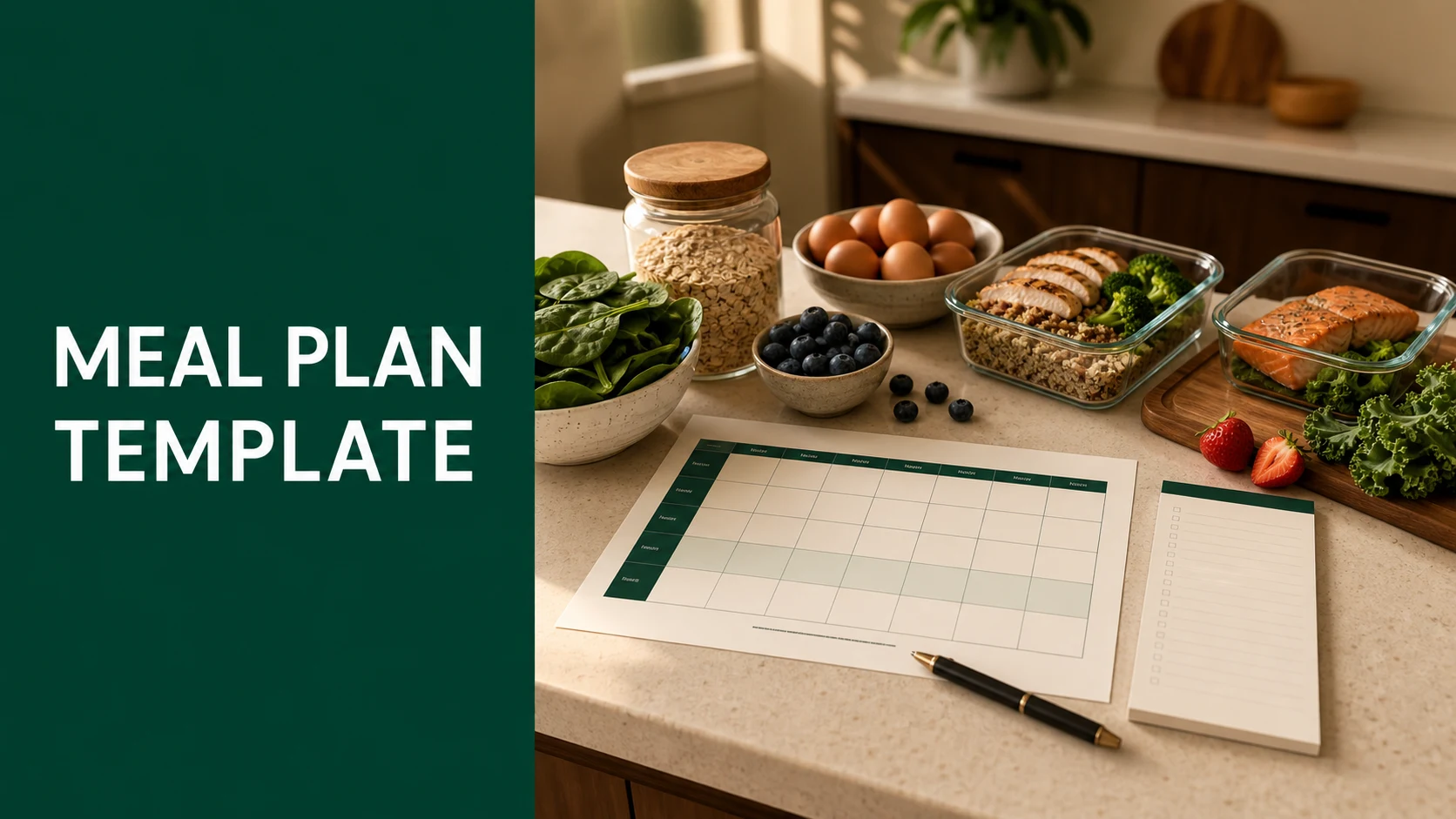
A useful meal plan template should answer four questions at a glance: what are we eating, what do we need to buy, what can be prepared early, and where is the flex space?
This page gives you a free weekly planner with breakfast, lunch, dinner, and snack slots; a categorized grocery list; prep and leftover notes; a printable PDF; a filled example; and a generator if you want help choosing meals.
Start here: Download the free weekly meal plan template (PDF). It includes a blank printable planner and a filled example. No email address or account is required.

Free weekly meal plan template
Use the grid below in Apple Notes, Google Docs, Notion, a spreadsheet, or on paper. You do not need to fill every cell. If you only plan dinners, leave breakfast and lunch blank.
Day | Breakfast | Lunch | Dinner | Snack / flex |
Monday | ||||
Tuesday | ||||
Wednesday | ||||
Thursday | ||||
Friday | ||||
Saturday | ||||
Sunday |
Add these notes below the grid:
- Week of:
- People or servings:
- Use-first ingredients: foods already open or nearing their use-by date.
- Prep-ahead tasks: only the chopping, cooking, thawing, or portioning that will make a later meal easier.
- Leftovers: name the meal and the day you plan to reuse it.
- Flex meal: a deliberate space for eating out, a changed schedule, or whatever is still in the refrigerator.
Copy-and-paste meal plan template
Copy this compact version into Apple Notes, Google Docs, a message thread, or wherever you already plan the week:
WEEK OF:
PEOPLE / SERVINGS:

MON - Breakfast: | Lunch: | Dinner: | Snack/flex:
TUE - Breakfast: | Lunch: | Dinner: | Snack/flex:
WED - Breakfast: | Lunch: | Dinner: | Snack/flex:
THU - Breakfast: | Lunch: | Dinner: | Snack/flex:
FRI - Breakfast: | Lunch: | Dinner: | Snack/flex:
SAT - Breakfast: | Lunch: | Dinner: | Snack/flex:
SUN - Breakfast: | Lunch: | Dinner: | Snack/flex:

USE FIRST:
PREP AHEAD:
LEFTOVERS:
FLEX / EATING OUT:

GROCERY LIST
Produce:
Protein:
Grains and pantry:
Dairy or alternatives:
Frozen:
Other:
How to fill it out in 10 minutes
1. Look at the week before choosing food
Mark late workdays, appointments, travel, workouts, social plans, and nights when cooking is unrealistic. A plan that ignores your actual calendar becomes obsolete by Tuesday.
2. Check what you already have
Scan the refrigerator, freezer, and pantry. Put opened produce, leftovers, and foods that need to be used soon in the Use first field. This gives the week a starting point and keeps the grocery list from duplicating what is already at home.
3. Choose two or three anchor meals
Start with the meals that require the most thought, usually dinners. Pick recipes you know, meals from a dietitian's plan, or reliable combinations such as a protein, a vegetable, and a grain. You do not need seven original dinners.
4. Schedule leftovers on purpose
If Tuesday's dinner makes four portions, write the leftovers into Wednesday lunch or Thursday dinner immediately. Leftovers are more useful when they have an assigned destination.
5. Add one flex slot
Leave one meal open for eating out, a schedule change, or using remaining ingredients. Flex space is part of the plan, not evidence that the plan failed.
6. Build the grocery list from the grid
Read each planned meal once, check the pantry, then add only missing ingredients. Grouping the list into produce, protein, pantry, dairy or alternatives, frozen, and other makes it easier to shop without rewriting everything.
7. Assign the smallest useful prep tasks
Do not turn Sunday into a restaurant shift unless you want to. A useful prep list might be: wash greens, cook a grain, make a sauce, hard-boil eggs, or move Wednesday's food from the freezer to the refrigerator.
A filled example for a busy week
This example repeats breakfasts, reuses ingredients, schedules leftovers, and keeps Saturday dinner flexible. It demonstrates the planning system; it is not a prescribed diet or a claim that these meals meet every person's nutrition needs.

Day | Breakfast | Lunch | Dinner | Snack / flex |
Monday | Yogurt + oats | Chicken bowl | Lentil soup | Apple + peanut butter |
Tuesday | Eggs + toast | Tuna wrap | Salmon + rice | Yogurt |
Wednesday | Overnight oats | Leftover soup | Tacos + slaw | Fruit + cheese |
Thursday | Yogurt + fruit | Leftover salmon bowl | Pasta + vegetables | Eggs |
Friday | Egg wrap | Chicken salad | Bean bowls | Edamame |
Saturday | Flexible breakfast | Leftovers | Dinner out | Optional |
Sunday | Oats + peanut butter | Soup + toast | Curry + rice | Prep taste |
Notice what makes the example practical:
- Yogurt, oats, eggs, chicken, greens, rice, and lentils appear more than once.
- Tuesday's salmon has a planned Thursday destination.
- Saturday dinner is intentionally open.
- The prep list supports later meals without pre-cooking the entire week.
Want help choosing the meals?
Answer a few questions to create a starting plan, then move the meals you want into the weekly template.
The generator provides general planning guidance, not medical nutrition therapy. Check the output against allergies, health conditions, religious or ethical preferences, and any plan from your clinician or registered dietitian.
Adapt the template without rebuilding it
For one person
Plan fewer distinct meals and use the leftovers field aggressively. Freeze extra portions before they become forgotten refrigerator leftovers.
For a family
Add the expected number of servings beside each dinner. Use the notes field for split meals, such as a mild base sauce with a spicy topping added separately.
For a tighter budget
Choose meals that reuse ingredients, check store offers only after deciding what you can realistically use, and schedule inexpensive anchors such as beans, lentils, eggs, frozen vegetables, oats, rice, or pasta where they fit your preferences.
For vegetarian planning
Write the actual protein source in the grid rather than only the recipe name. Beans, lentils, tofu, tempeh, edamame, eggs, dairy, and fortified alternatives vary in nutrition, so use labels and guidance appropriate to you.
For a plan from a dietitian or clinician
Use the template to organize timing, shopping, prep, and leftovers without changing the professional's instructions. If two professionals' instructions conflict, ask them to reconcile the difference rather than improvising a compromise.
Need more specific follow-through help? Read how to follow a dietitian meal plan between appointments.
Meal planning is not the same as meal prep
Meal planning decides what you intend to eat and what you need to buy. Meal prep does some of the cooking or assembly early. You can plan without batch cooking, and you can prep only one or two components.
If you want a concrete menu rather than a blank grid, use the 7-day high-protein meal plan. If you take a GLP-1 medication and want medication-specific context, use the GLP-1 diet plan and follow your prescriber's guidance.
Food-safety note
Refrigerate or freeze prepared food promptly in shallow containers. USDA guidance says perishable food should generally be refrigerated within two hours, or within one hour when the temperature is above 90°F. Most cooked leftovers should be used within three to four days or frozen earlier. When in doubt about a food's storage history, do not use smell or taste as the safety test.
Turn a paper plan into daily follow-through
The creators of BodyBuddy made this free template. The blank PDF works on its own; the generator and BodyBuddy are optional.
Already have a plan—from this template, a dietitian, another app, or your own notes? Share it with the BodyBuddy app to create a saved plan. BodyBuddy can check in by text, remember the meals you planned, accept updates by text, photo, or voice, and help you keep the next workable choice visible when the week changes.
BodyBuddy does not replace a registered dietitian or change a therapeutic diet on your behalf.
Frequently asked questions
Is this meal plan template free?
Yes. The blank printable PDF, filled example, copy-and-paste format, and in-page template are free and do not require an email address.
Can I edit the template before printing?
The in-page and copy-and-paste versions can be moved into Apple Notes, Google Docs, Notion, or a spreadsheet and edited there. The PDF is designed for printing or annotation.
What should a weekly meal plan template include?
At minimum: the days you plan to cover, the meals you want to decide in advance, a grocery list, and room for leftovers or schedule changes. Use-first ingredients and prep tasks make the plan more actionable.
Can I use it for one person or a family?
Yes. Add the number of servings beside meals and scale the grocery quantities accordingly. One-person plans often work best with repeated meals and frozen portions; family plans benefit from serving counts and notes about preferences.
What is the difference between meal planning and meal prep?
Meal planning is the decision and shopping system. Meal prep is early cooking or assembly. You can use this template even if you prefer to cook each meal fresh.
How do I turn a meal plan into a grocery list?
Review each meal, check what is already in the kitchen, and add only the missing ingredients. Group the list by store section so one ingredient used in several meals appears once with the total quantity needed.
Can I use the template with a dietitian's plan?
Yes, as an organizational layer. Keep the dietitian's instructions intact, including portions, timing, substitutions, or restrictions. Ask the dietitian before changing a therapeutic plan.
How long can prepared leftovers stay refrigerated?
USDA guidance says most cooked leftovers should be refrigerated promptly and used within three to four days. Freeze later-week portions sooner and thaw them safely in the refrigerator.
Sources and methodology
This template is an organizational tool for general education. It does not prescribe calories, macros, portion sizes, weight-loss rates, or a nutritionally complete diet. Get individualized guidance if you have allergies, an eating-disorder history, pregnancy or breastfeeding, diabetes managed with meal-timed medication, kidney or liver disease, a therapeutic diet, or other nutrition-related medical needs.
Related BodyBuddy guides
Everyone gives you a plan.BodyBuddy texts you until it happens.
BodyBuddy keeps you on track—from meals to doctor's appointments and everything in between.