
All posts
HYROX Stations in Order: Distances, Weights & Rules (2026–27)
See all 8 HYROX stations in order, plus 2026–27 Singles distances, sled weights, carry loads, wall-ball targets, and key movement rules.
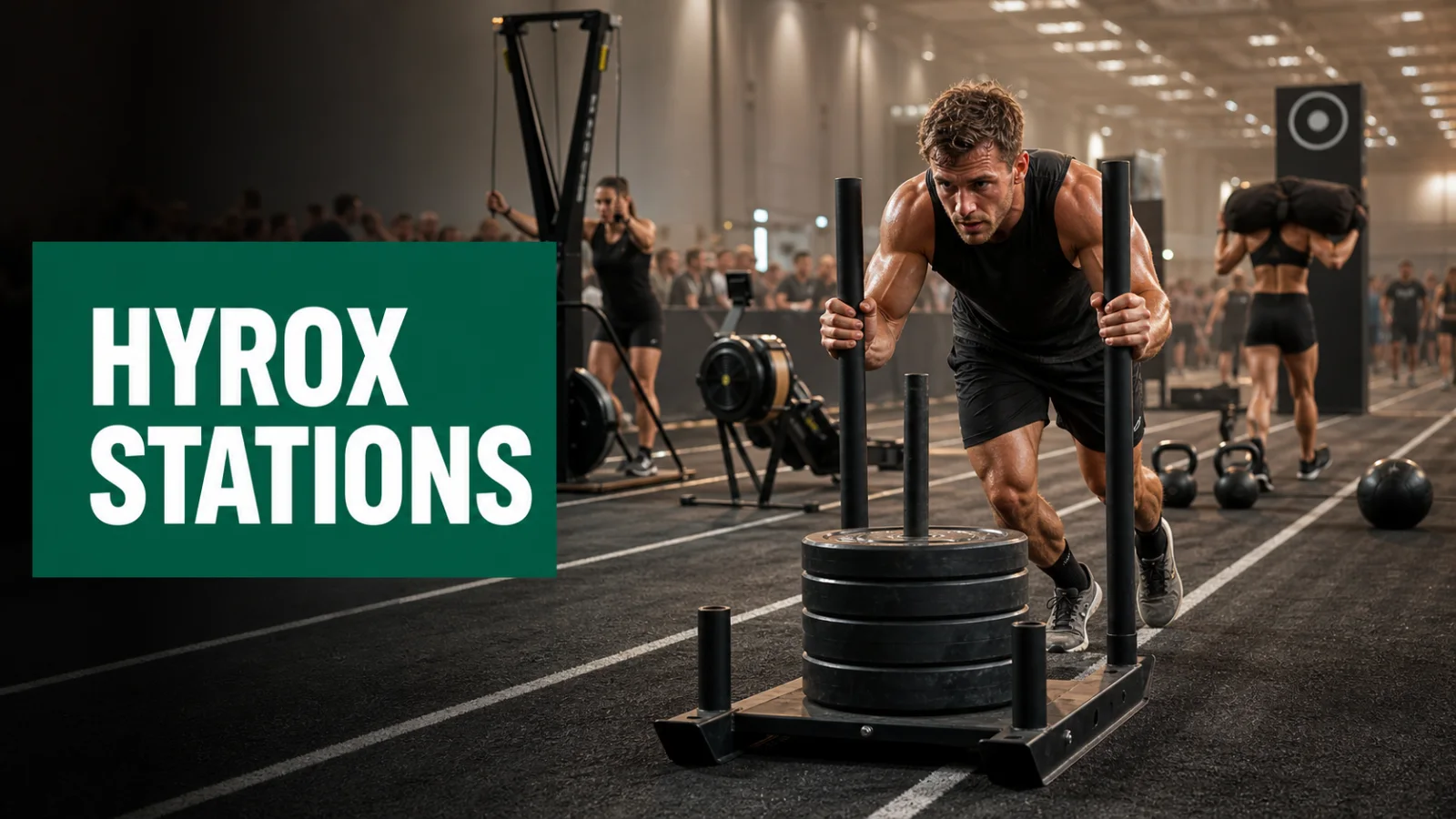
Updated August 12, 2026 for the official HYROX Singles 2026–27 rulebook.
Quick answer: A HYROX Singles race alternates eight 1 km runs with eight workout stations: SkiErg, sled push, sled pull, burpee broad jumps, rowing, farmers carry, sandbag lunges, and wall balls. The running adds up to 8 km. The station order and distances stay the same across the four Singles divisions; several weights change.
Scope: This guide covers the four Singles divisions in the 2026–27 rulebook: Women, Women Pro, Men, and Men Pro. Doubles, Relay, Adaptive, and Elite events have separate rules. Always check the current official rulebook and your event's athlete information before race day.
HYROX is simple to describe and surprisingly easy to misremember once fatigue sets in. You run, enter the Roxzone, complete the next station, and repeat. But station order matters: completing a station out of sequence can trigger a penalty, and missing a run or station can mean disqualification.
This reference puts the full sequence, distances, Singles weights, and the movement details most likely to cause a no-rep in one place.
HYROX stations in order

Order | What comes before it | Workout station | Work required |
1 | Run 1 | SkiErg | 1,000 m |
2 | Run 2 | Sled push | 50 m (4 × 12.5 m) |
3 | Run 3 | Sled pull | 50 m (4 × 12.5 m) |
4 | Run 4 | Burpee broad jumps | 80 m |
5 | Run 5 | Row | 1,000 m |
6 | Run 6 | Kettlebell farmers carry | 200 m |
7 | Run 7 | Sandbag lunges | 100 m |
8 | Run 8 | Wall balls | 100 valid reps |
That is 8 km of designated running plus eight stations. A venue may divide each 1 km segment into multiple laps. According to the current rulebook, individual laps can vary slightly because of the venue layout, but the designated run total remains 8,000 m.
A useful memory cue is:
Ski → push → pull → burpee → row → carry → lunge → wall ball.
HYROX Singles weights by division
Official race specifications use kilograms. Pound values below are approximate conversions for reference, not separate race standards.
Station | Women | Women Pro | Men | Men Pro |
Sled push, including sled | 102 kg (225 lb) | 152 kg (335 lb) | 152 kg (335 lb) | 202 kg (445 lb) |
Sled pull, including sled | 78 kg (172 lb) | 103 kg (227 lb) | 103 kg (227 lb) | 153 kg (337 lb) |
Farmers carry | 2 × 16 kg (35 lb) | 2 × 24 kg (53 lb) | 2 × 24 kg (53 lb) | 2 × 32 kg (71 lb) |
Sandbag lunges | 10 kg (22 lb) | 20 kg (44 lb) | 20 kg (44 lb) | 30 kg (66 lb) |
Wall ball | 4 kg (9 lb) | 6 kg (13 lb) | 6 kg (13 lb) | 9 kg (20 lb) |
Wall-ball target | 2.70 m (8 ft 10 in) | 2.70 m (8 ft 10 in) | 3.00 m (9 ft 10 in) | 3.00 m (9 ft 10 in) |
The SkiErg, row, burpee broad jump, and running distances do not change between these Singles divisions.
The sled figures above include the sled itself. Do not compare the kilograms too literally with a gym machine: the turf, sled, surface, and accumulated fatigue all change how the work feels. If possible, practice with a real sled on turf and learn to apply force without stopping at every step.
1. SkiErg: 1,000 meters
The SkiErg begins after the first run.
- A judge resets the monitor before you start.
- Both feet must remain on the SkiErg base. A dynamic or jumping motion is allowed, but your feet must land back on the base rather than the floor.
- After the monitor reaches 1,000 m, stay on the platform, raise an arm, and wait for the judge's confirmation before leaving.
- The damper is preset to resistance 6 for every division, but you may adjust it as often as you want.
Training takeaway: A higher damper is not automatically faster. Practice at the setting you can sustain without destroying your grip, back, and breathing before the sleds.
2. Sled push: 50 meters
The sled push is four 12.5 m lengths.
You must use the lane assigned by the judging team. The entire sled has to cross the 12.5 m line before you change direction, and the full sled must pass the final line to complete the station.
Division | Total listed mass |
Women | 102 kg |
Women Pro | 152 kg |
Men | 152 kg |
Men Pro | 202 kg |
Those totals include the sled.
Training takeaway: Short, steady steps and a torso angle you can hold are more useful than one explosive opening push followed by a long stop. Train the prescribed distance under fatigue, not only isolated heavy sled work.
3. Sled pull: 50 meters
The pull also uses four 12.5 m lengths.
- Use your assigned lane.
- Both you and the sled begin behind the designated line.
- Pull from within the marked Racers Box.
- The entire sled must pass each turnaround line.
- Stay standing; pulling from a seated or kneeling position is not allowed.
- Keep the rope in your lane so it does not interfere with another racer.
Division | Total listed mass |
Women | 78 kg |
Women Pro | 103 kg |
Men | 103 kg |
Men Pro | 153 kg |
Training takeaway: Practice gathering the rope without stepping out of your working area. Efficient footwork and rope management can save more time than frantic pulling.
4. Burpee broad jumps: 80 meters
This is not a loose sequence of burpees and forward hops. The race standard connects each burpee to a broad jump.
Key 2026–27 Singles rules include:
- Start each section with your hands behind the start line and your chest on the ground.
- You may jump or step out of the bottom of the burpee.
- Both feet must take off and land at the same time for the broad jump, with only a small permitted stagger.
- Extra steps and shuffles are not allowed.
- For subsequent burpees, your hands must be no more than 30 cm forward of your toes.
- Your chest must clearly touch the ground at the bottom.
- Both feet must cross the section's finish line before you turn.
Training takeaway: Practice the exact standard at a controlled rhythm. A slightly shorter repeatable jump often beats large jumps that force pauses or invite no-reps.
5. Row: 1,000 meters
A judge resets the rower before you begin. You must remain seated until the monitor reaches the full 1,000 m and a judge confirms completion.
The damper is preset to resistance 6, and you may adjust it. The footplates begin at position 4, but you may change them before starting.
Training takeaway: Know your preferred footplate and damper settings in advance. Use the first strokes to settle the machine rather than turning the station into a sprint you cannot recover from.
6. Kettlebell farmers carry: 200 meters
Division | Load |
Women | 2 × 16 kg |
Women Pro | 2 × 24 kg |
Men | 2 × 24 kg |
Men Pro | 2 × 32 kg |
Carry both kettlebells while moving, with your arms extended at your sides. You may set them down to rest, but they cannot move forward as you place them on the ground. At the finish, return them to the correct box with the handles upright.
The number of laps may differ by venue, so check the athlete map and count carefully.
Training takeaway: Grip is only part of the station. Train posture, breathing, turns, and picking the bells back up after a deliberate rest.
7. Sandbag lunges: 100 meters
Division | Sandbag |
Women | 10 kg |
Women Pro | 20 kg |
Men | 20 kg |
Men Pro | 30 kg |
The trailing knee must touch the ground on every lunge. Finish each rep standing tall with hips and knees extended, and alternate legs. You may stop with both feet parallel, but you may not take extra steps or shuffle between reps.
The sandbag must remain supported by you throughout the station; it cannot be placed on the ground or another surface to remove the load.
Training takeaway: Use a step length that lets you reach the ground and regain full extension cleanly. Rushing shortened reps can cost more than it saves.
8. Wall balls: 100 valid reps
The final station is 100 valid wall balls.
Division | Ball | Target |
Women | 4 kg | 2.70 m |
Women Pro | 6 kg | 2.70 m |
Men | 6 kg | 3.00 m |
Men Pro | 9 kg | 3.00 m |
A valid rep starts from a tall standing position. Squat until your hips descend lower than your knees, then throw the ball with both hands so it hits the correct physical target. If you let the ball bounce, you must stand tall again before beginning the next squat; you cannot catch the bounce and flow directly into another rep.
There is no warning system here: a valid rep counts, and an invalid one is a no-rep. The judge and physical target remain authoritative even when a digital counter is present.
Training takeaway: Build sets around repeatable depth and target contact. One hundred fast attempts are not useful if several do not count.
What changes between Open and Pro?
The format does not become longer in Pro. You still run 8 km, complete the same eight stations, cover the same distances, and perform 100 wall balls.
The differences are the external loads:
- Pro uses a heavier sled push and pull.
- Pro uses heavier kettlebells.
- Pro uses a heavier sandbag.
- Pro uses a heavier wall ball.
For Women Pro, the sled, carry, sandbag, and wall-ball loads match Men Open. Men Pro uses the heaviest listed loads. Target height follows sex category: 2.70 m for Women and Women Pro, and 3.00 m for Men and Men Pro.
How to use this list in training
Knowing the sequence is useful because HYROX is not eight isolated gym tests. Every station arrives after another 1 km run.
A practical preparation week usually needs some combination of:
- Running you can repeat under fatigue. Easy aerobic work, threshold work, and compromised running serve different purposes.
- Movement-standard practice. Train reps that would count, especially burpee broad jumps, lunges, and wall balls.
- Station-specific strength endurance. Sleds, carries, and lunges should not be surprises on race day.
- Transitions and equipment settings. Know your erg setup and learn to settle quickly at each station.
- Recovery. More race simulations are not always better. Full simulations create fatigue; targeted sessions let you improve specific weak points.
Need a schedule that turns these standards into weekly sessions? Use the free 8-week HYROX training plan. If you already have a coach's or training plan's schedule, BodyBuddy can keep it visible and follow up by text between sessions. Browse BodyBuddy plans or add the plan you already intend to follow.
Frequently asked questions
How many stations are in HYROX?
Eight. Each station follows a designated run segment, for eight runs and eight stations total.
How much running is in a HYROX race?
The designated running distance is 8 km, split into eight segments of approximately 1 km. Venue lap layouts can differ, so use the race-day signage and athlete map rather than assuming a fixed number of laps.
Are HYROX sled weights listed with or without the sled?
The 2026–27 Singles rulebook lists the sled push and pull totals including the sled.
Are HYROX Open and Pro distances different?
No. The Singles station order, running distance, station distances, and wall-ball rep count are the same. The main difference is the prescribed load at the weighted stations.
Is the HYROX Singles format the same as Doubles?
The overall race concept is related, but this table should not be used as a Doubles rulebook. Doubles has separate participation and work-sharing rules. Check the official Doubles rulebook for your division.
Which HYROX station is the hardest?
There is no universal hardest station. Sleds expose strength and force production, burpee broad jumps and lunges punish inefficient movement, and wall balls arrive when fatigue is highest. Your most expensive station is the one whose standard or load you have not practiced.
Official sources and accuracy note
This article was checked against the official HYROX Singles Rulebook for season 2026–27, the official race overview, and HYROX's rules and judging resources. Rules can change. Visit HYROX, open the current Rulebook, and confirm your event-specific instructions before competing.
HYROX is a brand of HYROX World GmbH. This independent guide is not affiliated with, sponsored by, or endorsed by HYROX World GmbH. It is editorial information, not medical advice or individualized coaching.
Related BodyBuddy guides
- HYROX vs CrossFit: Differences, Training, and Which Is Right for You?
- Cristiano Ronaldo's Daily Routine: Diet, Workout, Sleep & Recovery
- What Every Body Fat Percentage Actually Looks Like (5% to 50%)
- Steph Curry's Day in the Life: His Game-Day Routine, Diet, and Recovery
- Workout Journal: Free Templates for Any Workout
Everyone gives you a plan.BodyBuddy texts you until it happens.
BodyBuddy keeps you on track—from meals to doctor's appointments and everything in between.