
All posts
HYROX vs CrossFit: Differences, Training, and Which Is Right for You?
Compare HYROX vs CrossFit by format, movements, running, training, competition, and beginner fit—plus how to choose and prepare for either.
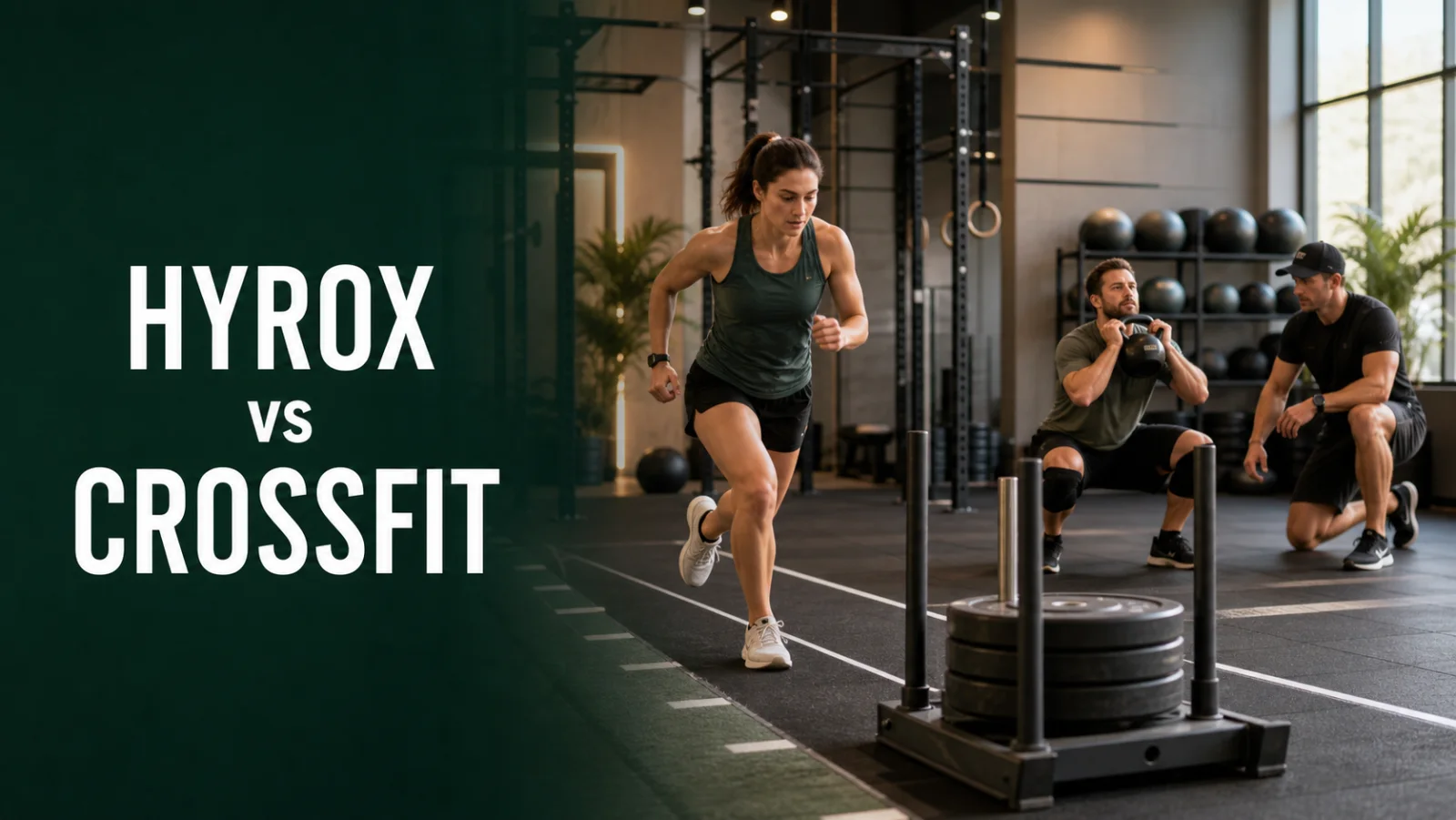
HYROX and CrossFit overlap, but they are not two versions of the same workout.
HYROX is a standardized indoor fitness race. Every standard race alternates 8,000 meters of designated running—divided into eight segments of approximately 1,000 meters—with the same eight functional workout stations in the same order. You can train specifically for a known test and compare results, while allowing for venue and Roxzone-layout differences.
CrossFit is first a fitness methodology. At an affiliate gym, the daily training varies and may include weightlifting, gymnastics, running, rowing, carries, and other functional movements. CrossFit also has competitions, including the worldwide Open and the elite CrossFit Games season, but ordinary CrossFit classes are not competitions.
That distinction answers most of the HYROX vs CrossFit question:
- Choose HYROX-focused training if you want a clear race date, a repeatable format, substantial running, and a narrower movement list.
- Choose CrossFit classes if you want coached, varied training across a broader range of strength, conditioning, and skill work.
- Use both if you enjoy CrossFit but want to race HYROX—provided you add enough running and event-specific practice.
This guide compares the published formats and available research. We have not personally tested every affiliate, coach, or event, so use the official rules and local coaching details for your final decision.

The simplest distinction: HYROX prepares you for one known race; CrossFit develops broader fitness through varied training.
HYROX vs CrossFit at a glance
Primary identity
- HYROX: A standardized fitness race and the training built around it.
- CrossFit: A constantly varied training methodology practiced in coached affiliate classes; it also has separate competitive events.
What stays the same
- HYROX: The race follows a known sequence of runs and stations. Division loads and how work is shared can differ.
- CrossFit: The underlying methodology stays consistent, but workouts, movements, loads, rep schemes, and time domains vary.
Running demand
- HYROX: Central. A standard race includes 8,000 meters of designated running in eight segments of approximately 1,000 meters.
- CrossFit: One tool among many. A given workout might feature running, rowing, biking, lifting, gymnastics, or a combination.
Movement range
- HYROX: Eight known stations: SkiErg, sled push, sled pull, burpee broad jumps, rowing, farmer's carry, sandbag lunges, and wall balls.
- CrossFit: Much broader. Programming can draw from weightlifting, powerlifting, gymnastics, monostructural conditioning, and other functional movements.
Typical training setting
- HYROX: A running plan plus strength and station practice, often at a gym with sleds, ergs, kettlebells, sandbags, and wall-ball targets.
- CrossFit: Usually a coach-led group class at an independently owned affiliate.
Best fit
- HYROX: People motivated by a fixed event and measurable race time.
- CrossFit: People motivated by variety, skill development, coaching, and broad general fitness.
What exactly is HYROX?
Each station follows another run segment. The station order is:
- 1,000-meter SkiErg
- Sled push
- Sled pull
- Burpee broad jumps
- 1,000-meter row
- Farmer's carry
- Sandbag lunges
- Wall balls
The current Singles rulebook sets 50 meters for each sled event, 80 meters of burpee broad jumps, 200 meters of farmer's carry, 100 meters of sandbag lunges, and 100 wall-ball reps. Loads and targets vary by division. For the full current sequence, weights, and movement rules, use our HYROX stations reference and confirm the latest official rulebook before racing. HYROX also offers doubles, relay, Pro, and adaptive formats at various events.
The important comparison point is standardization. You know the event before you enter. That makes HYROX closer to preparing for a road race with strength stations than showing up for an unknown workout.
Early research supports the running emphasis. In a 2025 study of 11 recreational HYROX athletes completing a simulated Open race, the running segments took more time than the stations, and faster overall performance was associated with higher measured aerobic capacity and more endurance training. The sample was tiny, so it should not be treated as a universal formula. A much larger 2026 analysis of nearly 40,000 Pro and Elite results also found that running consistently accounted for about half of total race time and was strongly associated with overall performance.
In plain English: being good at sleds and wall balls matters, but HYROX is not a strength circuit with a little jogging between stations. Running is a defining part of the event.
What exactly is CrossFit?
CrossFit officially defines its methodology around constantly varied functional movements performed at relative intensity. Programming changes across movements, loads, durations, and formats; emphasizes patterns such as squatting, hinging, pressing, pulling, carrying, running, and lifting; and adjusts the intended challenge to the person.
At a CrossFit affiliate, a typical one-hour class is led by a coach and may include a whiteboard briefing, warm-up, skill or strength practice, workout preparation, and the Workout of the Day. The coach explains the intended stimulus and helps scale movements, loads, volume, or range of motion.
That everyday class experience should not be confused with CrossFit competition.
The CrossFit Open is a worldwide participatory competition with workouts released over a defined period and multiple workout levels. Athletes submit scores to a leaderboard. At the far end of the competitive spectrum, the CrossFit Games season progresses through qualifying stages and culminates in an elite championship. Competition programming tests athletes; it is not a template for what every member does in an ordinary Tuesday class.
So when someone asks whether HYROX or CrossFit is “more competitive,” the honest answer depends on what they mean. A HYROX entry is explicitly a race. CrossFit classes are training, although participants may keep scores and can choose to enter competitions.
The five biggest differences
1. HYROX is predictable; CrossFit is varied
This is the cleanest distinction.
You can reverse-engineer HYROX because the sequence is published. Training can focus on running economy, station technique, division standards, transitions, and holding a sustainable pace under accumulated fatigue.
CrossFit deliberately exposes you to a broader set of tasks. You might back squat one day, combine pull-ups and double-unders another day, and complete a longer row-and-carry workout later in the week. You can repeat benchmark workouts to measure progress, but the daily experience is not built around rehearsing one race sequence.
If knowing the test calms you, HYROX may feel easier to plan for. If repetition bores you, CrossFit's variety may make consistency easier.
2. HYROX requires more dedicated running
A standard HYROX race contains 8,000 meters of designated running, broken into eight segments and interrupted by stations. That creates a specific problem: you must keep running after your legs, grip, and breathing have been taxed.
CrossFit can include running, but the methodology is not a running program. The next class might contain no running at all. Someone can become proficient in many CrossFit movements while still being underprepared for eight race-paced kilometers.
CrossFit athletes moving into HYROX therefore should not assume metcons alone replace running volume. Add running progressively, keep some sessions easy enough to recover from, and practice selected race transitions rather than turning every run into an all-out simulation.
3. CrossFit usually asks for a wider technical skill set
HYROX stations still require technique. Sled setup, SkiErg rhythm, rowing efficiency, burpee standards, lunge control, and wall-ball accuracy all affect effort and penalties.
CrossFit programming can go further into barbell and gymnastic skill. Depending on the affiliate and the athlete's level, that may include Olympic lifts, pull-up variations, handstands, rope climbs, and double-unders. These movements take time to learn and should be scaled while technique develops.
That can make HYROX's movement list more approachable conceptually. It does not make the full race easy.
4. HYROX training is specific; CrossFit aims broader
HYROX preparation works backward from one known performance. As race day approaches, training normally becomes more specific to the run distances, stations, transitions, loads, and pacing you will face.
CrossFit's stated aim is broad fitness across multiple physical skills and time domains. The purpose of variation is to avoid specializing only in one predictable test.
Neither approach is inherently better. Specificity is useful when you have a specific event. Breadth is useful when your goal is general capability and you enjoy learning different physical skills.
5. The training experience and progress measures feel different
Most CrossFit affiliates center the experience on scheduled group classes with a coach. HYROX training has no single required delivery model: you might use an online program, a coach, focused classes, outdoor runs, and a conventional gym. Affiliate quality and HYROX equipment access both vary, so evaluate the actual facility rather than its highlight reels.
HYROX also gives you one highly legible outcome: your finishing time and individual splits for a standardized race. You can identify whether running, Roxzone transitions, or a particular station consumed time.
CrossFit progress is distributed across many measures: workout times, rounds and repetitions, barbell loads, gymnastics skills, movement quality, and performance on repeated benchmarks. The record is broader, but there is no single score that summarizes everything you can do.
Ask which measurement motivates you: improving one repeatable race or progressing across many tasks. Equipment matters, too. Rehearsing HYROX requires ergs, a sled and turf, kettlebells, a sandbag, and a wall-ball target. Ask what the gym actually provides; “functional fitness gym” does not guarantee HYROX equipment, focused classes, or CrossFit affiliation.
HYROX training vs CrossFit training
Training should reflect your actual goal, schedule, and experience—not a generic social-media calendar. Still, the emphasis typically looks different.
A HYROX-focused week needs three qualities
- Running capacity: sustainable volume plus appropriate faster work.
- Strength and muscular endurance: especially for sleds, carries, lunges, and wall balls.
- Race-specific integration: selected run-to-station sessions for pacing and movement under fatigue.
Do not make every session a full HYROX simulation. The event is demanding, and repeatedly reproducing it can add fatigue without fixing the underlying limiter. Build the components, then combine them strategically. For a concrete starting schedule, use this free 8-week HYROX training plan for a first race.
A CrossFit-focused week follows the affiliate's programming
For most beginners, the main job is to attend consistently, learn the movements, and scale appropriately. Open preparation can include common movement standards and pacing scored workouts, but general-fitness members do not need to train like Games athletes.
Can CrossFit prepare you for HYROX?
Yes—CrossFit can provide a useful base for HYROX stations. It can build strength, work capacity, and familiarity with ergs, wall balls, burpees, carries, lunges, and sleds.
But CrossFit alone is not automatically a complete HYROX plan.
The likely gap is running specificity. Current HYROX studies identify running as a major part of total race time. A CrossFit athlete should assess weekly running volume, tolerance for repeated 1-kilometer efforts, and the ability to resume controlled running after stations.
A sensible transition could include:
- Keep two or three CrossFit classes that support strength and station skill.
- Add two or three runs appropriate to your current training history.
- Practice one targeted run-to-station combination periodically.
- Reduce conflicting volume if soreness or performance keeps worsening.
- Rehearse official movement standards and division loads before race day.
This is a framework, not an individualized prescription. A qualified coach can adapt it to your experience, equipment, and event date.
Which one is better for beginners?
Both can work for beginners. HYROX may be clearer if you already walk or run regularly, prefer familiar movements, and like a fixed date. In Doubles, both athletes complete the full designated running distance and share station work; relay teams divide race legs. CrossFit may offer more built-in instruction if you want a coach to guide each session and enjoy strength and skill development. Quality varies across affiliates, so observe a class and ask how beginners are onboarded.
Whichever you choose:
- Tell the coach about relevant limitations or recent time away from training.
- Start below the volume and intensity you think you can survive.
- Learn movement standards before chasing a leaderboard.
- Increase running, lifting, or high-intensity volume gradually.
- Treat persistent or worsening pain as a reason to stop and get appropriate guidance—not as proof the workout is “working.”
If you have an injury, concerning symptoms, a medical condition, are pregnant or postpartum, or are returning after a long layoff, get individualized advice before attempting a high-intensity race or class. Stop exercising and seek prompt medical help for chest pain, fainting, or other severe or unusual symptoms.
Research does not justify claims that either format is universally safe or dangerous. One systematic review found that 11 of 12 included injury studies had poor methodological quality. Coaching, technique, previous injury, fatigue, and progression all matter.
How to choose: a practical decision guide
Choose HYROX-focused training if most of these sound like you:
- I want a race on the calendar.
- I enjoy or am willing to train running consistently.
- I prefer knowing the movements in advance.
- I want one standardized result I can improve.
- I can access the event equipment or suitable substitutes.
Choose CrossFit if most of these sound like you:
- I want coach-led group classes.
- I enjoy varied workouts rather than one event sequence.
- I want to develop weightlifting and gymnastics skills as well as conditioning.
- I value a local gym community.
- I prefer measuring progress across many abilities.
Choose CrossFit plus HYROX-specific preparation if you enjoy your affiliate but have registered for a HYROX race. Keep the useful base, then deliberately train the demands your normal classes do not cover—especially running and race-standard practice.
Try a beginner CrossFit class and a HYROX training session. Check the commute, coaching, equipment, schedule, and total cost. Choose the environment you can attend for months, not the one that looks hardest in a short video.
Where BodyBuddy fits—and where it does not
BodyBuddy does not replace a CrossFit coach, HYROX program, or qualified professional. It should not decide your race loads, correct lifting technique, or diagnose pain.
Its narrower role is follow-through. If a coach gives you a program, you can import it into the BodyBuddy app and use daily text accountability to remember sessions, note what you completed, and keep the plan visible between coached workouts.
The creators of BodyBuddy publish this article. We therefore have an interest in the product mentioned above. The HYROX and CrossFit comparison itself is based on official format descriptions and the cited research, not hands-on claims about either brand.
For a broader look at following an exercise plan consistently, see daily accountability for fitness. You can also use this guide to track fitness progress without turning every workout into admin.
The verdict
HYROX and CrossFit share functional movements and hard conditioning, but solve different problems. HYROX gives you a known race and finishing time. CrossFit gives you a broad methodology, usually delivered in coached affiliate classes. It can include competition, but ordinary classes are not the CrossFit Games.
If your dream is to prepare for one repeatable hybrid race, choose HYROX-specific training. If you want varied, coached general fitness and a wider skill set, choose CrossFit. If you love CrossFit and want to race HYROX, you do not need to abandon it—just add the running and specificity the race actually requires.
Frequently asked questions
Is HYROX basically CrossFit with running?
No. That shorthand hides the central difference. HYROX is one fixed race format with 8,000 meters of designated running and eight known stations. CrossFit is a constantly varied methodology with a much broader movement library. CrossFit competitions are also programmed differently from normal affiliate classes.
Do you need to be good at running for HYROX?
You do not need to be an elite runner to enter, but you should prepare for eight running segments of approximately 1,000 meters each. Published HYROX research suggests running occupies a large share of total time and is strongly related to overall performance. Build running gradually rather than relying only on functional-fitness workouts.
Does HYROX have Olympic lifting or advanced gymnastics?
The standard HYROX station list does not include Olympic lifts, handstand walking, muscle-ups, or rope climbs. CrossFit programming and competitions may include technical barbell or gymnastic movements. Always check current official rules rather than assuming future events will never change.
Can a beginner do HYROX without doing CrossFit first?
Yes. CrossFit experience is not a prerequisite. A beginner still needs enough time to build running tolerance, learn each station, practice the official standards, and choose an appropriate division. Coaching can help if the equipment or movements are unfamiliar.
Can I train for HYROX at a CrossFit gym?
Possibly. Many CrossFit gyms have ergs, kettlebells, wall balls, sandbags, and suitable coaching. Sled space, HYROX-specific classes, open-gym access, and running programming vary. Ask the affiliate directly and make sure your overall plan includes progressive running and race-standard practice.
Sources
- HYROX: The Fitness Race — official race format and station sequence.
- HYROX Singles Rulebook, 2026/27 season — current official division loads, distances, standards, and rules. Consult the latest rulebook before racing.
- CrossFit: What Is CrossFit? — official overview of the methodology, coaching, relative intensity, and scaling.
- CrossFit: What to Expect at Your First CrossFit Class — official class structure and beginner guidance.
- CrossFit Games: Open Overview — official description of the participatory competition and workout levels.
- Brandt et al., 2025, Frontiers in Physiology — primary study of acute demands and performance correlates in 11 recreational HYROX athletes.
- Rappelt et al., 2026, Frontiers in Physiology — primary analysis of 39,696 HYROX Pro and Elite results across seven seasons.
- Barranco-Ruiz et al., 2020, Journal of Human Kinetics — systematic review of injuries reported in CrossFit, cross-training, and high-intensity functional training; most included studies were rated poor quality.
Related BodyBuddy guides
Everyone gives you a plan.BodyBuddy texts you until it happens.
BodyBuddy keeps you on track—from meals to doctor's appointments and everything in between.