
Fitness|August 14, 2026|BodyBuddy Team
Arnold Split Workout Plan: A Modern 6-Day Routine
Use this Arnold split workout plan for chest and back, shoulders and arms, and legs, with exact sets, reps, progression, and beginner and 4-day options.
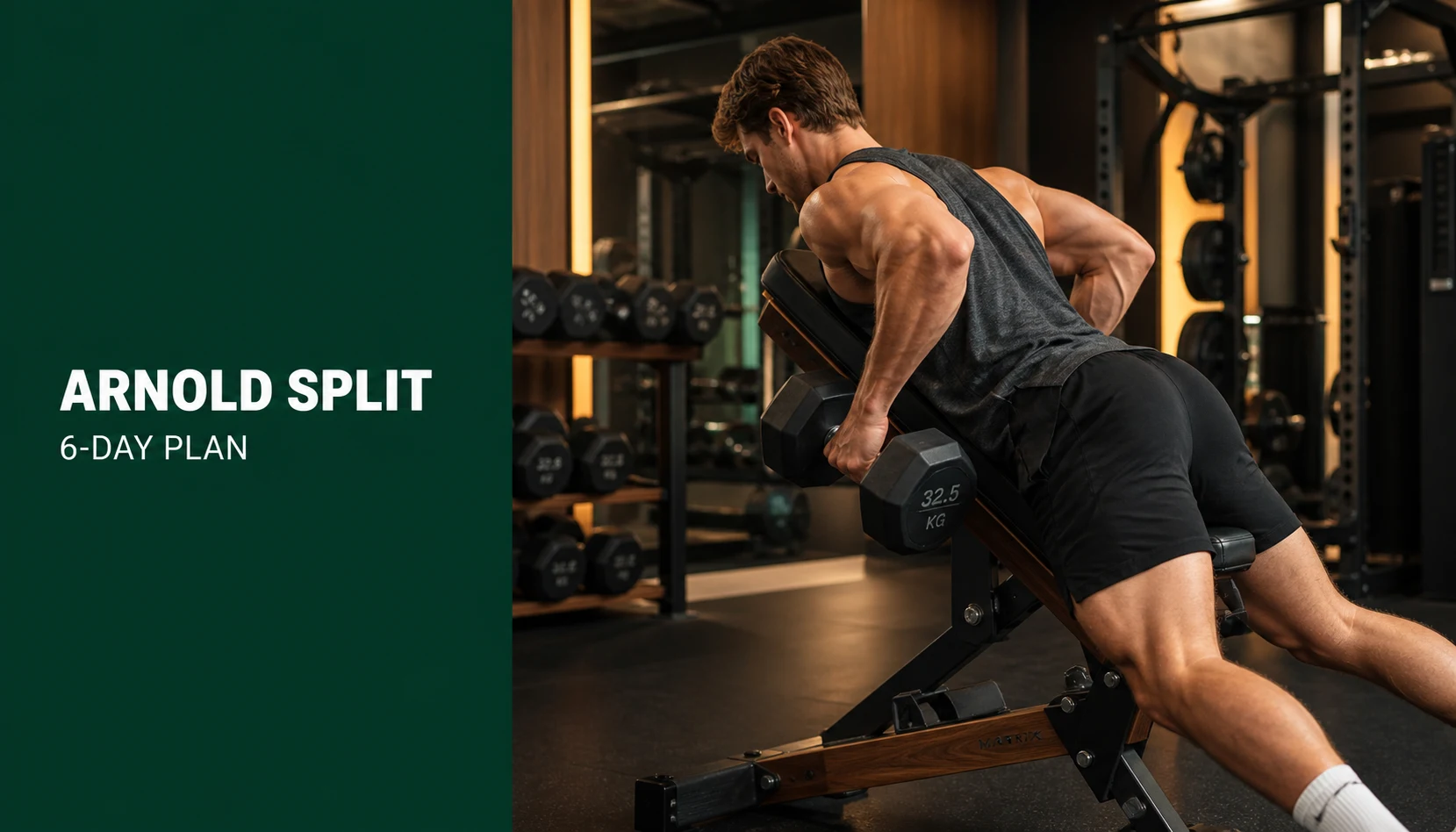
The Arnold split organizes training into three pairings—chest and back, shoulders and arms, then legs—and repeats that sequence twice before a rest day.
The weekly rhythm is:
Day | Workout |
Monday | Chest and Back A |
Tuesday | Shoulders and Arms A |
Wednesday | Legs A |
Thursday | Chest and Back B |
Friday | Shoulders and Arms B |
Saturday | Legs B |
Sunday | Rest |

The standard sequence repeats the three pairings, then protects a full rest day.
Quick answer: The classic Arnold split is a six-day bodybuilding split that pairs chest with back, groups shoulders with biceps and triceps, and gives legs their own day. The plan below is a modern, lower-volume BodyBuddy adaptation for experienced recreational lifters. It is not Arnold Schwarzenegger's historical two-a-day Double Split, his exact competitive routine, or a program endorsed by him.
If you are not already training consistently, use the beginner or four-day adaptation; more days are not automatically better.
Need more recovery between blocks? Follow the workouts in the same order but use three training days, one rest day, then repeat. That turns the week into an eight-day rotation: A sessions, rest, B sessions, rest.
What is the Arnold split?
In Arnold's own Pump Club writing, he describes the sequence as chest and back, shoulders and arms, and legs and abs “over and over.” He has also described a later six-day routine with those pairings.
That does not mean every routine labeled “Arnold split” is his routine. His competitive-era double split involved far more training, while his later machine circuit serves a different goal. Copying either set for set would be a poor default for most people.
This version keeps the useful structure while changing the dose:
- Each muscle gets two weekly exposures.
- A and B sessions change angles or rep ranges without changing the whole program.
- Most sets stop with about two controlled repetitions left.
- Volume is challenging but below a maximal bodybuilding routine.
- Progress comes from recording reps and loads.
Current guidance supports the underlying principle: train consistently, cover the major muscle groups, and fit the program to the person. Six days is one way to distribute the work—not a requirement.
Is this six-day plan right for you?
This plan is most appropriate when you:
- Have at least several months of consistent resistance training.
- Know how to squat or leg press, hinge, press, row, and use basic machines with control.
- Want a muscle-building routine rather than a sport-specific strength or endurance plan.
- Can train six days without sacrificing sleep, work, or other recovery needs.
- Are willing to keep exercises stable for six to eight weeks and log performance.
Choose the three-day version when you are new. Use the complete four-day upper/lower split when four sessions fit more reliably. If you are still choosing a training frequency, start with the broader guide to building a gym routine that fits your week.
How to use the workout tables
Perform 5–10 minutes of easy movement before each workout, then complete lighter practice sets for the first one or two exercises. Those warm-up sets do not count as working sets.
Choose loads that leave about two repetitions in reserve (2 RIR): roughly two more good reps with the same range and technique.
Start with two working sets for compound exercises and one working set for the final isolation exercises. The tables show ranges where a set can be added later. Add volume after two or three weeks only when technique is stable, performance is progressing, and recovery is good. The higher number is an option—not a minimum.
- Rest 2–3 minutes after demanding compound sets.
- Rest 60–90 seconds after most isolation exercises.
- Use a controlled range you can repeat without pain.
- Stop a set when your position or range clearly changes to finish the rep.
The exercise alternatives separated by “or” are options, not extra work. Pick one and keep it stable long enough to measure progress.
Monday: Chest and Back A
This session balances horizontal pressing, vertical pulling, rowing, and isolation work.
Exercise | Working sets | Reps | Rest |
Bench press | 2–3 | 6–8 | 2–3 min |
Pull-up or lat pulldown | 2–3 | 6–10 | 2 min |
Incline dumbbell press | 2 | 8–12 | 90–120 sec |
Chest-supported row | 2–3 | 8–12 | 90–120 sec |
Cable fly or pec deck | 1–2 | 12–15 | 60–90 sec |
Straight-arm pulldown | 1–2 | 12–15 | 60–90 sec |
Start with straight sets. Experienced lifters may alternate each press with the following pull, but should still rest enough to keep reps controlled.
Tuesday: Shoulders and Arms A
Monday already involves the front deltoids and arms, so keep Tuesday's loads controlled.
Exercise | Working sets | Reps | Rest |
Seated dumbbell shoulder press | 2 | 6–10 | 2 min |
Close-grip bench press | 2–3 | 6–10 | 2 min |
EZ-bar curl | 2–3 | 8–12 | 90 sec |
Dumbbell or cable lateral raise | 1–2 | 12–20 | 60–90 sec |
Incline dumbbell curl | 1–2 | 10–15 | 60–90 sec |
Overhead cable triceps extension | 1–2 | 10–15 | 60–90 sec |
Reverse pec deck | 1–2 | 12–20 | 60–90 sec |
If close-grip benching is uncomfortable, use a neutral-grip machine press or cable pressdown.
Wednesday: Legs A
Legs A is the heavier squat-and-hinge session; keep both lifts controlled.
Exercise | Working sets | Reps | Rest |
Back squat or leg press | 2–3 | 5–8 | 2–3 min |
Romanian deadlift | 2–3 | 6–10 | 2–3 min |
Leg press or supported split squat | 2 | 10–15 | 90–120 sec |
Seated or lying leg curl | 2 | 10–15 | 60–90 sec |
Standing calf raise | 2 | 8–15 | 60–90 sec |
Cable crunch | 2 | 10–15 | 60–90 sec |
If leg press is first, use the supported split squat in the third row. Keep Romanian deadlifts within a controlled range.
Thursday: Chest and Back B
The B session changes angles and uses supported or machine options.
Exercise | Working sets | Reps | Rest |
Incline barbell press or incline chest-press machine | 2–3 | 6–10 | 2–3 min |
Chest-supported row or machine row | 2–3 | 6–10 | 2 min |
Machine chest press | 2 | 8–12 | 90–120 sec |
Neutral-grip lat pulldown | 2–3 | 8–12 | 90–120 sec |
Pec deck | 1–2 | 12–20 | 60–90 sec |
Cable or machine pullover | 1–2 | 12–15 | 60–90 sec |
This is not a second max-effort bench day. Use repeatable reps rather than testing your best load.
Friday: Shoulders and Arms B
The B session uses machines and cables where practical.
Exercise | Working sets | Reps | Rest |
Machine shoulder press | 2 | 8–12 | 90–120 sec |
Cable pressdown | 2–3 | 8–12 | 60–90 sec |
Preacher curl | 2–3 | 8–12 | 60–90 sec |
Dumbbell or cable lateral raise | 1–2 | 12–20 | 60 sec |
Hammer curl | 1–2 | 10–15 | 60–90 sec |
Single-arm overhead cable extension | 1–2 | 10–15 | 60–90 sec |
Cable rear-delt fly or reverse pec deck | 1–2 | 12–20 | 60 sec |
Alternating a biceps set with a triceps set can save time without rushing.
Saturday: Legs B
The final session changes the squat pattern and adds unilateral work.
Exercise | Working sets | Reps | Rest |
Hack squat or front squat | 2–3 | 6–10 | 2–3 min |
Hip thrust | 2 | 8–12 | 90–120 sec |
Bulgarian split squat | 2 | 8–12 per leg | 90–120 sec |
Lying leg curl | 2 | 10–15 | 60–90 sec |
Seated calf raise | 2 | 12–20 | 60–90 sec |
Hanging knee raise | 2 | 8–15 | 60–90 sec |
Use support for Bulgarian split squats when balance is limiting. Replace hanging knee raises with reverse crunches if needed.
At the lower end of every set range, the week provides roughly 10 direct sets each for chest and back, 8 for delts, 6 each for biceps and triceps, 8 each for the quads and posterior chain, and 4 for calves. Pressing and pulling also train the shoulders and arms indirectly, so add optional sets one muscle group at a time rather than increasing every exercise together.
Sunday: Rest and review
Easy walking or mobility is fine, but do not insert another hard lifting session.
Review the week's log:
- Which exercises reached the top of their range?
- Did technique stay consistent?
- Did performance decline twice?
- Did six days fit your life?
Use those answers to plan the next week.
How to progress the Arnold split
Use double progression for every exercise:
- Start near the bottom of the listed rep range with about 2 RIR.
- Keep the load stable while adding controlled reps over later sessions.
- When every working set reaches the top of the range with the same technique and about 2 RIR for two sessions, increase the load by roughly 2–5%.
- Return to the bottom of the range and build again.
For a 3 × 6–8 bench press, a log might move from 8/7/6 to 8/8/7 and then 8/8/8. Repeat 8/8/8 once before adding weight.

Add load only after the full rep target is repeatable with the same technique.
Do not increase load when extra reps came from shortened range or changed technique. After two declining exposures, maintain or reduce the load.
Run the same core program for six to eight weeks before making a formal review. That is a review point, not an expiration date. If performance and recovery are moving in the right direction, the plan can continue.
Arnold's own writing emphasizes follow-through. Keeping exercises stable lets you compare this week's work with last week's.
Build the plan around your equipment
If you need different equipment or a shorter schedule, generate a starting plan here:
The generator provides general fitness guidance. Check its output against your current ability, equipment, health, and any instructions from a qualified professional.
Whichever version you use, record the date, exercise, load, reps, and any useful note about technique or pain. The Apple Notes workout template provides a simple copyable format if you do not already have a log.
Three-day beginner adaptation
Beginners can use one lower-volume session for each pairing with a rest day between workouts.
If you are completely new to resistance training, the beginner full-body circuit is an even simpler place to start before specializing.
Monday: Beginner chest and back
Exercise | Working sets | Reps |
Dumbbell bench press | 2 | 8–12 |
Lat pulldown | 2 | 8–12 |
Incline dumbbell press | 2 | 8–12 |
Seated cable row | 2 | 8–12 |
Wednesday: Beginner legs
Exercise | Working sets | Reps |
Goblet squat or leg press | 2 | 8–12 |
Dumbbell Romanian deadlift | 2 | 8–12 |
Supported split squat | 2 | 8–12 per leg |
Leg curl | 2 | 10–15 |
Calf raise | 2 | 10–15 |
Friday: Beginner shoulders and arms
Exercise | Working sets | Reps |
Seated dumbbell shoulder press | 2 | 8–12 |
Lateral raise | 2 | 12–15 |
Rear-delt fly | 2 | 12–15 |
Dumbbell curl | 2 | 8–12 |
Cable pressdown | 2 | 8–12 |
Rest 90–120 seconds, keep 2–3 good reps available, and add repetitions gradually.
Four-day Arnold-inspired adaptation
This version keeps the three pairings across four sessions.
Day | Focus | Exercises |
Monday | Chest and Back A | Use the Monday session above |
Tuesday | Legs A | Use the Wednesday session above |
Thursday | Shoulders and Arms A | Use the Tuesday session above |
Saturday | Full Body B | Incline dumbbell press, chest-supported row, leg press, leg curl, lateral raise, curl, and pressdown—2 sets each |
For Full Body B, use 8–12 reps for the presses, row, leg press, curl, and pressdown; use 10–15 for leg curls; and use 12–20 for lateral raises. Keep about 2 RIR and rest 60–120 seconds depending on the exercise.
This is Arnold-inspired, not the classic six-day sequence.
If equipment or goals point elsewhere, compare this with the eight-week calisthenics plan or the event-specific HYROX training plan instead of forcing a bodybuilding split onto every goal.
Arnold split vs. push/pull/legs
Neither structure is universally better. They organize overlapping work differently.
Question | Arnold split | Push/pull/legs |
Main pairings | Chest/back; shoulders/arms; legs | Pressing muscles; pulling muscles; legs |
Typical six-day frequency | Each pairing twice | Each category twice |
Opposing-muscle work | Chest and back share a session; biceps and triceps share a session | Chest/triceps and back/biceps are usually separated |
Fatigue tradeoff | Arm day follows chest/back, so arms have already assisted | Triceps work follows pressing and biceps work follows pulling in the same session |
Best reason to choose it | You enjoy antagonist pairings and dedicated arm work | You prefer grouping muscles by movement function |
A 2024 review found similar strength and muscle-growth outcomes between split and full-body routines when weekly volume was equated. It does not crown one body-part split; it shows the label matters less than appropriate work and adherence.
Choose the structure whose pairings and frequency you can repeat. For the alternative movement-based structure, use the complete push pull legs workout plan with both three-day and six-day schedules.
Cardio, missed workouts, and easier weeks
Easy walking or cycling can fit after lifting or on Sunday. The CDC's adult guidance also calls for at least 150 minutes of moderate aerobic activity or 75 minutes of vigorous activity per week, plus muscle strengthening. Build toward that gradually; if demanding cardio competes with recovery, use the four-day version rather than stacking everything.
If you miss one workout, do it on the next available day and continue the sequence. Do not double two full sessions. Avoid more than six consecutive lifting days, and preserve a rest day after completing the cycle. If only four sessions fit most weeks, adopt the four-day version instead of living in permanent catch-up mode.
Use an easier week when several markers deteriorate together: falling performance, disrupted sleep, persistent soreness, worsening joint comfort, or unusually low motivation.
For one week:
- Perform about half the usual working sets.
- Use loads roughly 5–10% lighter.
- Keep the same exercises and controlled technique.
- Return gradually if recovery improves.
Persistent pain, unusual fatigue, or repeated performance loss deserves individualized assessment.
Turn the split into daily accountability
The program only becomes useful when Monday's table turns into a completed workout—and when one missed Thursday does not end the month.
BodyBuddy can keep the plan in view through proactive text coaching. Share or import the routine, choose when check-ins should happen, and have BodyBuddy follow up between workouts. If you already have a coach, BodyBuddy can help you follow your personal trainer's workout plan between sessions rather than replacing it. This is the difference between a passive log and an exercise accountability app that follows up.
BodyBuddy does not replace a certified trainer, physical therapist, or clinician, and it cannot determine whether pain is safe to train through.
Frequently asked questions
What is the Arnold split workout plan?
The Arnold split trains chest and back together, shoulders and arms together, and legs separately. The three-day sequence is usually repeated twice for six lifting days, followed by a rest day. The program in this guide is a modern moderate-volume adaptation, not Arnold's exact competitive routine.
How many days per week is the Arnold split?
The classic schedule uses six lifting days and one rest day. The adaptations preserve the pairings with fewer sessions.
Is the Arnold split good for beginners?
The six-day version is usually more than a new lifter needs. Use the three-day adaptation and build gradually.
Can I do the Arnold split four days a week?
Yes. Use one chest/back day, one leg day, one shoulders/arms day, and one lower-volume full-body day. An upper/lower split is another straightforward four-day option.
Is the Arnold split better than push/pull/legs?
No. The Arnold split pairs opposing upper-body muscles; push/pull/legs groups muscles by movement function. Choose the schedule and pairings you can follow consistently.
Is it okay to train chest and back on the same day?
Yes. Many people enjoy alternating presses with pulls. Use appropriate loads and rest; the pairing does not require rushed supersets.
How long should an Arnold split workout take?
Most sessions should take 50–75 minutes after warm-up. If they run longer, keep the compound work and remove one isolation exercise rather than rushing.
How long should I run this program?
Review after six to eight weeks. Continue if technique, performance, and recovery are improving. Change an exercise sooner if it causes pain or becomes unavailable.
What should I do if I miss a workout?
Complete the missed workout on the next available day and continue the order. Do not combine two full sessions. If six days repeatedly does not fit, move to the four-day adaptation.
Do I need to train to failure on the Arnold split?
No. Start with roughly two good repetitions left on most working sets. Training to momentary failure is not required for the average healthy adult, and avoiding it on most sets makes the six-day schedule easier to recover from.
Safety notes
This workout plan is general education for healthy adults, not individualized medical, rehabilitation, or coaching advice.
- If you are pregnant, returning after surgery, managing a chronic condition, or dealing with a current injury, ask a qualified health professional what types and amounts of training are appropriate.
- Start with fewer sessions or the beginner version if you are not already active. The CDC recommends starting slowly and working toward more time or challenge.
- Stop exercising and seek urgent assessment for chest pain or pressure, fainting, severe or unusual shortness of breath, or another acute concerning symptom.
- Stop or modify an exercise for sharp, localized, or worsening pain. Do not use this article to diagnose it.
- Increase one variable at a time. Do not add weight, repetitions, sets, cardio, and a sixth training day simultaneously.
- Use a spotter or appropriate safety equipment when an exercise and load require it.
Sources and methodology
This guide uses Arnold's own published descriptions to identify the split, then applies current public-health and resistance-training guidance to create a lower-volume recreational adaptation.
The creators of BodyBuddy produced this guide. BodyBuddy is not affiliated with Arnold Schwarzenegger, Arnold's Pump Club, or the cited organizations. None reviewed, endorsed, or approved this program.
Put this into practice
Keep going with BodyBuddy
Use the next step that matches what you came here to do.
Related BodyBuddy guides
Want daily accountability?
BodyBuddy texts you every day.
Build a healthier relationship with food and movement, one text at a time.