
Fitness|August 14, 2026|BodyBuddy Team
Calisthenics Workout Plan: Free 8-Week Beginner Program
Use this free 8-week calisthenics workout plan for beginners: three full-body sessions per week, exact sets and reps, scaling, and progressions.
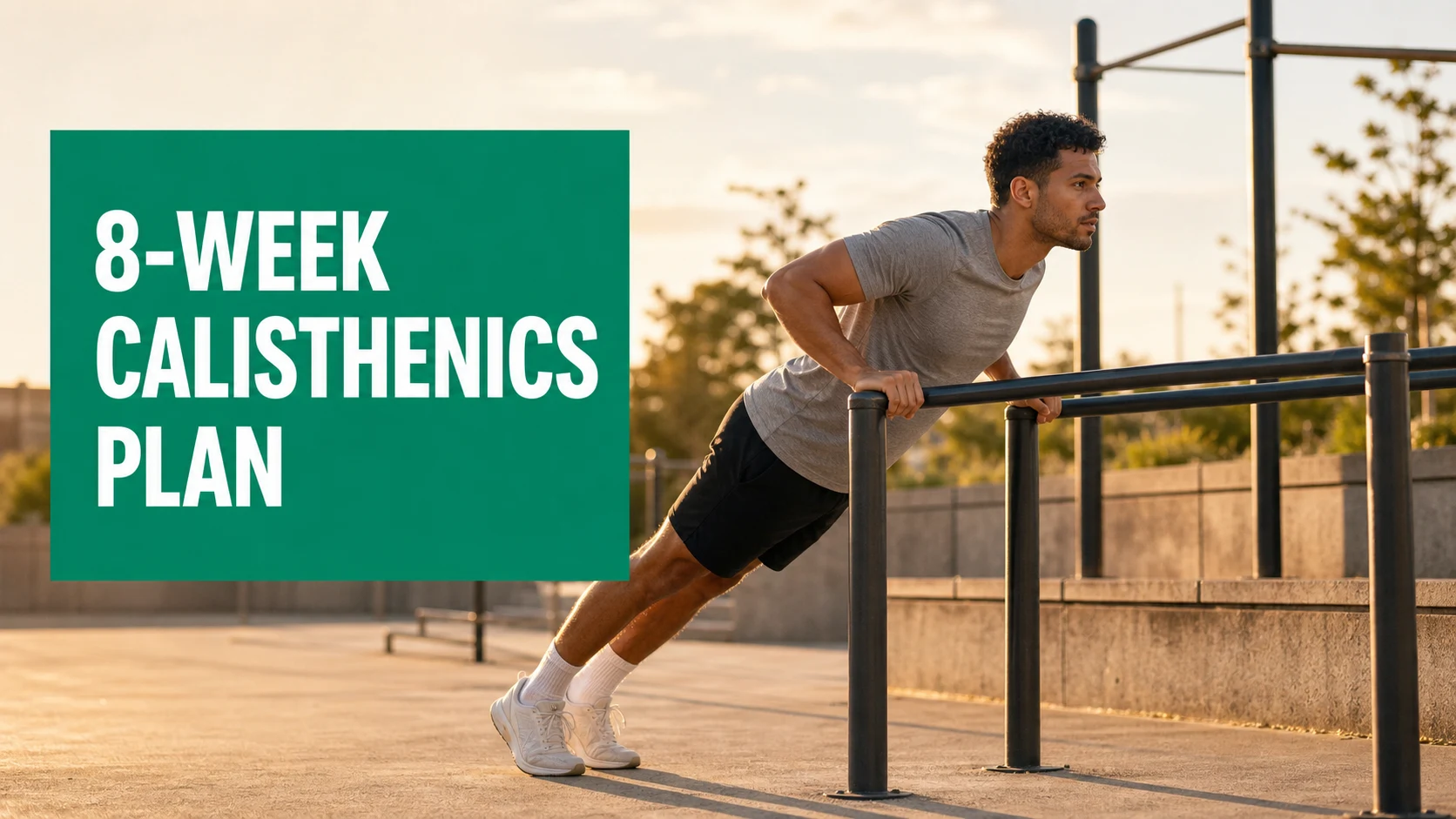
The best beginner calisthenics workout plan is simple enough to repeat: train your whole body three times per week on nonconsecutive days, alternate two workouts, and make one small progression only after you can complete every set with clean form.
This free eight-week plan takes 30–45 minutes per session. It includes exact sets and reps, easier and harder versions of every movement, a lighter week, and a clear rule for when to progress.
Who this is for: generally healthy adults who are new to structured calisthenics and can perform a pain-free chair squat and wall push-up. It is not a rehabilitation, pregnancy/postpartum, pediatric, or return-from-surgery program.
The 8-week plan at a glance
Train on three nonconsecutive days—for example, Monday, Wednesday, and Friday.
Week | Schedule | Training target | Effort |
1 — Learn | A / B / A | Rep moves: 2 × 6–8; timed holds: 2 × 15–20 sec | Stop with 3–4 clean reps left |
2 — Add reps | B / A / B | Rep moves: 2 × 8–12; timed holds: 2 × 20–25 sec | Stop with about 3 reps left |
3 — Add a set | A / B / A | Moves 1–3: reps 3 × 6–10 or holds 3 × 20–30 sec; moves 4–5: reps 2 × 8–12 or holds 2 × 20–30 sec | Stop with 2–3 reps left |
4 — Build | B / A / B | Moves 1–3: reps 3 × 8–12 or holds 3 × 25–35 sec; moves 4–5: reps 2 × 10–15 or holds 2 × 25–35 sec | Stop with about 2 reps left |
5 — Deload | A / B / A | Rep moves: 2 × 6–8; timed holds: 2 × 15–20 sec using the same variations | Lighter week; stop with 3–4 clean reps left |
6 — Progress | B / A / B | One progressed movement: 3 × 5–8 reps or 3 × 15–20 sec; unchanged rep moves: 3 × 8–12; unchanged holds: 3 × 20–30 sec | Stop with 2–3 reps left |
7 — Build again | A / B / A | Rep moves: 3 × 6–10; timed holds: 3 × 20–35 sec | Stop with about 2 reps left |
8 — Consolidate | B / A / B | First 2 sessions: rep moves 2 × 6–8 and holds 2 × 15–20 sec. Final session: compare with week 1 | No failure test; finish with 2 clean reps left |
Rest 60–120 seconds between sets. Harder rows and assisted pull-up work may need the full two minutes. Rep ranges are per side for unilateral movements, including split squats, reverse lunges, single-leg bridges and hinges, and dead bugs. Timed side-plank holds are also per side. When a progression changes from repetitions to a hold—such as a dead bug to a plank or a band pulldown to a scapular hang—use that week's timed-hold prescription.
Reps left means how many more good repetitions you believe you could complete before technique breaks down. The plan never requires training to failure.
What you need
Calisthenics uses bodyweight as resistance, but a balanced routine still needs a safe way to pull.
Use one of these:
- A resistance band with an anchor specifically designed and secured for exercise.
- Stable rings or a low bar installed for bodyweight training.
- A properly mounted pull-up bar.
- A gym cable or assisted pull-up machine if that is what you have.
Do not improvise rows with a towel in a door, a loose rail, or furniture that was not designed to hold your bodyweight. If you do not have a safe overhead setup, use a secure horizontal row or band row instead of pull-up progressions.
A mat is optional. A stable chair or bench can help with squats, split squats, and incline push-ups, but it should not slide or tip.
Workout A: squat, push, row, bridge, core
Use the easiest variation that lets you complete the prescribed range with controlled form.
Movement | Start here | Progression ladder |
1. Squat | Chair squat | Chair squat → bodyweight squat → 3-second lowering squat |
2. Horizontal push | Wall push-up | Wall → high incline → lower incline → floor push-up |
3. Horizontal pull | Band row | Band row → high ring/low-bar row → lower-body-angle row |
4. Glute/hinge | Glute bridge | Glute bridge → long-lever bridge → supported single-leg bridge |
5. Core | Dead bug | Dead bug → forearm plank → hollow-tuck hold |
Technique cues for Workout A
- Squat: keep the whole foot planted and use a depth you can control without pain.
- Push-up: keep your ribs and pelvis stacked instead of letting the hips sag. Raise the surface if the final repetitions lose shape.
- Row: pull the chest toward the handles or bar while keeping the body rigid. Make the body angle more upright to reduce difficulty.
- Bridge: finish by squeezing the glutes, not by arching the lower back.
- Core: breathe normally. End the set when you can no longer maintain the intended trunk position.

Choose the version that leaves clean repetitions in reserve. Progressing the angle is more useful than forcing sloppy floor push-ups.
Workout B: single-leg, vertical push, vertical pull, hinge, side core
Movement | Start here | Progression ladder |
1. Single-leg | Supported split squat | Supported split squat → reverse lunge → rear-foot-elevated split squat |
2. Vertical push | High-incline pike push-up | High incline → box pike → floor pike push-up |
3. Vertical pull | Band pulldown (reps) or scapular hang (timed hold) | Band pulldown/scapular hang → foot- or band-assisted pull-up → controlled eccentric |
4. Hinge | Bodyweight good morning | Good morning → kickstand hinge → supported single-leg hinge |
5. Side core | Knee side plank | Knee side plank → full side plank → longer-lever side plank |
Technique cues for Workout B
- Split squat: hold a stable support until you can control the lowering and stand without pushing off the back leg.
- Pike push-up: use an incline that feels comfortable at the wrists and shoulders. If it does not, repeat your best pain-free incline push-up instead.
- Pull-up preparation: keep the movement controlled. Do not jump into long eccentric repetitions before you can manage the position.
- Hinge: move the hips back while keeping the spine comfortable and the standing foot stable.
- Side plank: shorten the lever before letting the hips rotate or drop.
How to progress without guessing
Use this rule for every movement:
- Pick a variation you can perform at the bottom of the week's rep range.
- Keep the same variation until you hit the top of the range for every set in two separate workouts.
- Confirm that you still had about two clean reps left and did not shorten the range of motion.
- Progress one rung on that movement—or keep the variation and add only one repetition.
- If the new rung drops below the prescribed range, return to the previous version and keep building there longer.
Do not simultaneously add a harder variation, more sets, less rest, and faster tempo. One progression is enough.
The 2026 American College of Sports Medicine resistance-training guidance emphasizes consistency over complexity and notes that bodyweight and home-based resistance training can be effective. A small randomized study also found that four weeks of progressive push-up variations improved upper-body strength, but that does not mean this entire eight-week program has been clinically tested.
Your five-minute warm-up
Before each session:
- Walk or march for 60–90 seconds.
- Complete 5–8 controlled chair squats.
- Circle the shoulders and gently move the wrists through comfortable ranges.
- Perform 5 easy wall or incline push-ups.
- Perform 5 easy rows or band pulldowns.
- Do one lighter practice set of the first two exercises.
A warm-up should make the session feel more familiar, not tire you out.
What if you cannot do a push-up?
Start at the wall. If that is comfortable, move to a high counter or secure bar. Lower the incline gradually over several weeks.
A floor push-up is not the entry requirement. The correct starting variation is the one that lets you control the whole repetition and finish each set with clean reps left.
What if you cannot do a pull-up?
Most beginners cannot. You do not need to test one every workout.
Build pulling strength with secure band rows, ring rows, pulldowns, assisted pull-ups, and brief scapular hangs. Move to controlled eccentric pull-ups only when you can safely reach the top position and lower without dropping.
If there is no safe pulling setup, repeat a secure horizontal row. Do not sacrifice equipment safety to make the routine look more “pure.”
Can you combine this plan with running?
Yes. Put easy running, walking, or cycling on one or two days between strength sessions, and protect at least one full rest day.
A practical week might be:
- Monday: Workout A
- Tuesday: easy run or brisk walk
- Wednesday: Workout B
- Thursday: rest or easy mobility
- Friday: Workout A
- Saturday: easy cardio
- Sunday: full rest
If leg soreness keeps making your runs worse—or running fatigue keeps reducing your squat and lunge quality—reduce one activity before adding more. This guide on balancing cardio and strength training explains the tradeoff in more detail.
If a session feels too hard
Use the first option that solves the problem:
- Raise the push-up or pike-push-up surface.
- Make the row angle more upright.
- Use more assistance on pull-up work.
- Hold a stable support during split squats.
- Reduce the range to one you can control without pain.
- Complete one fewer set.
- Repeat the previous week instead of doubling missed sessions.
Missing one workout does not require starting over. Continue with the next scheduled session. If you miss a full week, repeat the last week you completed comfortably.
When to stop
Stop the session and seek appropriate medical assessment for chest pressure or pain, fainting, severe or unusual shortness of breath, or another acute concerning symptom. This is not a complete list.
Stop or modify an exercise for sharp, localized, or worsening joint or tendon pain. New muscle fatigue is different from pain that changes how you move.
If you are pregnant or postpartum, have a chronic condition, recently had surgery, are returning from injury, or have been advised to restrict exercise, ask a qualified clinician or physical therapist for individualized guidance before using a general program.
Personalize the plan
The plan above is intentionally simple. If you want a different schedule, available-equipment setup, or goal emphasis, use the free workout-plan generator below.
A plan only helps if it survives the week
This guide was created by the creators of BodyBuddy.
After you choose the plan you intend to follow, BodyBuddy can keep it visible, check in by text, log what happened, and follow up when a workout gets missed. It does not replace a qualified coach or decide whether pain is safe to train through.
If three weekly sessions are too much right now, this full-body circuit workout for beginners is a simpler single-session starting point. If you want to build your own long-term structure, use the guide to making a good gym routine.
Frequently asked questions
Is this calisthenics workout plan good for complete beginners?
It is designed for generally healthy adult beginners who can perform a pain-free chair squat and wall push-up. Use the first rung of each movement ladder and repeat a week when needed. Someone returning from surgery, injury, pregnancy, or a long period of inactivity may need a more individualized starting point.
How many days per week should a beginner do calisthenics?
This plan uses three nonconsecutive full-body sessions. That gives each movement regular practice while leaving recovery days between sessions. Two consistent sessions are still useful if three do not fit your week.
Is calisthenics really equipment-free?
Not always. Squats, bridges, and push-ups can use the floor, wall, or a stable surface, but balanced pulling work usually needs a secure band setup, rings, a low bar, a pull-up bar, or gym equipment. Avoid improvised anchors and furniture not designed for bodyweight loading.
Can calisthenics build muscle?
Bodyweight exercises can provide progressive resistance. Muscle-building results depend on training effort, progression, nutrition, recovery, and individual factors. As a movement becomes easy, use a harder leverage, a larger controlled range, more reps within the plan, or appropriate external resistance.
Should beginners train to failure?
No. This plan keeps roughly two or more clean repetitions in reserve. The ACSM's 2026 guidance does not treat momentary failure as necessary for the average healthy adult to make progress.
When should I move to a harder exercise?
Progress after you reach the top of the prescribed range for every set in two workouts, maintain the intended range of motion, and still have about two clean reps left. Progress one movement at a time.
Do I need to practice handstands or muscle-ups?
No. Those are skills, not prerequisites for getting stronger with calisthenics. First build repeatable squatting, pushing, pulling, hinging, and trunk-control patterns. Skill-specific work can come later with appropriate coaching and preparation.
Sources and methodology
This program combines general resistance-training principles with beginner-friendly bodyweight regressions. It is educational guidance, not individualized medical care or a promise of a specific result.
Put this into practice
Keep going with BodyBuddy
Use the next step that matches what you came here to do.
Related BodyBuddy guides
Want daily accountability?
BodyBuddy texts you every day.
Build a healthier relationship with food and movement, one text at a time.