Fitness|August 14, 2026|BodyBuddy Team
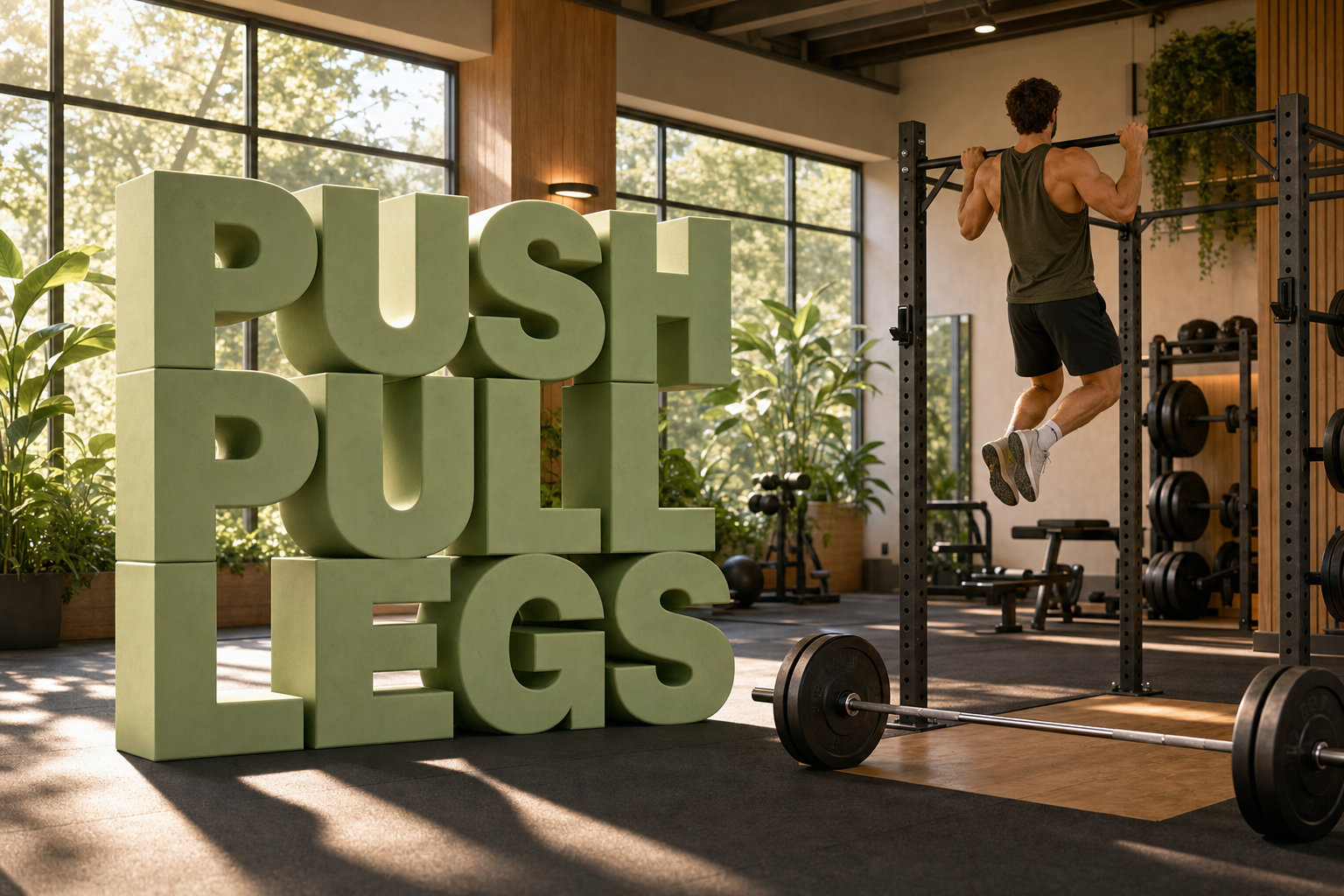
Push Pull Legs Workout Plan: Complete 3-Day and 6-Day PPL Routines
Use this complete push pull legs workout plan with exact exercises, sets, reps, rest, progression, and both 3-day and 6-day PPL schedules.

A push pull legs workout divides resistance training into three clear sessions:
- Push day: chest, shoulders, and triceps
- Pull day: back, rear delts, and biceps
- Leg day: quads, hamstrings, glutes, and calves
Run those sessions once each for a simple three-day PPL routine, or use A and B versions to train six days and give each area two weekly exposures.
Quick answer: Start with the three-day plan if consistency is still the main challenge. Use the six-day plan only when you already recover well from regular lifting and six sessions genuinely fit your week. More days are not automatically better.
Push pull legs schedule at a glance
Version | Example schedule | Exposure per area | Best fit |
3-day PPL | Mon Push, Wed Pull, Fri Legs | Once weekly | A simple, schedule-first introduction |
6-day PPL | Push A, Pull A, Legs A, Push B, Pull B, Legs B, Rest | Twice weekly | Experienced recreational lifters who recover well |
Recovery rotation | Push, Pull, Legs, Rest, then repeat | Twice every 8 days | People who want PPL frequency without six straight sessions |
The six-day week looks like this:

The workout order matters more than the weekday labels. Resume the next uncompleted session after a disruption.
The American College of Sports Medicine's 2026 resistance-training guidance emphasizes a useful principle: consistency and a plan that fits the person matter more than unnecessary complexity. PPL is not magic. Its value is that every exercise has an obvious home and the sequence is easy to repeat.
What is a push pull legs split?
A push pull legs split groups exercises by the job the muscles perform.
On push day, you press resistance away from you or overhead. On pull day, you pull resistance toward you or pull your body toward an anchor. On leg day, you train squat, hinge, lunge, knee-flexion, and calf patterns.
This structure can make a crowded program easier to organize:
- Presses and triceps work stay together.
- Rows, pulldowns, rear-deltoid work, and curls stay together.
- Lower-body work gets its own session rather than being squeezed in at the end.
- A and B workouts can change angles without changing the entire routine.
- Missed workouts are simple to handle because you continue the sequence.
The split does not determine results by itself. Weekly work, effort, exercise technique, recovery, and whether you actually follow the plan matter more.
Is PPL right for you?
PPL is a strong fit when you:
- Enjoy gym-based resistance training.
- Want a muscle-building plan with clear session themes.
- Prefer several focused exercises over full-body sessions.
- Can keep the main exercises stable long enough to measure progress.
- Will record loads and repetitions instead of choosing a new workout every day.
PPL may be a poor fit when you can train only two days, frequently miss sessions, or need a sport- or rehabilitation-specific program. If you have exactly four dependable days, the four-day upper/lower workout split is usually easier to recover from and schedule.
If you can train three days and want each major muscle group trained more often, a full-body routine can distribute the work more efficiently. The three-day PPL plan below remains useful when its simplicity is what helps you show up.
How to use the workout tables
The tables list working sets. Warm-up and practice sets are separate.
Before each session, do 5–10 minutes of easy movement and complete lighter practice sets for the first one or two compound exercises. Choose a load that leaves about 1–3 good repetitions in reserve at the end of most working sets.
- Rest 2–3 minutes after demanding compound sets.
- Rest 60–120 seconds after most isolation exercises.
- Pick one exercise when a row says “or”; do not perform every alternative.
- Use a controlled range you can repeat without sharp or escalating pain.
- Stop the set when your position or range changes substantially to finish the rep.
The ACSM summary of its 2026 position stand notes that training to momentary failure and complicated periodization are optional for the average healthy adult. You do not need to turn every set into a test.
3-Day Push Pull Legs Workout
Use any three consistent, nonconsecutive days. Monday, Wednesday, and Friday are examples—not requirements.
This is a manageable starting plan, not a claim that once-weekly exposure maximizes every outcome. Run it for at least six weeks before judging it, unless pain, poor recovery, or another clear problem calls for an earlier change.
Monday: Push day workout
Exercise | Working sets | Reps | Rest |
Barbell or dumbbell bench press | 3 | 6–10 | 2–3 min |
Incline dumbbell press | 3 | 8–12 | 90–120 sec |
Seated dumbbell shoulder press | 2 | 8–12 | 2 min |
Cable or dumbbell lateral raise | 3 | 12–20 | 60–90 sec |
Triceps pressdown | 3 | 10–15 | 60–90 sec |
Wednesday: Pull day workout
Exercise | Working sets | Reps | Rest |
Lat pulldown or assisted pull-up | 3 | 6–10 | 2 min |
Chest-supported row | 3 | 8–12 | 2 min |
Single-arm cable or dumbbell row | 2 | 10–15 | 90 sec |
Rear-delt fly | 3 | 12–20 | 60–90 sec |
Dumbbell or cable curl | 3 | 8–12 | 60–90 sec |
Friday: Leg day workout
Exercise | Working sets | Reps | Rest |
Squat or leg press | 3 | 6–10 | 2–3 min |
Romanian deadlift | 3 | 8–12 | 2–3 min |
Bulgarian split squat | 2 | 8–12 per side | 90–120 sec |
Leg extension | 2 | 10–15 | 60–90 sec |
Leg curl | 2 | 10–15 | 60–90 sec |
Calf raise | 3 | 10–20 | 60–90 sec |
Dead bug or cable crunch | 2 | 8–15 | 60–90 sec |
If that first week creates soreness that changes normal movement for several days, reduce one set from each exercise rather than forcing the full dose.
Push Day Workout: Chest, Shoulders, and Triceps
The push session should cover a horizontal press, a second chest angle, an overhead press, side-deltoid work, and direct triceps work.
The bench press and incline press already train the front deltoids and triceps. That is why the plan does not need four additional shoulder presses or several triceps exercises. More overlap is still more work.
Useful substitutions:
If this does not fit | Use this instead |
Barbell bench press | Dumbbell bench press or chest-press machine |
Incline dumbbell press | Incline machine press or elevated push-up |
Seated shoulder press | Neutral-grip dumbbell or machine press |
Cable lateral raise | Dumbbell lateral raise |
Pressdown | Overhead cable extension or close-grip push-up |
Keep the replacement stable for several sessions. A substitution is useful when it fits your equipment or body better—not when it prevents comparison with last week.
Pull Day Workout: Back, Rear Delts, and Biceps
The pull session combines vertical and horizontal pulling. Pulldowns or pull-ups emphasize a vertical path; rows add horizontal pulling. Rear-deltoid work and curls finish the session without requiring another heavy compound.
Useful substitutions:
If this does not fit | Use this instead |
Pull-up | Assisted pull-up or lat pulldown |
Chest-supported row | Seated cable row or supported dumbbell row |
Single-arm cable row | One-arm dumbbell row |
Rear-delt fly | Reverse pec deck or band pull-apart |
Dumbbell curl | Cable curl or EZ-bar curl |
If grip limits every back set before the target muscles are challenged, first check load and technique. Straps can be a later option, but they should not hide a load you cannot control.
Leg Day Workout: Quads, Hamstrings, Glutes, and Calves
Leg day needs more than a squat. The plan pairs a knee-dominant movement with a hip hinge, unilateral work, knee extension, knee flexion, and calf work.
Useful substitutions:
If this does not fit | Use this instead |
Back squat | Leg press, hack squat, or goblet squat |
Romanian deadlift | Dumbbell Romanian deadlift or cable pull-through |
Bulgarian split squat | Reverse lunge or supported split squat |
Leg extension | An additional controlled squat-pattern set |
Leg curl | Stability-ball or slider leg curl |
Standing calf raise | Seated or leg-press calf raise |
Balance is not the goal of a split squat. Hold a stable support when that lets the working leg do better work.
6-Day Push Pull Legs Workout
Use this version when you already lift consistently, sleep and recover adequately, and can complete six sessions without crowding out the rest of your life.
The schedule places roughly 72 hours between sessions for the same area:
Day | Session |
Monday | Push A |
Tuesday | Pull A |
Wednesday | Legs A |
Thursday | Push B |
Friday | Pull B |
Saturday | Legs B |
Sunday | Rest |
Six consecutive lifting days are optional. If fatigue builds, use a rolling Push / Pull / Legs / Rest rhythm instead. That creates an eight-day cycle with no more than three training days in a row.
Push A
Exercise | Sets | Reps |
Bench press | 3 | 6–10 |
Incline dumbbell press | 2 | 8–12 |
Seated overhead press | 2 | 6–10 |
Lateral raise | 3 | 12–20 |
Triceps pressdown | 3 | 10–15 |
Pull A
Exercise | Sets | Reps |
Pull-up or lat pulldown | 3 | 6–10 |
Chest-supported row | 3 | 8–12 |
Rear-delt fly | 3 | 12–20 |
Incline dumbbell curl | 3 | 8–12 |
Legs A
Exercise | Sets | Reps |
Back squat or leg press | 3 | 6–10 |
Romanian deadlift | 3 | 8–12 |
Bulgarian split squat | 2 | 8–12 per side |
Leg curl | 2 | 10–15 |
Calf raise | 3 | 10–20 |
Optional cable crunch | 2 | 10–15 |
Push B
Exercise | Sets | Reps |
Incline bench press | 3 | 6–10 |
Machine or dumbbell chest press | 2 | 8–12 |
Dumbbell shoulder press | 2 | 8–12 |
Cable lateral raise | 3 | 12–20 |
Overhead triceps extension | 3 | 10–15 |
Pull B
Exercise | Sets | Reps |
Chin-up or neutral-grip pulldown | 3 | 6–10 |
One-arm cable row | 3 | 8–12 |
Reverse pec deck | 3 | 12–20 |
Hammer curl | 3 | 10–15 |
Legs B
Exercise | Sets | Reps |
Leg press or hack squat | 3 | 8–12 |
Hip thrust | 2 | 8–12 |
Reverse lunge | 2 | 8–12 per side |
Seated leg curl | 3 | 10–15 |
Calf raise | 3 | 10–20 |
Optional hanging knee raise | 2 | 8–15 |
The week provides approximately 10 direct sets for chest, 12 for back, 10 for the front and side delts, 6 for rear delts, 6 each for biceps and triceps, 10 knee-dominant lower-body sets, 8 hamstring sets, and 6 calf sets. Compound exercises also train several muscles indirectly, so set accounting is approximate.
ACSM describes roughly 10 weekly sets per muscle group as a hypertrophy-oriented target. This template reaches that neighborhood for several muscle groups once indirect compound work is considered, while arms and calves receive fewer direct sets. A 2026 dose-response meta-regression found that more weekly resistance-training volume generally produced greater gains, but with diminishing returns.
Make this PPL plan fit your equipment and schedule
If dumbbells are your main equipment, use the complete dumbbell workout plan for exact 3-day and 4-day at-home sessions with no-bench substitutions.
Use the free generator to create a starting plan around your training days, equipment, experience, and goals:
The generator provides general fitness guidance. Review the output against your current ability, equipment, health, and any instructions from a qualified professional.
How to progress a PPL workout
Use double progression:
- Choose a load that reaches the bottom of the range with about two good reps left.
- Keep the load stable while adding controlled repetitions over later sessions.
- When every working set reaches the top of the range with 1–2 reps in reserve, add the smallest practical load increase—usually about 2–5%.
- Return to the bottom of the range and build again.
For a 3 × 6–10 bench press, you might move from 8/8/7 to 9/8/8, then eventually 10/10/10. Only then would you add load and return near six reps.

Add repetitions first. Add load after the top of the range is repeatable with the same technique.
Do not add weight when the extra repetitions came from a shorter range or a changed position. If a lift regresses for two consecutive exposures, hold the load and review sleep, soreness, exercise setup, and total work.
Record the date, exercise, load, repetitions, and one useful note. The Apple Notes workout template gives you a copyable format if you do not already have a log.
What to do when recovery stalls
One poor session is information, not a crisis. Several declining sessions across different exercises are a clearer signal.
Use an easier week when persistent fatigue, joint soreness, and broad performance declines appear together:
- Complete about half the normal working sets.
- Keep 3–4 repetitions in reserve.
- Do not test personal records.
- Resume normal training only when everyday movement and warm-up performance feel normal again.
If six days repeatedly creates the problem, reduce frequency. The 2023 network meta-analysis of resistance-training prescriptions found that many different prescriptions improved strength and muscle growth. The routine you can recover from and repeat is more useful than the most aggressive template.
How to handle a missed PPL workout
Do not double sessions or restart the week.
Resume the next uncompleted workout and continue the sequence. If Wednesday Legs A is missed, do Legs A on the next available training day. Push B follows after that.
The weekday label is a convenience. Preserving the order prevents one area from being skipped every time life interrupts the same day.
For a five-day week, use the same rolling rule. Train the next five sessions in sequence, take your planned rest days, then continue where you stopped the following week. Do not force a fixed five-day calendar that repeatedly gives one area less work. If you want a fixed weekday schedule with one major body-part focus per session, use the complete five-day bro split workout plan; that is a body-part split, not a five-day PPL rotation.
PPL vs. the Arnold split vs. upper/lower
Split | Main organization | Common frequency | Best reason to choose it |
Push/pull/legs | Pressing, pulling, lower body | 3 or 6 days | Clear movement-based sessions |
Arnold split | Chest/back, shoulders/arms, legs | Usually 6 days | You enjoy opposing-muscle pairings and bodybuilding work |
Upper/lower | Upper body, lower body | Usually 4 days | Fewer weekly sessions and simpler recovery |
The modern Arnold split workout plan and PPL both use six sessions in their standard form, but the pairings differ. The upper/lower plan is often the cleaner choice when four days fit more reliably.
None is universally superior. Choose the structure that fits your week, covers your goals, and makes progression easy to measure.
Start daily accountability for this plan with BodyBuddy
A workout table helps only when it survives contact with a real week.
You can bring your selected workout plan into BodyBuddy, then have BodyBuddy carry it into proactive text-message accountability—what is scheduled, what was completed, what changed, and what comes next. That is useful when the problem is not finding another routine; it is following the one you chose.
If you are still deciding how many days you can sustain, read how to make a good gym routine before committing to six.
Frequently asked questions
Is push pull legs good for beginners?
It can be. The three-day version gives every session a simple purpose. A full-body plan may train each major muscle more frequently on the same three-day schedule, so choose PPL because the structure helps you stay consistent—not because it is mandatory.
Is a 3-day or 6-day PPL routine better?
The three-day version is easier to schedule and recover from. The six-day version distributes more weekly work and trains each area twice. Six days is appropriate only when you already tolerate regular lifting and can sustain the schedule.
Can push pull legs build muscle?
Yes. PPL can support muscle growth when weekly work, effort, exercise selection, food, and recovery are appropriate. The split is an organizational tool; it does not replace progressive training.
Can I run PPL five days per week?
Yes. Use a rolling sequence rather than resetting every Monday. Complete the next five sessions, take your planned rest days, and continue with the next uncompleted session the following week.
What order should PPL workouts follow?
Push, pull, and legs is conventional, but the starting point can change. Keep the sequence consistent and place the session you most want to improve after a rest day when practical.
How long should a PPL workout take?
Most sessions here take about 45–75 minutes, depending on warm-ups, rest periods, equipment availability, and whether you are using the three-day or six-day volume.
Should every set go to failure?
No. Most sets should finish with 1–3 good repetitions available. A systematic review and meta-analysis found that training to failure was not required for strength or hypertrophy outcomes when programs were otherwise comparable.
Where does cardio fit in a PPL routine?
Use easy or moderate cardio after lifting or on separate days when it does not compromise your main training. Start with a dose you already tolerate. Avoid adding several hard intervals at the same time as a major increase in lifting volume.
Does PPL train the core?
Compound lifts require trunk control, but direct core work can still be useful. Add two controlled sets after one or both leg sessions. More is not automatically better.
How long should I run the same PPL plan?
Use six to eight weeks as a review point, not an expiration date. Continue when performance and recovery are moving in the right direction. Change exercises only when equipment, comfort, goals, or a genuine plateau calls for it.
Safety
This plan is general education for healthy adults, not rehabilitation or medical advice. Choose exercises, loads, and ranges appropriate to your ability. Build gradually, use rack safeties or a competent spotter when appropriate, and stop for sharp or escalating pain, chest pain, faintness, or unusual severe breathlessness.
If you have an active injury, concerning symptoms, pregnancy or postpartum considerations, or a chronic condition that affects exercise, get individualized guidance from a qualified professional.
The CDC recommends muscle-strengthening activity on at least two days per week that works all major muscle groups. A six-day bodybuilding-style split is one optional way to organize more training—not a public-health requirement.
Sources
Put this into practice
Keep going with BodyBuddy
Use the next step that matches what you came here to do.
Want daily accountability?
BodyBuddy texts you every day.
Build a healthier relationship with food and movement, one text at a time.