
Fitness|August 14, 2026|BodyBuddy Team
Dumbbell Workout Plan: Complete 3-Day and 4-Day Routines at Home
Follow a complete dumbbell workout plan at home with 3-day and 4-day routines, exact sets and reps, no-bench swaps, and a printable 12-week guide.
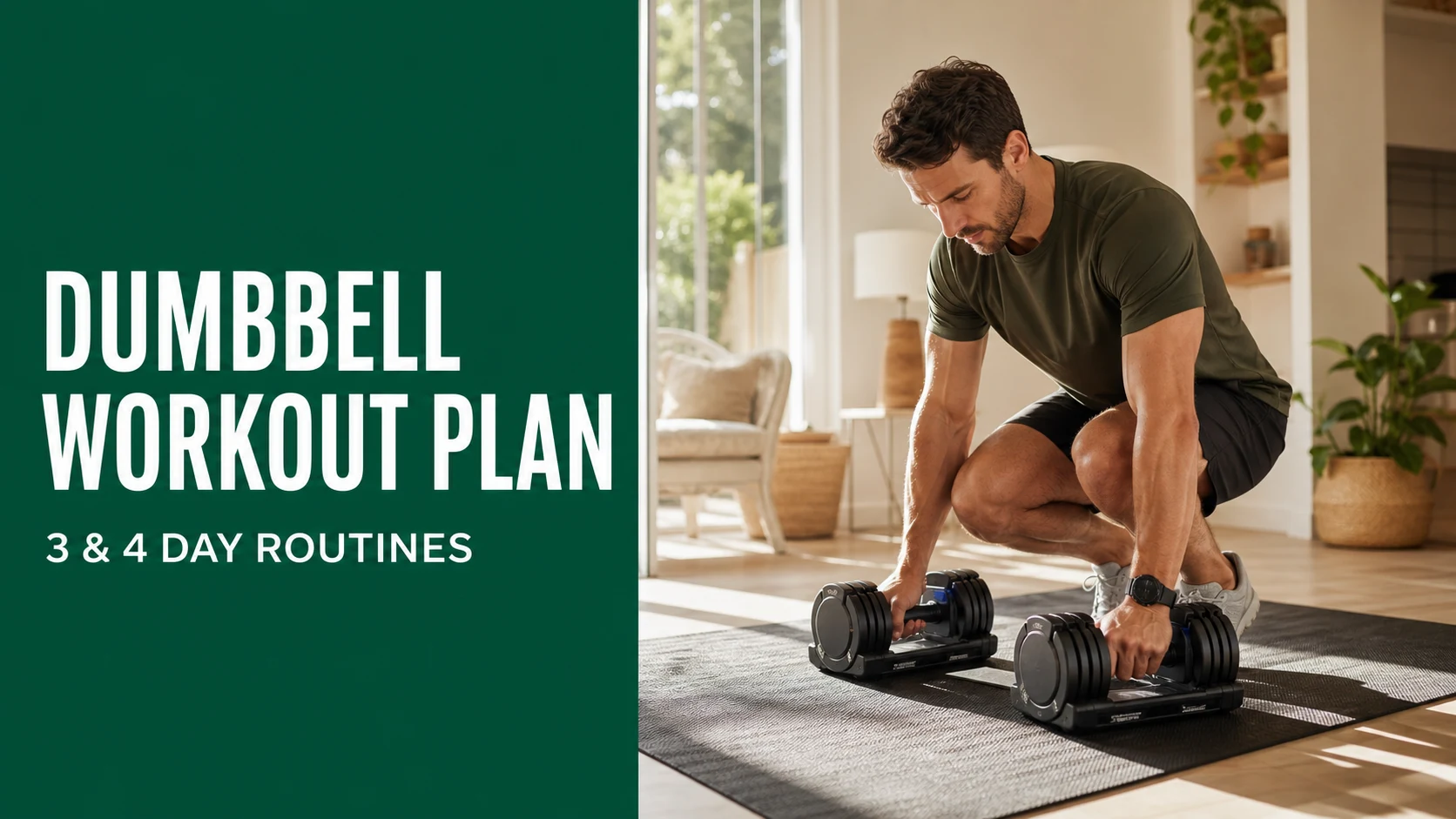
A useful dumbbell workout plan does not need dozens of exercises or a fully equipped gym. It needs a repeatable schedule, enough work for every major muscle group, and a progression rule you can use when the same weights start to feel easier.
This guide gives you two complete options:
- A 3-day full-body plan for beginners and busy schedules
- A 4-day upper/lower plan for people who already train consistently and want more weekly work
Both versions work at home with dumbbells and floor space. A bench is optional.
Quick answer: If you are unsure which plan to choose, start with the three-day routine for 12 weeks. Train on nonconsecutive days, stop most sets with 1-3 good repetitions left, and add repetitions before adding weight.
Dumbbell workout plan at a glance
Plan | Example schedule | Session length | Best fit |
3-day full body | Mon, Wed, Fri | 45-60 min | Beginners, home training, busy weeks |
4-day upper/lower | Mon Upper, Tue Lower, Thu Upper, Fri Lower | 45-70 min | Consistent lifters who recover well |

The weekdays are examples. Preserve the workout order even when your calendar changes.
The printable includes both routines, the 12-week roadmap, the progression rule, and a no-bench substitution chart.
The American College of Sports Medicine's 2026 resistance-training guidance emphasizes that regular participation matters more than unnecessary complexity. It also notes that home-based training and different forms of resistance can improve strength and physical function. Dumbbells are not a compromise when they give you enough resistance to train the movements you need.
Should you use the 3-day or 4-day dumbbell plan?
Use the three-day plan when:
- You are new to planned resistance training.
- Three sessions fit your normal week more reliably than four.
- You want to practice each major movement several times per week.
- Your available dumbbells are limited and you need a simple progression system.
- You are returning after time away and want a manageable starting dose.
Use the four-day plan when:
- You already complete three resistance-training sessions most weeks.
- Upper/lower sessions fit your calendar better than full-body sessions.
- You want more exercise variety and direct arm, shoulder, or calf work.
- You recover well between sessions for the same area.
Choose one version. Do not combine the three-day and four-day routines into a seven-session week.
Four days are not automatically better. A 2024 systematic review and meta-analysis found similar strength and muscle-growth outcomes for split and full-body routines when weekly volume was equated. Choose the schedule you can actually repeat.
What equipment do you need?
At minimum:
- One pair of dumbbells, or one adjustable dumbbell
- Enough clear floor space to lie down and step backward safely
- Supportive shoes when the floor is slippery
- A stable chair, couch edge, or wall only when a substitution specifically uses it
Adjustable dumbbells make progression easier because small load changes are available. Fixed dumbbells still work; the progression section below explains what to do when the next pair is too heavy.
A bench is useful for supported rows and bench presses, but it is not required. Floor presses, standing presses, split squats, Romanian deadlifts, and supported one-arm rows cover the same broad movement needs without one.
Dumbbell-only training does have limits. Rows train the back but do not perfectly replace a vertical pull such as a pulldown or pull-up, and Romanian deadlifts do not replace loaded knee-flexion work such as a leg curl. If you have a resistance band or pull-up bar, you can add two controlled sets of a pulldown or assisted pull-up after a row and two sets of band leg curls after a lower-body session. Treat those as additions, not as evidence that every tool produces an identical stimulus.
How to use the workout tables
The listed sets are working sets. Warm-up and practice sets are separate.
Before each workout, complete 5-10 minutes of easy movement and one or two lighter practice sets for the first squat, press, row, or hinge. Then:
- Finish most working sets with about 1-3 good repetitions in reserve.
- Rest 2 minutes after squats, presses, rows, lunges, and Romanian deadlifts.
- Rest 60-90 seconds after lateral raises, curls, triceps work, carries, and core work.
- Pick one movement when a row says "or." Do not perform every alternative.
- Use a range you can control without sharp or escalating pain.
- Stop the set when you have to shorten the range or substantially change position to finish the repetition.
The ACSM practical summary notes that complicated periodization and training to momentary failure are optional for the average healthy adult. You do not need to turn each home workout into a test.
3-Day Full-Body Dumbbell Workout Plan
Train on three nonconsecutive days. Monday, Wednesday, and Friday are examples, not requirements.
Workout A
Exercise | Working sets | Reps | Rest |
Goblet squat | 3 | 8-12 | 2 min |
Dumbbell floor press | 3 | 8-12 | 2 min |
One-arm dumbbell row | 3 | 8-12 per side | 2 min |
Dumbbell Romanian deadlift | 3 | 8-12 | 2 min |
Standing dumbbell shoulder press | 2 | 8-12 | 90-120 sec |
Suitcase carry | 2 | 30-45 sec per side | 60-90 sec |
Workout B
Exercise | Working sets | Reps | Rest |
Dumbbell reverse lunge | 3 | 8-12 per side | 2 min |
Close-grip dumbbell floor press | 3 | 8-12 | 2 min |
Two-dumbbell bent-over row | 3 | 8-12 | 2 min |
Dumbbell glute bridge | 3 | 10-15 | 90-120 sec |
Dumbbell lateral raise | 2 | 12-20 | 60-90 sec |
Dead bug | 2 | 8-12 per side | 60 sec |
Workout C
Exercise | Working sets | Reps | Rest |
Dumbbell split squat | 3 | 8-12 per side | 2 min |
Neutral-grip dumbbell floor press | 3 | 8-12 | 2 min |
Supported one-arm dumbbell row | 3 | 10-15 per side | 2 min |
Dumbbell Romanian deadlift | 3 | 8-12 | 2 min |
Arnold press or shoulder press | 2 | 8-12 | 90-120 sec |
Hammer curl | 2 | 10-15 | 60-90 sec |
Overhead dumbbell triceps extension | 2 | 10-15 | 60-90 sec |
This week provides about nine direct sets each for the chest, back, and knee-dominant lower body; nine sets across the main hip-hinge and glute patterns; and six direct shoulder sets before counting pressing overlap. The arms also work during presses and rows, with two additional direct sets each in Workout C.
That is a moderate starting template, not a universal optimum. The ACSM describes roughly 10 weekly sets per muscle group as a hypertrophy-oriented target, while emphasizing that training should be individualized. Start with the plan you can recover from and add work only when your performance and schedule support it.
4-Day Dumbbell-Only Workout Plan
Use an upper/lower schedule with at least one rest day between the two weekly upper sessions and between the two lower sessions.
Upper A
Exercise | Working sets | Reps |
Dumbbell floor press | 4 | 6-10 |
One-arm dumbbell row | 4 | 8-12 per side |
Standing dumbbell shoulder press | 2 | 8-12 |
Dumbbell lateral raise | 2 | 12-20 |
Dumbbell curl | 2 | 10-15 |
Lying dumbbell triceps extension | 2 | 10-15 |
Lower A
Exercise | Working sets | Reps |
Goblet squat | 3 | 8-12 |
Dumbbell Romanian deadlift | 3 | 8-12 |
Dumbbell reverse lunge | 2 | 8-12 per side |
Standing dumbbell calf raise | 3 | 10-20 |
Suitcase carry | 2 | 30-45 sec per side |
Upper B
Exercise | Working sets | Reps |
Neutral-grip dumbbell floor press | 4 | 8-12 |
Two-dumbbell bent-over row | 4 | 8-12 |
Arnold press | 2 | 8-12 |
Bent-over rear-delt raise | 2 | 12-20 |
Hammer curl | 2 | 10-15 |
Overhead dumbbell triceps extension | 2 | 10-15 |
Lower B
Exercise | Working sets | Reps |
Dumbbell split squat | 3 | 8-12 per side |
Dumbbell deadlift | 3 | 6-10 |
Dumbbell glute bridge | 3 | 10-15 |
Dumbbell lateral lunge | 2 | 8-12 per side |
Standing dumbbell calf raise | 3 | 10-20 |
Dead bug | 2 | 8-12 per side |
The four-day version provides eight direct chest sets, eight direct back sets, eight direct shoulder sets, four direct sets each for biceps and triceps, 10 knee-dominant lower-body sets, nine hinge or bridge sets, and six calf sets. Compound exercises create additional overlap.
If four sessions begin to disappear from your calendar, switch to the three-day plan rather than compressing four workouts into fewer days. The complete four-day upper/lower split is another option when you sometimes have access to barbells, cables, or machines.
How to run this dumbbell plan for 12 weeks
Do not replace the routine every two weeks. Keep the main exercises stable long enough to see whether repetitions, load, control, or comfort are improving.
Weeks | Focus | How to train |
1-2 | Learn | Use 2 working sets per exercise, leave about 3 good reps, and record your starting loads |
3-6 | Build | Use the listed sets, apply double progression, and leave 1-3 good reps |
7 | Easier week | Complete about half the listed sets and leave 3-4 good reps |
8-11 | Build again | Resume the listed sets and continue from your established loads |
12 | Review | Reduce sets by about one-third, use clean repeatable reps, and review the next block without max testing |
Repeat a week instead of advancing when soreness changes normal movement for several days, several exercises regress, or your technique is becoming less repeatable.
How to choose the right dumbbell weight
Choose a weight that lets you reach the bottom of the listed range with the same position from the first repetition to the last and about 1-3 good repetitions still available.
The correct dumbbells will differ by exercise. A weight that challenges your Romanian deadlift may be far too heavy for a lateral raise. That is normal.
If you cannot reach the bottom of the range, reduce the weight or use an easier variation. If you can exceed the top of the range easily while maintaining the target effort, progress the exercise.
Do not use a calculator to force one pair of dumbbells onto every movement. Use the repeated set performance in your own log.
How to progress when dumbbell weight jumps are large
Use double progression:
- Keep the same load while adding controlled repetitions across sessions.
- When every working set reaches the top of the range with 1-2 good reps left, increase the load.
- Return near the bottom of the range and build again.
For a 3 x 8-12 floor press, a progression might look like this:
Session | Load | Repetitions |
1 | 25 lb each | 10 / 9 / 8 |
2 | 25 lb each | 11 / 10 / 9 |
3 | 25 lb each | 12 / 12 / 12 |
4 | 30 lb each | 8 / 8 / 8 |

Add repetitions first. Increase the dumbbell only after the top of the range is repeatable.
If the next pair is too large a jump:
- Use the heavier dumbbell for the first set and the current load for the remaining sets.
- Add the heavier load to another set only after the first one reaches the target range cleanly.
- Use a single-arm or single-leg version when it is appropriate and stable.
- Add a brief pause in the hardest controlled position, then keep that variation consistent.
- Consider small compatible add-on weights when the equipment manufacturer allows them.
Do not add repetitions, sets, slower tempo, and load at the same time. Change one variable and record it.
Beginner dumbbell exercise cues
Goblet squat
Hold one dumbbell close to your chest. Let the knees and hips bend together, keep the whole foot supported, and descend only as far as you can control. Stand without letting the weight drift away from you.
Dumbbell floor press
Lie on the floor with knees bent. Keep the upper arms at a comfortable angle from the torso, lower until the upper arms gently meet the floor, pause without bouncing, and press the dumbbells over the shoulders.
One-arm dumbbell row
Support the free hand on a stable surface or your thigh. Keep the trunk still, pull the elbow toward the hip, and lower until the shoulder blade can move without twisting your torso.
Dumbbell Romanian deadlift
Keep the dumbbells close to your legs. Push the hips backward with soft knees, stop when your hamstrings limit the motion or your back position changes, then stand by driving the floor away and bringing the hips through.
Reverse lunge or split squat
Use a wall or stable support when balance is the limiting factor. Lower under control, keep the front foot planted, and use a range that does not create sharp or escalating pain.
Standing dumbbell shoulder press
Start with the weights near shoulder height. Keep the ribs and pelvis controlled as you press overhead. If you have to lean far backward, reduce the load or use a half-kneeling one-arm press.
Dumbbell workout at home without a bench
Exercise that uses a bench | No-bench substitution |
Dumbbell bench press | Dumbbell floor press |
Incline dumbbell press | Standing low-to-high squeeze press or elevated push-up |
Chest-supported row | Supported one-arm row or two-dumbbell bent-over row |
Seated shoulder press | Standing or half-kneeling shoulder press |
Hip thrust on bench | Dumbbell glute bridge from the floor |
Bulgarian split squat | Split squat or reverse lunge |
The floor press uses a shorter range than a bench press. That is not automatically a problem; it is simply a different exercise. Progress it on its own terms instead of pretending the loads transfer exactly.
How to use the plan with one dumbbell
Complete all repetitions on one side, then switch sides for rows, presses, split squats, reverse lunges, carries, curls, and triceps extensions.
For goblet squats, Romanian deadlifts, glute bridges, and calf raises, hold the dumbbell with both hands. If one dumbbell is too light for a two-leg movement, use a stable single-leg variation or a slower paused version before adding excessive repetitions.
Expect one-dumbbell sessions to take longer because the sides are trained separately. Rest after both sides are complete.
Make the plan fit your equipment and schedule
Use the free generator to create a starting routine around your available dumbbells, training days, experience, and goals:
The generator provides general fitness guidance. Review the result against your current ability, equipment, health, and any instructions from a qualified professional.
What to do when you miss a workout
Do not double the next session or restart the entire plan.
Resume the next uncompleted workout. If you miss Workout B, complete Workout B on the next available day and continue to Workout C after that. The sequence matters more than the weekday label.
If the four-day plan repeatedly becomes three days, move to the three-day routine. That is a plan-design decision, not a failure.
Record the date, exercise, dumbbell weight, repetitions, and one useful note. The Apple Notes workout template gives you a copyable log if you do not already use one.
Start daily accountability for this plan with BodyBuddy
A printable routine can tell you what to do. It cannot notice that Wednesday's workout quietly moved to "tomorrow" three times.
Bring your chosen plan into BodyBuddy and BodyBuddy can carry it into proactive text-message accountability: what is scheduled, what happened, what changed, and what comes next. That is useful when the problem is no longer finding another workout; it is following the plan you selected.
If you are still deciding how many days fit, read how to make a good gym routine before choosing four.
Frequently asked questions
Is a dumbbell-only workout plan effective?
Yes. Dumbbells can train the main squat, hinge, lunge, press, pull, carry, calf, and arm patterns. Results depend on appropriate effort, weekly work, progression, recovery, and consistency rather than the equipment label alone.
Is this dumbbell workout plan good for beginners?
The three-day version is designed as a manageable general starting point for healthy adults. Use two sets per exercise during the first two weeks, learn the movements, and increase only when your repetitions remain controlled.
Can I build muscle with dumbbells at home?
Yes, when the exercises remain challenging and weekly work progresses. The ACSM notes that home-based resistance training and different equipment types can produce meaningful improvements. Very strong lifters may eventually need heavier dumbbells or additional equipment for some movements.
Do women need a different dumbbell workout plan?
Not by default. Exercise selection should follow the person's goals, experience, comfort, available equipment, recovery, and relevant health considerations—not a generic men's or women's label. The same three-day or four-day structure can be adjusted to the individual.
What dumbbell weight should a beginner use?
There is no single correct starting number. Use a load that reaches the bottom of the target range with stable technique and about 1-3 good repetitions left. Expect different starting weights for squats, rows, presses, raises, and curls.
Can I do the same dumbbell workout three times per week?
You can, but alternating the A, B, and C sessions distributes movement variations and direct work more evenly. If you prefer one repeated session, cover a knee-dominant exercise, hip hinge, press, row, shoulder movement, and carry or core exercise.
How long should a dumbbell workout take?
Most sessions here take 45-70 minutes, depending on warm-ups, rest, equipment changes, and whether you train one side at a time.
Can I use this plan for weight loss?
Resistance training can be part of a weight-management plan, but it does not determine energy balance by itself. Use this routine to build or maintain strength and pair it with nutrition, sleep, and aerobic activity appropriate to you. Read the beginner guide to strength training for weight loss for that specific goal.
Should every set go to failure?
No. Most working sets should finish with 1-3 good repetitions available. A systematic review and meta-analysis found that training to failure was not required for strength or muscle-growth outcomes when programs were otherwise comparable.
How long should I follow the same dumbbell plan?
Twelve weeks is a useful review point, not an expiration date. Continue when loads, repetitions, control, and recovery are improving. Change an exercise when equipment, comfort, goals, or a genuine plateau calls for it—not because the calendar demands novelty.
Safety
This plan is general education for healthy adults, not individualized medical or rehabilitation advice. Select loads, ranges, and exercises appropriate to your ability. Build gradually and keep the training area clear.
Lock adjustable dumbbells before lifting and confirm plates or selectors are secure before any overhead or floor-press set.
If you are pregnant, recently postpartum, returning after surgery, managing a chronic condition that affects exercise, or dealing with a current injury, get individualized guidance from a qualified professional.
Stop and seek urgent assessment for chest pain or pressure, fainting, severe or unusual shortness of breath, or another acute concerning symptom. Stop or modify an exercise for sharp, localized, or worsening pain.
The CDC recommends muscle-strengthening activity on at least two days per week that works all major muscle groups. The three-day and four-day schedules here are optional ways to organize more structured resistance training, not public-health requirements.
Sources
Put this into practice
Keep going with BodyBuddy
Use the next step that matches what you came here to do.
Want daily accountability?
BodyBuddy texts you every day.
Build a healthier relationship with food and movement, one text at a time.