
Fitness|August 14, 2026|BodyBuddy Team
4-Day Workout Split: Free Upper/Lower Plan + Progression
Follow a complete 4-day upper/lower workout split with exercises, sets, reps, progression rules, substitutions, and a free custom plan generator.
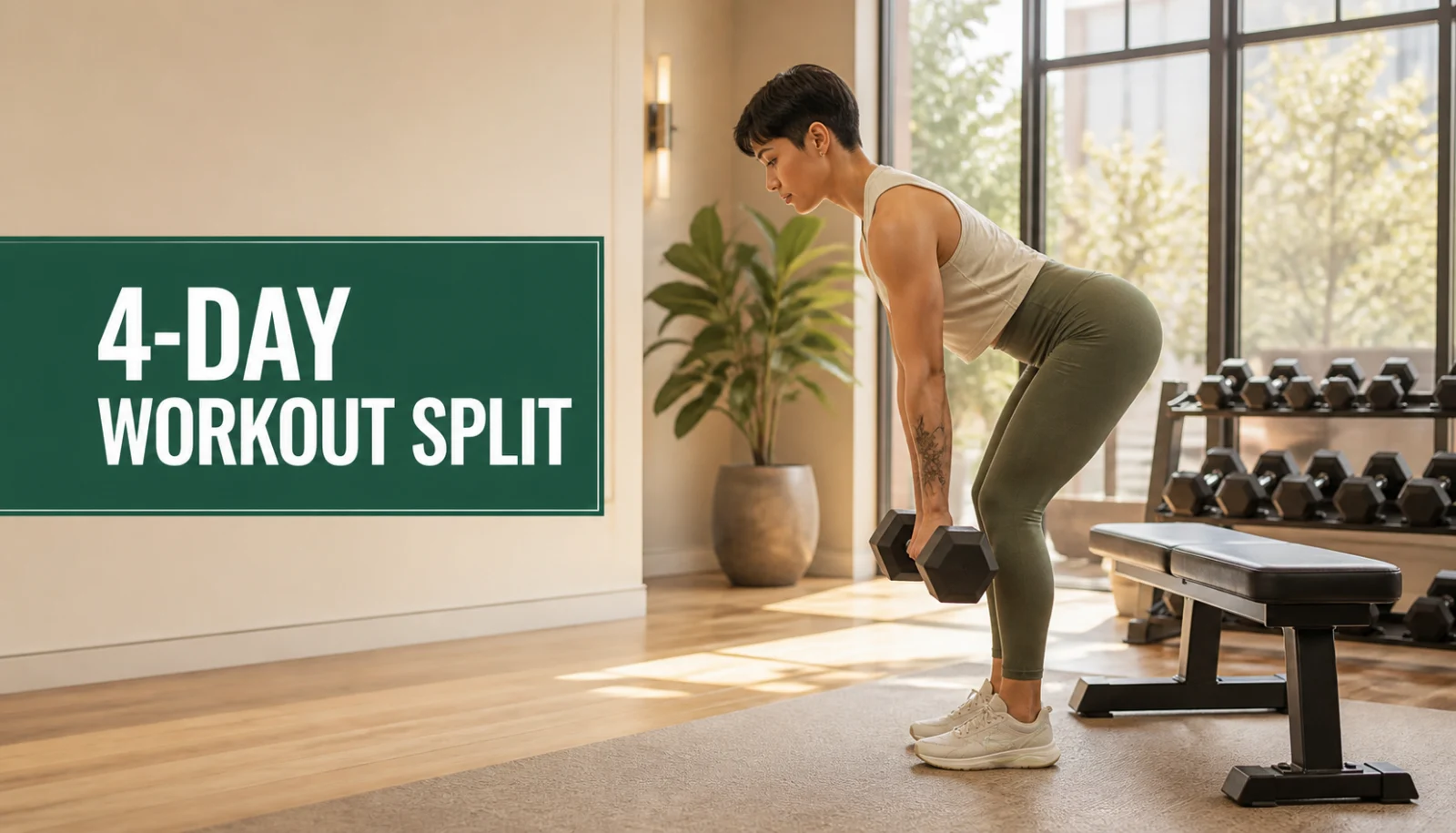
A four-day workout split gives you enough room to train every major muscle group twice each week without turning the gym into a seven-day commitment.
The simplest version is an upper/lower split:
- Monday: Upper A
- Tuesday: Lower A
- Wednesday: Rest or easy activity
- Thursday: Upper B
- Friday: Lower B
- Saturday and Sunday: Rest, walking, mobility, or other easy activity
The program below is a general template for healthy adults who already know the basic movement patterns or can learn them with qualified instruction. It uses four 45–70 minute strength sessions, moderate weekly volume, and a simple progression rule. Use eight weeks as your first formal review point rather than rewriting the program after every difficult session.
Quick answer: For most people training four days per week, an upper/lower split is a practical default. It distributes pressing, pulling, squatting, hinging, and single-leg work across the week while leaving three non-lifting days for recovery and life.
The complete 4-day workout split
Start with loads that let you finish each set with about 2–3 good repetitions still available. The final reps should feel challenging, but your technique should remain controlled.
Warm up before each session with 5–10 minutes of easy movement, then perform a few lighter practice sets for the first one or two exercises. Warm-up sets do not count toward the listed working sets.
Day 1: Upper A
This day uses a horizontal press and row as the main lifts, then fills in shoulders, vertical pulling, and arms.
Exercise | Working sets | Reps | Rest |
Bench press or dumbbell bench press | 3 | 6–8 | 2–3 min |
One-arm dumbbell row | 3 | 8–10 per side | 90–120 sec |
Seated dumbbell overhead press | 2 | 8–10 | 90–120 sec |
Lat pulldown or assisted pull-up | 2 | 8–12 | 90–120 sec |
Cable triceps pressdown | 2 | 10–15 | 60–90 sec |
Dumbbell curl | 2 | 10–15 | 60–90 sec |
Technique priority: keep the main press and row smooth. Stop the set if your range of motion shortens or you have to change position to finish a rep.
Day 2: Lower A
This is the squat-focused lower-body day. The Romanian deadlift adds a hinge without requiring another maximal lift.
Exercise | Working sets | Reps | Rest |
Back squat, front squat, or goblet squat | 3 | 6–8 | 2–3 min |
Romanian deadlift | 3 | 8–10 | 2 min |
Reverse lunge | 2 | 8–10 per side | 90–120 sec |
Seated or lying leg curl | 2 | 10–15 | 60–90 sec |
Standing calf raise | 2 | 10–15 | 60–90 sec |
Plank | 2 | 30–60 sec | 60 sec |
Technique priority: use a squat variation that lets you control the full range you can perform comfortably. A goblet squat or machine squat is a legitimate starting point; the barbell is not mandatory.
Day 3: Upper B
This day changes the angles and uses slightly higher rep ranges. It is not an “easy” day, but it should not become a second max-effort bench session.
Exercise | Working sets | Reps | Rest |
Incline dumbbell press | 3 | 8–10 | 2 min |
Lat pulldown, assisted pull-up, or pull-up | 3 | 8–10 | 2 min |
Chest-supported row | 2 | 10–12 | 90 sec |
Dumbbell or cable lateral raise | 2 | 12–15 | 60–90 sec |
Push-up or cable fly | 2 | 10–15 | 60–90 sec |
Hammer curl + overhead triceps extension | 2 each | 10–15 | 60–90 sec |
You can perform the curl and triceps exercise as a superset if the gym setup allows it. Complete one set of curls, move to triceps, rest, and repeat.
Day 4: Lower B
The second lower-body day starts with a main lower-body lift, then emphasizes unilateral and posterior-chain work. Use a trap-bar deadlift if you know the movement; otherwise use the leg-press option below. If you choose leg press, your week's primary hinge remains the Romanian deadlift on Lower A.
Exercise | Working sets | Reps | Rest |
Trap-bar deadlift or leg press | 3 | 5–6 deadlift / 8–10 leg press | 2–3 min |
Bulgarian split squat or supported split squat | 3 | 8–10 per side | 90–120 sec |
Hip thrust or glute bridge | 2 | 8–12 | 90–120 sec |
Leg extension | 2 | 10–15 | 60–90 sec |
Seated or lying leg curl | 2 | 10–15 | 60–90 sec |
Seated or standing calf raise | 2 | 10–15 | 60–90 sec |
Dead bug or Pallof press | 2 | 8–12 per side | 60 sec |
If deadlifts make the rest of the session fall apart, reduce the load, use two working sets, or choose the leg press. The goal is repeatable training—not proving how tired you can get on Friday.
How to progress the plan
Use double progression: increase repetitions first, then increase weight.
For an exercise listed as 3 sets of 6–8:
- Choose a weight you can perform for 6 controlled reps on all three sets while leaving about 2–3 good reps available.
- Keep the same weight and gradually add reps across sessions.
- When you can complete 8 reps on every working set with the same controlled technique, add the smallest practical amount of weight next time.
- Return to the lower end of the range and build again.
Example:
Week | Bench press result | Next step |
1 | 8, 7, 6 | Keep the weight |
2 | 8, 8, 7 | Keep the weight |
3 | 8, 8, 8 | Add a small amount next time |
4 | 7, 6, 6 at the new weight | Build from here |
You do not need to add weight every workout. A cleaner rep, a slightly fuller range, or completing the same work with less strain can also be progress.
For a timed core hold such as a plank, add 5–10 seconds while position stays controlled. Once every set reaches 60 seconds, choose a slightly harder variation rather than holding indefinitely.
The 2026 American College of Sports Medicine resistance-training guidance emphasizes that consistency, progressive training, and matching the program to the person matter more than complicated methods. It also notes that training to momentary failure and elaborate periodization are optional for the average healthy adult—not requirements.
Generate a version for your schedule and equipment
The four-day template above assumes access to a reasonably equipped gym. If you train at home, prefer machines, have limited time, or want a different goal, build a personalized starting plan below.
The generator provides general fitness guidance. Check the result against your current ability, available equipment, health conditions, and any instructions from a qualified professional.

A useful program makes the next session obvious. Recording what you did makes the next progression possible.
The 45-minute version
When time is tight, preserve the main movement patterns and trim accessories. Do the first four exercises on each day, then choose one of the remaining movements if time allows.
To move efficiently:
- Keep the main compound lifts as straight sets.
- Pair non-competing accessories, such as curls with triceps or calves with core.
- Set up before your first working set so you are not searching for equipment between every exercise.
- Use a machine or dumbbell substitute if a station has a long wait.
- Stop adding exercises once the session's essential work is complete.
A shorter workout you repeat is more useful than a theoretically perfect 90-minute session you regularly skip.
Exercise substitutions
Equipment varies. Match the exercise's role in the session, not the exact brand of machine. A substitute may not be mechanically identical; it should preserve the day's balance without duplicating another movement excessively.
If this is unavailable or uncomfortable | Try this instead |
Barbell bench press | Dumbbell bench press, chest press machine, or push-up |
One-arm dumbbell row | Cable row or chest-supported row |
Overhead press | Landmine press or machine shoulder press |
Pull-up | Assisted pull-up or lat pulldown |
Back squat | Goblet squat, front squat, hack squat, or leg press |
Romanian deadlift | Cable pull-through, hip hinge with dumbbells, or hip thrust |
Bulgarian split squat | Reverse lunge, step-up, or supported split squat |
Trap-bar deadlift | Leg press, block pull, or another coached hinge variation |
Leg curl | Stability-ball leg curl or slider leg curl |
Cable core exercise | Dead bug, side plank, or suitcase carry |
An exercise should fit your body and your current skill—not force you into pain because it appeared in a template.
Is a four-day split right for you?
This split is a good fit when:
- You can reliably protect four training windows most weeks.
- You want to train each major area more than once per week.
- Two consecutive lifting days feel manageable when followed by rest.
- You prefer 45–70 minute sessions over cramming the same work into two very long days.
- You are willing to record reps and loads instead of changing the entire program every week.
A three-day full-body plan may be better when:
- You are completely new to resistance training.
- Your schedule changes every week.
- Four sessions would crowd out sleep or recovery.
- You also do several demanding sport, running, or group-fitness sessions.
- You cannot currently recover from back-to-back training days.
There is no magic in the word “split.” A 2024 systematic review found similar strength and muscle-growth outcomes from split and full-body routines when weekly training volume was equated. The best structure is the one that lets you perform enough quality work, recover, and stay consistent.
How to combine the split with cardio
Keep easy cardio flexible. Walking, easy cycling, or conversational-pace cardio can fit after lifting or on a non-lifting day.
For harder intervals or long endurance sessions:
- Avoid placing the hardest running workout immediately before Lower A or Lower B when possible.
- Start with one demanding cardio session per week rather than adding several at once.
- If lower-body performance keeps declining, reduce cardio intensity, lifting volume, or both.
- Protect at least one genuinely easy day each week.
Adults should still work toward the broader aerobic and muscle-strengthening recommendations that fit their health and ability. The CDC's current guidance calls for at least 150 minutes of moderate-intensity aerobic activity or 75 minutes of vigorous activity per week, plus muscle-strengthening work on at least two days. You can build toward that total gradually.
What to do when you miss a workout
Do not double the next session.
If you miss one day, do that workout on your next available training day and preserve the sequence: Upper A → Lower A → Upper B → Lower B. Avoid more than two lifting days in a row. If only three sessions fit, begin the following week with the remaining workout.
If you miss a full week, repeat the previous week's loads or use slightly less. You have not lost the program; you are simply resuming it.
If four days repeatedly becomes three, switch to a plan designed for three days. A routine should serve your life, not make every imperfect week feel like failure.
When to reduce volume or take an easier week
One difficult workout is normal. A pattern matters more.
Consider an easier week if several of these persist together:
- Performance falls across multiple exercises for two weeks.
- Normal loads feel unusually heavy before the working sets begin.
- Soreness is interfering with the next scheduled session.
- Sleep, motivation, or joint comfort has clearly worsened.
- You are compensating with increasingly sloppy technique.
For one week, keep the same exercises but perform about half the usual working sets and use comfortable loads. Then resume gradually. If pain, fatigue, or performance problems continue, get individualized help rather than endlessly rewriting the spreadsheet.
Turn the plan into daily accountability
The useful part of a workout plan is not the table—it is doing the next session, recording what happened, and returning after a missed day.
BodyBuddy can keep this plan in view and turn it into proactive text coaching. You can share a plan, choose the check-in rhythm that fits your week, and have BodyBuddy follow up between workouts. If a personal trainer already gave you a program, use their plan rather than replacing it.
BodyBuddy does not replace a certified trainer, physical therapist, or clinician, and it cannot determine whether pain is safe to train through.
Frequently asked questions
What is the best 4-day workout split?
An upper/lower split is a practical default for four weekly sessions: two upper-body days and two lower-body days. It distributes major movement patterns across the week and gives each area two exposures without requiring six gym days. “Best” still depends on your experience, goals, equipment, other activity, and schedule.
Is four days a week enough to build muscle?
Yes, four well-planned resistance-training days can provide enough weekly work for muscle growth. More days are not automatically better. The quality and progression of the work, total weekly volume, nutrition, sleep, and consistency all matter.
Can a beginner use a 4-day split?
A beginner can use one, especially with qualified help learning the exercises. But a two- or three-day full-body plan is often easier to practice and recover from at first. Choose four days only if it genuinely fits your week.
How long should I run this program?
Use eight weeks as a sensible first review point unless an exercise causes pain or the schedule clearly does not fit. Keep useful exercises stable long enough to measure progress. You can continue beyond eight weeks if reps, loads, technique, or comfort are still improving.
Should I train to failure?
You do not need to take every set to failure. Start with roughly 2–3 good reps left on most working sets. That gives you room to learn the movements, maintain technique, and recover for the next session.
Can I do Monday, Tuesday, Thursday, and Friday?
Yes. That is the default schedule in this plan because it creates two training blocks separated by a rest day. Monday, Tuesday, Friday, and Saturday also works. Avoid four consecutive lifting days when you can.
What if I can only train three days this week?
Continue through the workouts in order rather than trying to squeeze four sessions into three days. Avoid more than two lifting days in a row, and start the next week with whichever workout remains. If this happens most weeks, choose a three-day routine instead.
Is upper/lower better than push/pull/legs?
Neither split is universally better. Upper/lower fits naturally into four days. Push/pull/legs often fits three or six days more cleanly, though it can be adapted. The structure matters less than whether weekly work, recovery, and progression fit you. Compare the exact sessions in the complete push pull legs workout plan.
Can I use only dumbbells?
Yes. Use dumbbell presses and rows, goblet squats, Romanian deadlifts, split squats, hip thrusts, lateral raises, curls, and triceps work. For exact at-home sessions, progression rules, and no-bench substitutions, follow the complete dumbbell workout plan.
Safety notes
This program is general education, not individualized medical or rehabilitation advice.
- If you are pregnant, returning after surgery, managing a chronic condition, or dealing with a current injury, ask a qualified health professional what types and amounts of training are appropriate.
- Stop the session and seek urgent assessment for chest pain or pressure, fainting, severe or unusual shortness of breath, or another acute concerning symptom.
- Stop or modify an exercise for sharp, localized, or worsening pain. Do not use this article to diagnose it.
- Increase training gradually. Do not add weight, repetitions, sets, and extra cardio all at once.
- Use a spotter or safety equipment when an exercise and load require it.
Sources and methodology
This plan was built as a moderate, repeatable template for healthy adults—not as a promise of a specific result.
The creators of BodyBuddy produced this guide. BodyBuddy is not affiliated with the cited organizations, and none of them reviewed or endorsed this program.
Related BodyBuddy guides
Want daily accountability?
BodyBuddy texts you every day.
Build a healthier relationship with food and movement, one text at a time.