
Fitness|August 19, 2026|BodyBuddy Team
3-Day Workout Split: Complete Gym Plan + Progression
A complete 3-day workout split with exact exercises, sets, reps, substitutions, and an 8-week progression plan for beginners and intermediate lifters.
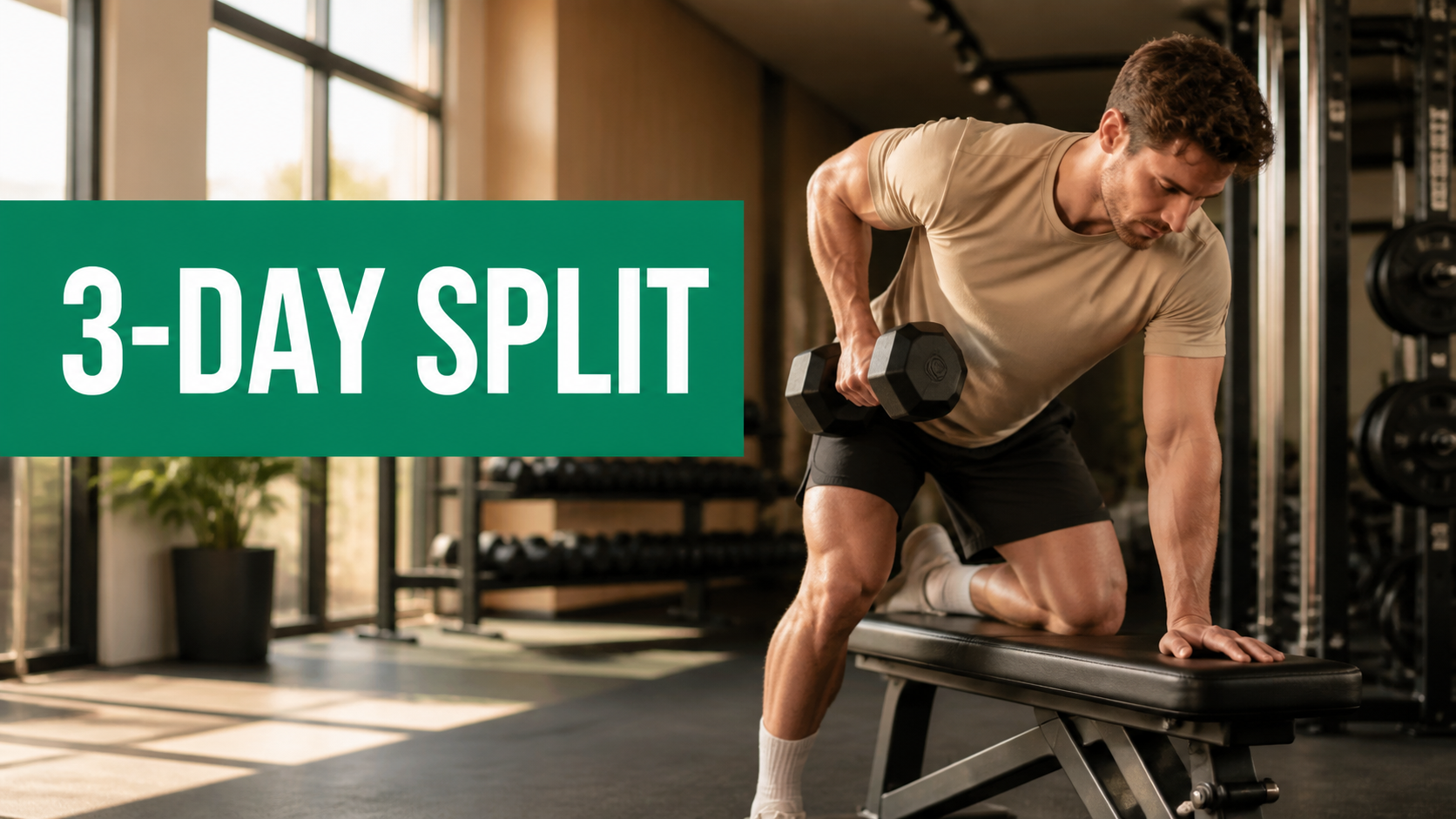
A good three-day workout split does not need three dozen exercises or a complicated rotating calendar.
If you can reliably reach the gym three times per week, the cleanest setup for most recreational lifters is a full-body A/B/C routine: every workout includes a lower-body movement, a push, a pull, and a small amount of core or loaded-carry work.
That structure gives each major muscle group multiple opportunities to work during the week without requiring you to live in the gym.
The short version:
Day | Main emphasis | Suggested schedule |
Workout A | Squat and horizontal press | Monday |
Workout B | Hip hinge and single-leg strength | Wednesday |
Workout C | Balanced full-body volume | Friday |
Each session should take roughly 50–70 minutes, including the warm-up.
The plan at a glance: Train on three nonconsecutive days when possible. Start each set with a weight you could lift for another two or three good repetitions. Add reps first, then add a small amount of weight.

Why use a full-body three-day split?
“Workout split” can mean several things. A push/pull/legs routine is technically a three-day split, but when it is performed only three times per week, most muscle groups receive one focused training session.
A full-body split distributes the work across all three days instead.
That makes it especially practical when:
- You can train three days per week consistently
- You want to build general strength and muscle
- You are a beginner or returning after time away
- Your schedule occasionally forces you to miss a workout
- You prefer shorter sessions over one enormous “leg day”
A 2024 systematic review and meta-analysis compared split and full-body resistance-training programs across 14 studies. It found similar improvements in strength and muscle growth when total weekly training volume was matched. In other words, the label on the split matters less than doing enough useful work and repeating it consistently.
That fits the American College of Sports Medicine’s updated 2026 guidance: regularly training all major muscle groups matters more for most adults than chasing an unnecessarily complex routine.
How to read this plan
- Work sets are the challenging sets listed in the tables. Warm-up sets do not count.
- Rep range means you may stop anywhere inside that range while maintaining good form.
- Reps in reserve describes how many additional clean repetitions you believe you could have performed.
- For most sets, finish with approximately two repetitions in reserve.
- Rest approximately 2–3 minutes after large compound lifts and 60–90 seconds after smaller movements.
- The exercise order is intentional. Do the most demanding lifts before smaller accessory work.
You do not need to train to failure to make this plan effective.
The warm-up
Use the first 8–12 minutes to prepare for that day’s movements, not to exhaust yourself.
1. Raise your temperature
Spend 3–5 minutes walking briskly, cycling, rowing, or using another comfortable cardio machine.
2. Rehearse the movements
Perform a few controlled repetitions of the patterns you will train:
- Bodyweight squats
- Hip hinges
- Reverse lunges
- Arm circles or band pull-aparts
- Incline push-ups
3. Build up to your first working weight
Before the first major lift, perform two or three lighter sets.
For example, before a working squat set:
- Empty bar or very light weight: 8–10 repetitions
- Approximately half your working weight: 5 repetitions
- A moderately heavy warm-up: 2–3 repetitions
- Begin your work sets
You may also want one lighter rehearsal set before the first unfamiliar upper-body movement.
Workout A: squat and press
Exercise | Work sets × reps | Beginner-friendly substitute |
Back squat | 3 × 6–8 | Goblet squat or leg press |
Barbell bench press | 3 × 6–10 | Dumbbell bench or machine chest press |
Lat pulldown | 3 × 8–12 | Assisted pull-up |
Romanian deadlift | 2 × 8–10 | Dumbbell Romanian deadlift |
Seated dumbbell shoulder press | 2 × 8–12 | Machine shoulder press |
Farmer carry | 2 × 30–45 seconds | Suitcase carry or plank |
The squat and bench press are the priority movements. Take full rest periods and avoid rushing them.
On Romanian deadlifts, lower the weight only as far as you can maintain a controlled hip hinge and stable back position. More range is not automatically better.
Workout B: hinge and single-leg strength
Exercise | Work sets × reps | Beginner-friendly substitute |
Trap-bar deadlift | 2 × 5–6 | Kettlebell deadlift |
Incline dumbbell press | 3 × 8–12 | Incline machine press |
Bulgarian split squat | 3 × 8–10 per side | Reverse lunge or supported split squat |
Seated cable row | 3 × 8–12 | Chest-supported dumbbell row |
Leg curl | 2 × 10–15 | Stability-ball leg curl |
Dead bug | 2 × 8–12 per side | Heel tap |
A trap bar is not mandatory. You can use a conventional deadlift if you already perform it comfortably, or choose a kettlebell deadlift while learning the hinge pattern.
If balance limits your split squats before your legs become tired, lightly hold a rack or stable support.
Workout C: balanced full-body volume
Exercise | Work sets × reps | Beginner-friendly substitute |
Leg press or front squat | 3 × 8–12 | Goblet squat |
Standing overhead press | 3 × 6–10 | Seated dumbbell or machine press |
Hip thrust | 3 × 8–12 | Glute bridge |
Assisted pull-up | 3 × 8–12 | Neutral-grip lat pulldown |
Dumbbell bench press | 2 × 10–15 | Elevated push-up |
Pallof press | 2 × 10–12 per side | Side plank |
This session uses moderate rep ranges and should feel challenging without turning into a race.
If you have another demanding activity planned for the weekend, keep one or two extra repetitions in reserve on the leg exercises.
Optional arm work
The presses and pulling exercises already train your arms. If direct arm work matters to you and you are recovering well, add:
- Workout B: dumbbell curl, 2 × 10–15
- Workout C: cable triceps pressdown, 2 × 10–15
Treat these as optional. Do not let them extend the workout by another half hour.
Beginner and intermediate versions
You can use the same exercises regardless of experience. The difference is how much work you begin with and how aggressively you progress.
Variable | Beginner version | Intermediate version |
Initial work sets | 2 sets per exercise for weeks 1–2 | Use the sets listed in the plan |
Effort | Finish with 3 reps in reserve | Finish with 1–3 reps in reserve |
Optional arm work | Skip initially | Add if useful and recoverable |
Main priority | Repeatable technique | Gradual increases in reps and load |
Session cap | Approximately 60 minutes | Approximately 70 minutes |
A beginner does not need a completely different collection of exercises. A beginner needs a manageable starting dose and enough repetition to learn the movements.
If six exercises feel like too much at first, perform the first five. Add the carry or core movement after the main routine feels settled.
How to progress the plan
Use double progression: increase repetitions inside the listed range before increasing the weight.
Suppose your bench-press target is 3 sets of 6–10 repetitions.
Your log might look like this:
Session | Weight | Completed reps |
Week 1 | 95 lb | 8, 8, 7 |
Week 2 | 95 lb | 9, 8, 8 |
Week 3 | 95 lb | 10, 10, 9 |
Week 4 | 95 lb | 10, 10, 10 |
Next session | 100 lb | Return to 6–8 reps |
Once you reach the top of the range on every set with controlled form—and still have roughly one or two clean repetitions available—add the smallest practical amount of weight.
Typical increases might be:
- 2.5–5 pounds for upper-body exercises
- 5–10 pounds for lower-body exercises
- The next machine pin when smaller jumps are unavailable
If the available dumbbell jump is too large, stay at the current weight and make the repetitions cleaner before moving up.
Do not force progress every workout
A workout is still productive if you repeat last week’s numbers with better control.
Do not add weight when:
- Your range of motion is getting shorter
- You are using momentum to finish repetitions
- Your technique changes substantially between early and late sets
- You cannot reach the bottom of the rep range
- Normal fatigue has turned into persistent pain
An eight-week progression
The logbook determines when a specific lift increases. This timeline simply gives the program an overall direction.
Weeks | Focus |
1–2 | Learn the exercises and establish conservative working weights. Beginners perform 2 work sets per exercise. |
3–4 | Use the full plan. Add repetitions while keeping approximately 2 reps in reserve. |
5–6 | Increase weight on exercises that have reached the top of their rep ranges. |
7 | Try to improve one variable: an extra rep, a small load increase, or cleaner execution. |
8 | Review recovery and performance. Continue normally if you feel good; reduce each exercise by one set for a lighter week if fatigue has accumulated. |
After week eight, you do not need to discard the routine. If you are progressing and enjoying it, repeat the process.
Change an exercise when it causes a persistent problem, equipment is unavailable, or progress has been stalled for several weeks—not because the calendar says your program has expired.
Exercise substitutions
A substitution should preserve the movement’s job inside the program.
Movement pattern | Main options | Other useful options |
Squat | Back squat, front squat | Goblet squat, hack squat, leg press |
Hip hinge | Deadlift, Romanian deadlift | Trap-bar deadlift, hip thrust, back extension |
Horizontal push | Barbell or dumbbell bench | Machine press, push-up |
Horizontal pull | Cable or dumbbell row | Chest-supported row, machine row |
Vertical push | Barbell or dumbbell overhead press | Machine press, landmine press |
Vertical pull | Pull-up, lat pulldown | Assisted pull-up, band pulldown |
Single-leg | Split squat | Reverse lunge, step-up |
Core or carry | Farmer carry, Pallof press | Dead bug, plank, suitcase carry |
Use the same substitute for several weeks rather than selecting a different exercise every session. Consistency makes it much easier to tell whether you are improving.
Build a version around your equipment
If this routine does not match your gym, schedule, or preferred exercises, generate a three-day plan that does.
Choose three training days in the generator, then use the resulting plan as your repeatable baseline. If you start the plan with BodyBuddy, BodyBuddy can turn it into daily text accountability and help you keep the week moving when your schedule changes.
What to do when you miss a workout
Do not cram two full-body sessions together to “catch up.”
Instead, treat A, B, and C as a rolling sequence.
If you miss Wednesday’s Workout B:
- Do Workout B on your next available training day
- Perform Workout C after that
- Begin again with Workout A
The sequence matters more than the weekday labels.
If you miss one session
Continue with the missed workout on your next gym day.
If you miss most of a week
Repeat the previous week’s weights. Do not try to complete six workouts during the following week.
If you miss two or more weeks
Use slightly lighter loads and fewer sets during your first week back. Once the movements feel normal again, return to the regular plan.
This is one reason a full-body split works well for imperfect schedules: one missed day does not eliminate an entire week of lower-body or pulling work.
Can you combine this plan with cardio?
Yes. This strength plan does not replace aerobic activity.
The CDC recommends that adults work toward at least 150 minutes of moderate-intensity aerobic activity—or 75 minutes of vigorous activity—per week, alongside muscle-strengthening activity on at least two days.
A manageable week might look like:
Day | Activity |
Monday | Workout A |
Tuesday | Brisk walk or easy cycling |
Wednesday | Workout B |
Thursday | Rest or light cardio |
Friday | Workout C |
Saturday | Recreational cardio, hike, or sport |
Sunday | Rest |
If hard running or intervals interfere with your lifting performance, separate them from the most demanding lower-body session or reduce their volume.
How long should you follow this three-day split?
Follow it long enough to evaluate it properly.
Eight to twelve weeks is a reasonable first run, but the routine can remain useful much longer. Continue while:
- Your repetitions or weights are gradually improving
- The sessions fit your schedule
- You are recovering between workouts
- The exercises feel productive
- You still want the results the plan is designed to support
A plan does not stop working merely because it is no longer new.
Frequently asked questions
What is the best three-day workout split?
For many people who can train exactly three days per week, a full-body A/B/C routine is the most practical option. It distributes leg, push, and pull training across the week and makes an occasional missed session easier to handle.
“Best” still depends on your goals, preferences, equipment, and ability to recover.
Is push/pull/legs good for three days per week?
It can work, particularly if you prefer longer, body-part-focused sessions. However, a three-day push/pull/legs schedule usually trains each area directly once per week.
A full-body plan exposes each movement pattern to practice throughout the week. Research indicates that either split can work when weekly training volume is appropriately matched.
Can a three-day workout split build muscle?
Yes. Three weekly resistance-training sessions can provide meaningful training volume for every major muscle group.
Muscle gain also depends on gradually challenging the muscles, eating in a way that supports your goal, sleeping adequately, and performing the plan consistently.
Is this plan suitable for beginners?
Yes. Beginners should start with the two-set version, choose conservative weights, and focus on repeatable technique.
If you have never used a particular lift, ask a qualified trainer to help you set up the equipment and learn the movement.
Do women need a different three-day split?
Not by default. The same basic movement patterns and progression principles apply. Exercise selection and starting loads should reflect the individual, not a gendered template.
Can I do this three-day split at home?
Yes, but you will need to substitute exercises based on your equipment. Dumbbells, resistance bands, a bench, and bodyweight variations can cover every movement pattern in the plan.
How many exercises should a full-body workout include?
For this plan, five or six movements are enough. More exercises are not automatically better, especially if the extra work makes the sessions difficult to recover from or repeat.
How much rest should I take between training days?
A nonconsecutive schedule such as Monday, Wednesday, and Friday works well. One day between sessions is generally helpful because every workout trains the full body.
Safety notes
This routine is general fitness information for healthy adults, not individualized medical advice.
Speak with a qualified health professional before beginning or substantially increasing exercise if you have a chronic health condition, significant injury, unexplained symptoms, or instructions that affect how you should train.
Stop the session and seek appropriate help if you experience chest pain, faintness, or severe or unusual pain. Normal muscular effort is not the same as sharp or worsening pain.
The simple rule that makes this plan work
Do the next scheduled workout.
Do not compensate for an imperfect week with an extreme one. Do not replace the program every time progress slows for a few days. Keep the exercises recognizable, record the work, and make the smallest useful improvement when you are ready.
Three repeatable training days will beat an elaborate six-day split that exists only on paper.
Sources
Want daily accountability?
BodyBuddy texts you every day.
Build a healthier relationship with food and movement, one text at a time.