
BodyBuddy logoBodyBuddy

A 3-day workout split for beginners

The answer is below, sourced to the ACSM position stands, the federal activity guidelines, the NSCA, the NIA, and the frequency and volume reviews on PubMed. After that, if you want someone texting you the session and logging your sets every day, that's me.

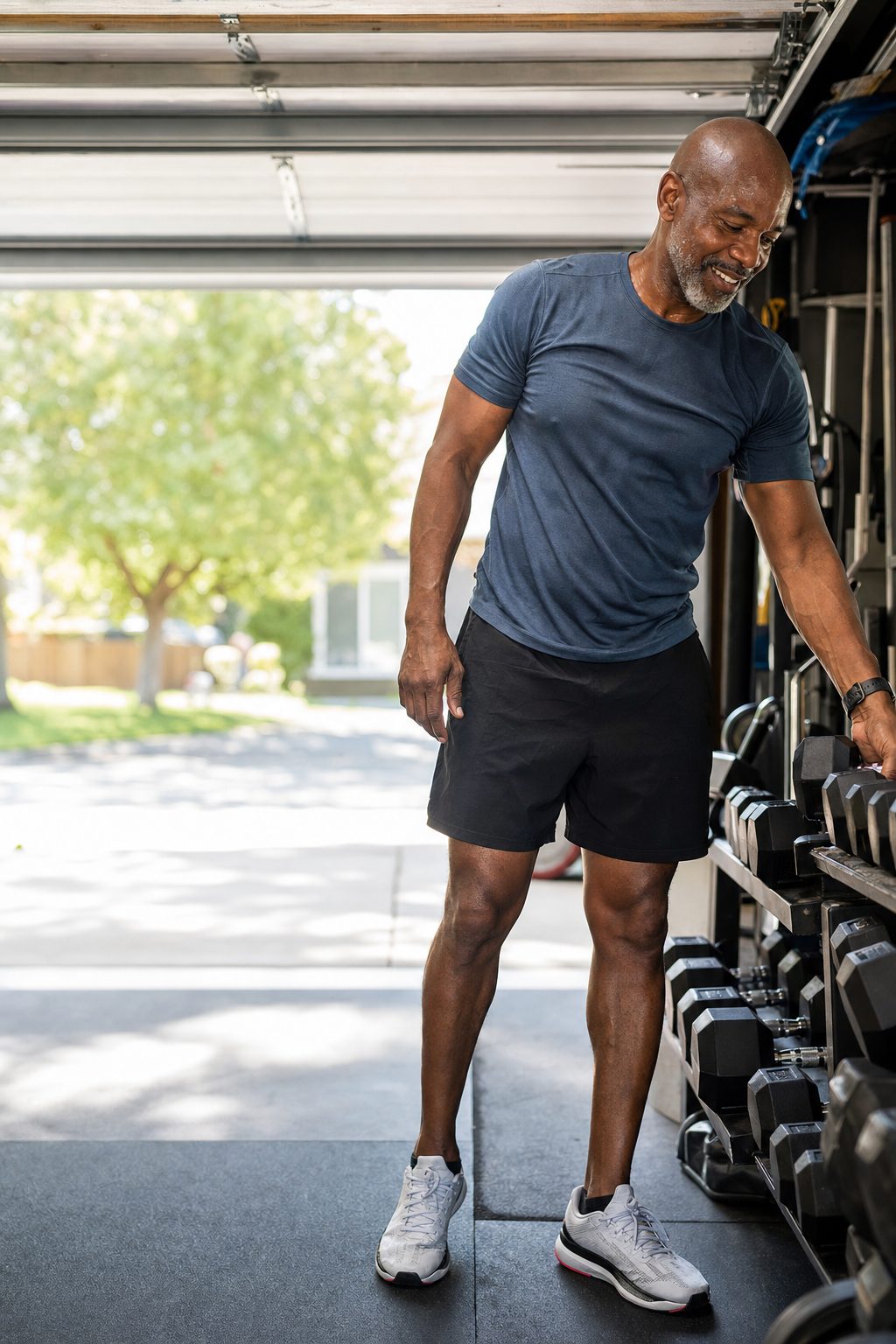
A man in his fifties setting a dumbbell back on the rack in a bright garage gym

12 weeks

push day 🏋️ last week you benched 135 for 8. same again, or add 5?

A beginner's 3-day week, from the sources

For a beginner, the sources describe three days as three full-body sessions on nonconsecutive days, and they reserve body-part splits for people with months of training behind them. Here is what each source says, with its owner and date, a sample week built from those rules, and the sources at the bottom.

People without diagnosed chronic conditions and without symptoms such as chest pain or pressure, dizziness, or joint pain most likely do not need to consult a health care provider about physical activity, and people who develop new symptoms when increasing their levels of activity should consult one (HHS, Physical Activity Guidelines for Americans, 2nd edition, 2018). The NHLBI says to talk with your doctor if you have symptoms such as chest pain or dizziness during physical activity (NHLBI, March 24, 2022). Chest pain, heaviness, or discomfort, shortness of breath, light-headedness, or sudden dizziness can be heart attack symptoms, and the NHLBI's instruction is to call 9-1-1 for emergency medical care, even if you are not sure that you're having a heart attack (NHLBI, Heart Attack Symptoms, March 24, 2022).

Who counts as a beginner

ACSM defines novice as untrained individuals with no resistance training experience or who have not trained for several years, intermediate as approximately 6 months of consistent training, and advanced as years of training (ACSM position stand, Progression Models in Resistance Training for Healthy Adults, Medicine & Science in Sports & Exercise, March 2009). The NSCA uses the same three levels and says the primary factor in setting training frequency is the client's training status and overall level of fitness, since lesser-trained clients usually require more rest between workouts (NSCA, Determination of Resistance Training Frequency, excerpted from NSCA's Essentials of Personal Training, 2nd edition).

If you have trained for less than about six months, or not at all for several years, every recommendation on this page for novices is the one that applies to you.
How many days

The federal floor is two. Adults should do muscle-strengthening activities of moderate or greater intensity that involve all major muscle groups on 2 or more days a week (HHS, Physical Activity Guidelines for Americans, 2nd edition, 2018). ACSM's recommendation is 2 to 3 days a week for novice training, 3 to 4 for intermediate, and 4 to 5 for advanced (ACSM, 2009). ACSM's 2026 update keeps the floor, with author Stuart Phillips saying that training all major muscle groups at least twice a week matters far more than chasing a perfect or complex plan (ACSM, announced March 17, 2026).

The NSCA spells out what a beginner's week looks like. The recommendation for the novice is to use frequencies of two or three days per week when training the entire body, on nonconsecutive days such as Monday and Thursday; Tuesday, Thursday, and Saturday; or Monday, Wednesday, and Friday (NSCA). For a client who reaches intermediate status, it recommends increasing to three or four days a week, which means training two or more days in a row, and names split routines, where a session trains only one part of the body, certain muscle areas, or push or pull movements, as a common strategy (NSCA).

So for a beginner, a 3-day split is a full-body session done three times a week with a day off between sessions.

What the frequency studies found

A 2016 meta-analysis found higher training frequency associated with a greater hypertrophy effect size than lower frequency, 0.49 against 0.30, found that twice a week promoted superior hypertrophy to once a week on a volume-equated basis, and concluded that the major muscle groups should be trained at least twice a week to maximize growth. It left open whether three times a week beats twice (Schoenfeld, Ogborn and Krieger, Sports Medicine, November 2016).

A larger 2019 meta-analysis of 25 studies found no significant difference between higher and lower frequency when weekly volume was equated, and concluded that for a given volume people can choose a weekly frequency per muscle group based on personal preference (Schoenfeld, Grgic and Krieger, Journal of Sports Sciences, June 2019). For strength, a 2018 meta-analysis of 22 studies found effect sizes rising from 0.74 at once a week to 0.82, 0.93, and 1.08 at two, three, and four or more times a week, with no significant effect once volume was equated (Grgic et al., Sports Medicine, May 2018). Its authors read that as frequency mattering mainly as a way to fit in more volume, and note that most of the studies used untrained participants (Grgic 2018).

What that means for a three-day week is that the third day is extra room for sets. The second day is where the published gain against once a week sits.

Sets, repetitions, and effort

ACSM recommends that novice loads correspond to a repetition range of an 8 to 12 repetition maximum (ACSM, 2009). The NIA says one set of eight to 12 repetitions of each exercise is effective, two or three sets may be more effective, and a beginner can try exercises without weights or bands until comfortable with the movements (NIA, content reviewed January 14, 2025).

On volume, a 2017 meta-analysis of 15 studies found a graded dose-response, with each additional weekly set associated with a 0.37% increase in muscle gain (Schoenfeld, Ogborn and Krieger, Journal of Sports Sciences, June 2017). ACSM's 2026 update gives about 10 sets per muscle group per week for hypertrophy and heavier loads of 80% of one-repetition maximum for 2 to 3 sets per exercise for strength (ACSM, 2026).

The NIA and ACSM's 2026 update disagree about effort, so each is printed with its owner. The NIA says to perform the exercises to the point at which it would be difficult to do another repetition (NIA, 2025). ACSM's 2026 update reports that training to fatigue or momentary muscle failure did not consistently impact outcomes for the average healthy adult (ACSM, 2026).

A sample week

This week is built only from the rules above, with the owner of each rule on its line. It is a layout to fill with exercises from your plan, and it sets no loads.

  • Days: Monday, Wednesday, Friday, each a full-body session, with at least one day off between (NSCA; NIA says avoid working the same muscle group on any two days in a row)
  • Muscle groups each session: legs, hips, chest, back, abdomen, shoulders, and arms, which is the NIA's list of major muscle groups (NIA, 2025)
  • Order within a session: large before small muscle groups, and multiple-joint before single-joint exercises (ACSM, 2009)
  • Sets and repetitions: one set of 8 to 12 is effective and two or three may be more effective (NIA, 2025), at a load you can lift 8 to 12 times (ACSM, 2009)
  • Warm-up: lighter weight on the same exercises first (HHS, 2018; NIA, 2025)
  • Rest between sets: 1 to 2 minutes at the 6 to 12 repetition range (ACSM, 2009)
  • Tuesday, Thursday, and the weekend: aerobic activity toward 150 minutes a week, or rest (HHS, 2018)
  • Adding weight: 2 to 10% when you can do one or two repetitions over the target (ACSM, 2009)

One trial ran almost this exact shape. Resistance-trained men did 3 total-body workouts a week of 3 sets of 8 to 12 repetitions on 7 exercises for 8 weeks (Schoenfeld et al., Journal of Strength and Conditioning Research, July 2016). Those were experienced lifters, so their set count is higher than the NIA's starting point.

Warm-up

A warm-up for muscle-strengthening activity commonly involves doing exercises with lighter weight (HHS, 2018). The NIA says to warm up for muscle-strengthening activity by doing exercises with less weight, and for aerobic activity to do a little light activity, such as easy walking, before and after (NIA, 2025). The CDC's answer to a fear of injury is to learn how to warm up and cool down (CDC, Overcoming Barriers to Physical Activity, last reviewed February 5, 2025).

The injury evidence is thinner than the advice. A systematic review of five high-quality randomized trials found three where warming up significantly reduced injury risk and two where it did not, concluded there is insufficient evidence to endorse or discontinue routine warm-up, and said the weight of evidence favours a decreased risk (Fradkin, Gabbe and Cameron, Journal of Science and Medicine in Sport, June 2006).

Rest between sets and between days

ACSM gives rest by goal. For hypertrophy it gives 1 to 2 minutes between sets in the 6 to 12 repetition zone, and for heavy loads of 1 to 6 repetitions it gives 3 to 5 minutes (ACSM, 2009). A systematic review of six studies found that both short rests of 60 seconds or less and longer rests may be useful for hypertrophy, with newer findings in trained people suggesting a possible advantage for longer rests (Grgic et al., European Journal of Sport Science, September 2017). One trial in resistance-trained men found 3-minute rests produced greater strength and thigh muscle growth than 1-minute rests over 8 weeks (Schoenfeld et al., 2016).

Between sessions, the NSCA says novice clients should have 1 to 3 days between resistance training sessions, but never more than 3, to facilitate recovery (NSCA). The NIA says to avoid working the same muscle group on any two days in a row to allow for muscle recovery between sessions (NIA, 2025).

Adding weight

ACSM's progression rule is specific. When training at a given repetition-maximum load, apply a 2 to 10% increase in load once you can perform the current workload for one to two repetitions over the desired number (ACSM, 2009). The NIA names the other levers: gradual increases in the amount of weight, the number of sets or repetitions, or the number of days a week will result in stronger muscles (NIA, 2025).

The federal guidelines start slower for someone coming from nothing, saying muscle-strengthening can start at just 1 day a week at a light or moderate level of effort, build to 2 days, and then possibly more, with intensity increased slightly each week until it becomes moderate or greater (HHS, 2018). ACSM's 2026 update also reports that complex periodization did not consistently impact outcomes for the average healthy adult (ACSM, 2026).

What I do with all this, and what I don't

You pick a three-day plan from the library, send me the one your trainer wrote, or we build one with the workout plan tool, and I text you that day's session on Monday, Wednesday, and Friday or whichever days you chose. You text back what you lifted in whatever shorthand you use, and I log every set. When you hit one or two repetitions over the target, I tell you the plan's rule says to add weight, which is ACSM's 2 to 10% (ACSM, 2009), and I keep the number you actually lifted. When a session slips, we move it so there is still a day between sessions and never more than three, which is the NSCA's spacing.

I never set your loads, never diagnose an ache, and never clear you for exercise. When what you tell me matches the symptoms in the line above, I say so and tell you to call.

No clinician reviewed this page. It restates the ACSM, NSCA, HHS, NIA, CDC, and NHLBI documents and the studies linked below, and those are the documents to trust over anything here.

Sources

What you can do with BodyBuddy

I text you the session on your three days

Pick a three-day plan or send me yours, and on each training day I put that day's full-body session in the thread before you leave the house.

wednesday, full body 🏋️ leg press, row, chest press, rdl, plank. same weights as monday?

I tell you when the plan says add weight

Text me your sets the way you'd write them in Notes and I log each one. When you beat the rep target by one or two, ACSM's rule says add 2 to 10%, and I say so on the day.

you got 13 and 14 on the row last time with a 12 target. plan says go up, so try the next plate today

I keep the days spaced

When a session slips, we move it so there is still a rest day between sessions and never more than three days off, which is the spacing the NSCA gives beginners.

missed today, no stress. thursday and saturday keeps a day between each and still gets you 3 this week

Text like you're talking to a friend

Tap to start a conversation if this sounds like you.

Pick your three days and a plan, and we start Monday

Everything above starts from one text. Tell me which three days work, what equipment you have, and whether you already have a plan. We either pick one from the library or work from yours, and I carry it with you every training day. Your clinician clears the exercise and I work inside what they told you.

Common questions

Should a beginner do full-body or a body-part split?

The NSCA recommends two or three full-body sessions a week on nonconsecutive days for novices, and describes split routines as the common strategy at intermediate status (NSCA). ACSM puts intermediate at about 6 months of consistent training (ACSM, 2009).

Is three days a week better than two?

Twice a week beat once a week for muscle growth when volume was equated (Schoenfeld 2016). When weekly volume was equal, higher frequency made no significant difference, so a third day mostly adds room for more sets (Schoenfeld 2019; Grgic 2018).

How many sets and reps should a beginner do?

The NIA says one set of 8 to 12 repetitions per exercise is effective and two or three may be more effective (NIA, 2025). ACSM recommends novice loads of an 8 to 12 repetition maximum (ACSM, 2009).

How long should I rest between sets?

ACSM gives 1 to 2 minutes for hypertrophy work in the 6 to 12 repetition zone and 3 to 5 minutes for heavy sets of 1 to 6 (ACSM, 2009).

Francis, founder of BodyBuddy

Hi, I'm Francis 👋

If you're like me, staying consistent is the hard part. I built BodyBuddy to give everyone the daily accountability to follow through.

Francis John, BodyBuddy FounderText me

7-day free trial, cancel anytime.

No one is reading your texts

Nobody monitors your thread. A conversation is reviewed by our own staff only in limited cases, such as a request for human help or a safety concern, and never shared outside.

Your data is yours to delete

You can request deletion of your personal data at any time, and deleting your account removes it from our systems.

Not sold or used for advertising

We do not sell consumer health data or share it for advertising. Service providers process it only to deliver the features you choose.

Everyone gives you a plan.BodyBuddy texts you until it happens.

A coach that stays with you through every plan, every setback, and all the days in between.