
BodyBuddy LogoBodyBuddy

Keeping weight off after stopping Ozempic or Wegovy

The answer is below, sourced to the STEP trials, a 2026 pooled analysis, and the labels. After that, if you want someone asking what you ate and what you did each day now that the medication is not doing it for you, that's me.

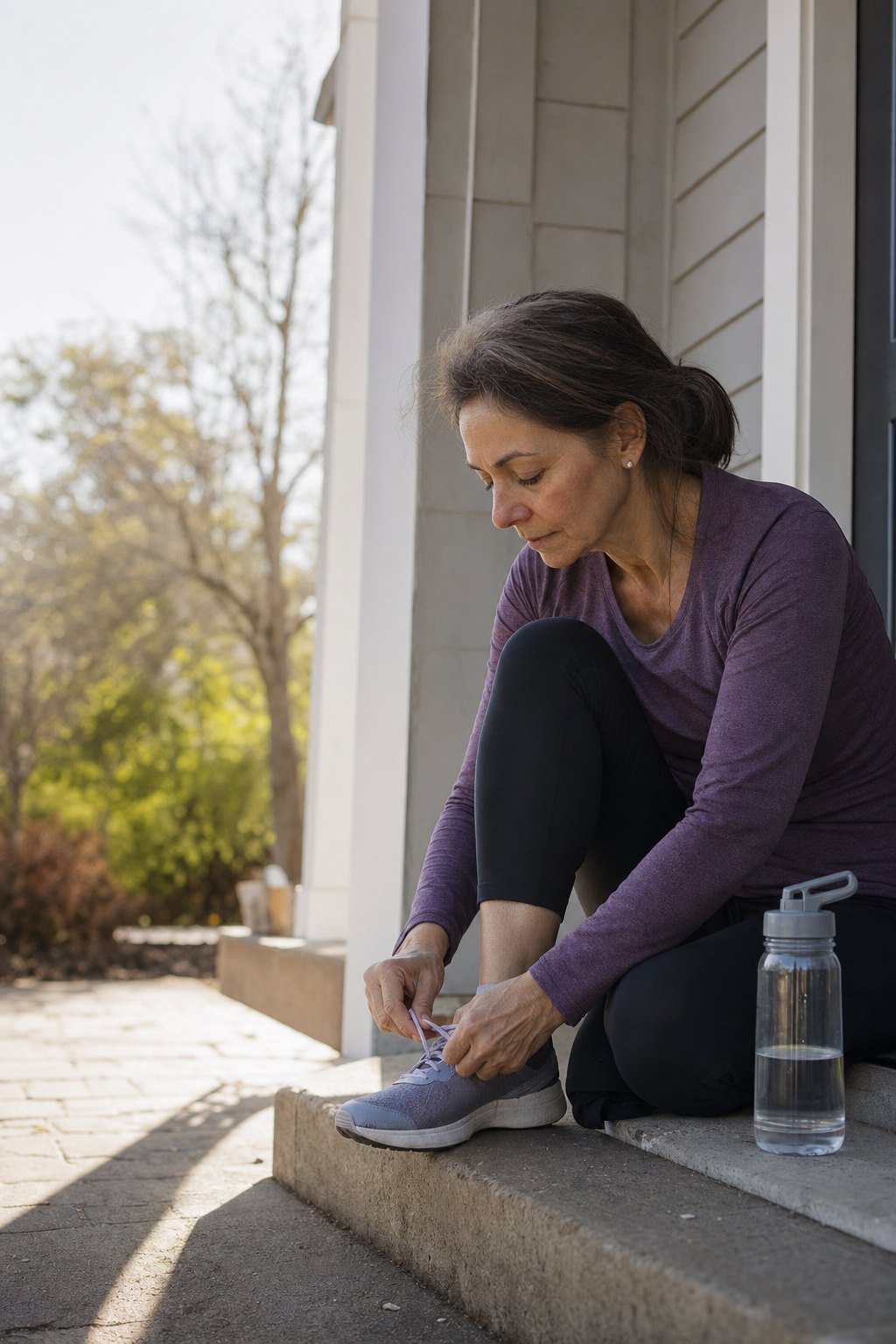
A woman lacing running shoes on a front step in the morning
172 lbsGoal168 lbs
last shot was 3 weeks ago. how has the appetite been this week? 🥗

What happens to weight after stopping semaglutide, from the sources

The numbers people repeat about coming off these drugs come from studies that measured different things over different windows. Here is what each one says, with its name attached, and the sources at the bottom.

Stopping, pausing, tapering, or restarting is your prescriber's decision, and MedlinePlus says plainly not to stop using semaglutide injection without talking to your doctor (MedlinePlus, updated 05/15/2026). While you are still taking it, the Wegovy Medication Guide says to stop and get medical help right away for swelling of the face, lips, tongue, or throat, a severe rash or itching, a very rapid heartbeat, fainting or feeling dizzy, or problems breathing or swallowing, and to stop and call your provider right away for severe pain in your stomach area that will not go away, with or without nausea or vomiting (Wegovy Medication Guide, revised 08/2025).

The STEP 1 extension study

In the STEP 1 extension, every participant came off treatment at week 68 and was weighed again at week 120, a year after the last dose. The 327 people in the extension analysis set regained 11.6 percentage points of lost weight (SD 7.7) in the semaglutide arm, against 1.9 percentage points (SD 4.8) in the arm that had been on placebo (Wilding et al., Diabetes, Obesity and Metabolism, August 2022). That is roughly two thirds of what the semaglutide group had lost. In absolute terms, mean body weight in that group went from 87.5 kg at week 68 to 99.0 kg at week 120.

A third of the loss stayed. Net change from week 0 to week 120 was 5.6% (SD 8.9%) for the semaglutide group and 0.1% (SD 5.8%) for placebo (Wilding 2022). Blood pressure and most of the lipid improvements reverted toward baseline over that year, while improvements in LDL cholesterol, C-reactive protein, and HDL cholesterol held against baseline.
The STEP 4 trial

STEP 4 ran the comparison the other way around. Everyone took semaglutide through a 20-week run-in and mean body weight declined by 10.6%, then 803 people who had reached the 2.4 mg dose were randomized either to continue or to switch to placebo (Rubino et al., JAMA, March 23, 2021). From week 20 to week 68, the 535 who continued lost a further 7.9% and the 268 who switched to placebo gained 6.9%, a difference of 14.8 percentage points (95% CI 13.5 to 16.0).

The Wegovy label carries this trial as Study 5 and prints a caveat with it. Because patients who discontinued during titration and those who did not reach the 2.4 mg weekly dose were not eligible for the randomized treatment period, the results may not reflect the experience of patients in the general population who are first starting Wegovy (Wegovy prescribing information, revised 08/2025).

The pooled trials

A 2026 systematic review included 48 studies and modeled the regain curve from six randomized trials covering 3,236 participants. At one year after cessation, 60% of the weight lost during treatment had been regained, and the modeled curve plateaus at 75.3% of the weight lost (95% CI 68.9 to 81.6), which leaves about a quarter of the loss in place (eClinicalMedicine, March 2026). Regain follows a decelerating pattern with a rate constant of 0.0302 per week, a half-life of 23.0 weeks, and the trajectories looked broadly similar across trials of liraglutide, semaglutide, and tirzepatide.

The authors put a limit on their own curve. Trial data runs only to 52 weeks after cessation, so anything past that window is extrapolation (eClinicalMedicine, March 2026).

Outside a trial

A retrospective cohort of 7,938 adults at one health system in Ohio and Florida followed people for a year after they stopped a GLP-1. Those treated for obesity had lost an average of 8.4% of body weight before stopping and had regained 0.5% one year later, and those treated for type 2 diabetes had lost 4.4% and went on to lose a further 1.3% (Cleveland Clinic, published in Diabetes, Obesity and Metabolism, announced March 12, 2026).

Part of that flat line comes from people going back on something. Within 12 months, 20% had restarted their original medication and 27% had switched to a different one, including older obesity medications (Cleveland Clinic, March 12, 2026). This is one retrospective cohort in two states, so it describes that group and predicts nothing about you, and it sits next to the trial numbers above rather than replacing them.

The labels

Wegovy is indicated in combination with a reduced calorie diet and increased physical activity, and one of its stated indications is to reduce excess body weight and maintain weight reduction long term (Wegovy prescribing information, revised 08/2025). The diet and the activity are written into the indication itself, so they were meant to be running alongside the drug the whole time rather than starting after it.

Ozempic is a different label with a different job. It is indicated as an adjunct to diet and exercise to improve glycemic control in adults with type 2 diabetes mellitus, and it carries no weight-management indication (Ozempic prescribing information, revised May 2026). MedlinePlus adds the line that covers both drugs, that semaglutide injection helps to control diabetes and weight loss but does not cure it, and it tells you to follow all exercise and dietary recommendations made by your doctor or dietitian (MedlinePlus, updated 05/15/2026).

Published numbers for food and movement

MedlinePlus puts protein for healthy adults at 10% to 35% of your total calorie needs, and it gives the arithmetic, that one gram supplies 4 calories, so 100 grams of protein in a 2,000-calorie day is 20% of the total (MedlinePlus, review date 04/01/2025). That is a range rather than a target, and yours gets set inside it by you and whoever knows your history.

The CDC puts adult activity at 150 minutes of moderate-intensity physical activity a week, or 75 minutes of vigorous-intensity, or an equivalent combination of the two, plus at least 2 days of muscle-strengthening activity that works all major muscle groups, meaning legs, hips, back, abdomen, chest, shoulders, and arms (CDC, last updated December 20, 2023). Nothing on this page tells you to start any of that, because clearing you for exercise belongs to your prescriber.

What I do with all this, and what I don't

I never tell you to stop, taper, pause, or restart, and I never touch a dose. Those decisions belong to your prescriber, and when you ask me about them I send you back to that office. I do not diagnose, I do not clear you for exercise, and I never set a calorie target below what your dietitian or your prescriber gave you.

The daily part is what I am for. You text me the food and I log it with the calories and protein, because appetite returns after the last dose and a running log catches that in the first week instead of the third month. We pick movement you will actually keep, and walking counts, and your steps come from your phone. Once a week I send a recap with the weight trend so you are reading weeks instead of mornings. When a target keeps getting missed, I say the target is wrong for your life and we change it.

No clinician reviewed this page. It restates the STEP 1 extension, STEP 4, the eClinicalMedicine meta-regression, the Cleveland Clinic cohort, the Wegovy and Ozempic prescribing information, MedlinePlus, and the CDC, all linked below, and those are the documents to trust over anything here.

What you can do with BodyBuddy

I ask what you ate, every day

A photo or a sentence, and I log it with the calories and protein. Appetite comes back after the last dose, and a running log shows you that in the first week rather than the third month.

logged it. 610 cal, 44g protein. that puts you at 88g today 👍

I put the movement on the calendar and follow up

We pick sessions you'll keep doing, you tell me the days, and I text you on those days. Walking counts, and your steps come from your phone.

you said tuesdays and thursdays. it's tuesday. 30 minute walk or the gym?

I send a weekly recap and move the targets

You tell me how the week felt, then I tell you what I saw in the log and the weight trend. When a target keeps getting missed, I say so and we change it.

week 3 off the shot 📉 weight flat, protein short on the two late work nights. want to fix those nights?

Text like you're talking to a friend

Tap to start a conversation if this sounds like you.

Bring what your prescriber told you

Everything above starts from one text. Send me the plan your prescriber or dietitian gave you for coming off, or a photo of it, and the daily targets come from your own instructions instead of from memory. Your prescriber owns the taper and the dose, and I work inside what they told you.

Francis, founder of BodyBuddy

Hi, I'm Francis 👋

If you're like me, staying consistent is the hard part. I built BodyBuddy to give everyone the daily accountability to follow through.

Francis John, BodyBuddy FounderText me

7-day free trial, cancel anytime.

No one is reading your texts

Nobody monitors your thread. A conversation is reviewed by our own staff only in limited cases, such as a request for human help or a safety concern, and never shared outside.

Your data is yours to delete

You can request deletion of your personal data at any time, and deleting your account removes it from our systems.

Not sold or used for advertising

We do not sell consumer health data or share it for advertising. Service providers process it only to deliver the features you choose.

Everyone gives you a plan.BodyBuddy texts you until it happens.

A coach that stays with you through every plan, every setback, and all the days in between.