
BodyBuddy LogoBodyBuddy

Postpartum weight loss

The answer is below, sourced to ACOG, the CDC, MedlinePlus, and La Leche League. After that, if you want someone asking how the day went while you're doing all of this on four hours of sleep, that's me.

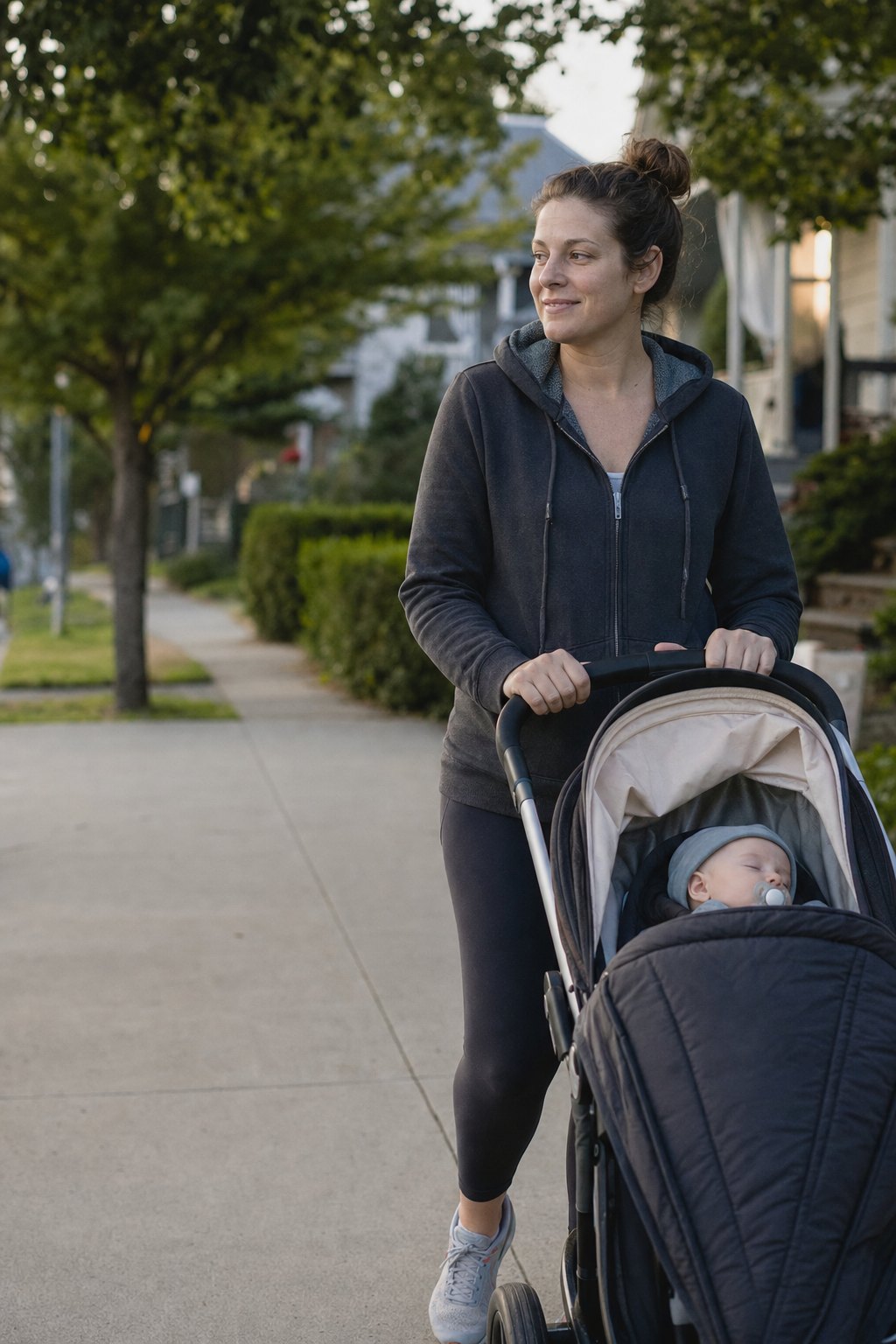
A woman on a morning walk pushing a stroller with a sleeping baby
168 lbsGoal145 lbs
how was the night? we'll size today's walk to it

Postpartum weight loss, from the sources

Most of the numbers people repeat about this window come from documents that disagree with each other. Here is what each one actually says, with its name attached, and the sources at the bottom.

The CDC's urgent maternal warning signs apply during pregnancy and in the year after delivery, and the instruction is to seek medical care immediately. They are a headache that won't go away or gets worse, dizziness or fainting, changes in vision, a fever of 100.4°F or higher, extreme swelling of hands or face, thoughts about harming yourself or your baby, trouble breathing, chest pain or a fast-beating heart, severe nausea and vomiting, severe belly pain that doesn't go away, heavy vaginal bleeding or passing tissue, and overwhelming tiredness, plus severe swelling, redness, or pain in a leg or arm during pregnancy and up to six weeks after birth (CDC Hear Her, reviewed May 2024). Cleveland Clinic sets its fever threshold higher at 101°F (Cleveland Clinic, updated 02/27/2024), so act on the lower CDC number. For mood, Postpartum Support International lists the PSI HelpLine at 1-800-944-4773, which works by callback after you leave a confidential message, the National Maternal Mental Health Hotline at 1-833-852-6262 by call or text, 24/7 in English, Spanish, and more than 60 other languages through interpreters, the National Suicide Prevention Hotline at 988, and the Crisis Text Line, text HOME to 741741 (Postpartum Support International).

When to start

ACOG says that after a healthy pregnancy and a normal vaginal delivery, you should be able to start exercising again soon after the baby is born, usually a few days after giving birth or as soon as you feel ready (ACOG FAQ131, updated September 2022, reviewed October 2024). After a cesarean birth or complications, ACOG's instruction is to ask your ob-gyn when it is safe to begin again. No source on this page names a week number for that, and every one of them defers to your provider. Cleveland Clinic says the same thing in plainer words, that your healthcare provider will let you know when it's safe to exercise (Cleveland Clinic, Postpartum, updated 02/27/2024).

Actively trying to lose weight has its own clock. La Leche League says to wait at least six to eight weeks after birth, because your body is recovering from birth and getting used to making milk (LLLI, updated November 2024). MedlinePlus draws a similar line and says to give yourself until your 6-week checkup (MedlinePlus, review date 10/1/2025). Office on Women's Health says to talk to your doctor before you start any type of diet or exercise plan (womenshealth.gov, updated September 26, 2025).

One piece of framing is worth carrying through the rest of this. ACOG calls the comprehensive postpartum visit a medical appointment and says it is not an "all-clear" signal, and that completing it does not remove the need for continued recovery and support through 6 weeks postpartum and beyond (ACOG Committee Opinion 736, reaffirmed 2025).
The rate the sources give

La Leche League, citing the Academy of Nutrition and Dietetics, puts safe and sustainable loss at one pound per week, or about four pounds per month (LLLI citing Academy of Nutrition and Dietetics 2022, updated November 2024). MedlinePlus goes higher and says losing about a pound and a half a week should not affect your milk supply or your health (MedlinePlus, review date 10/1/2025). Those two disagree, so both are printed here with their names on them.

MedlinePlus also gives the longer plan, that most women lose half of their baby weight by 6 weeks after childbirth and should plan to return to their pre-pregnancy weight by 6 to 12 months after delivery (MedlinePlus, review date 10/1/2025). What tends to happen is slower than the plan. In a US cohort of 774 women weighed directly, about 75% were heavier one year postpartum than before pregnancy, with 47.4% retaining more than 10 pounds and 24.2% more than 20 pounds, and mean retention at 6 months was 12.0 pounds (Endres et al., Obstetrics & Gynecology, 2015). That is one observational cohort of mostly low-income women at five US sites, so it describes a group and predicts nothing about you. No guideline body publishes those percentages, so do not read them as a CDC or ACOG statistic.

Office on Women's Health is deliberately vaguer and warns against rushing, saying not to expect or try to lose the additional pregnancy weight right away, and that gradual loss over several months is the safest way, especially while breastfeeding (womenshealth.gov, updated September 26, 2025). La Leche League puts it more kindly, that pregnancy weight wasn't gained overnight so it may not disappear very quickly either (LLLI, updated November 2024).

Calories while breastfeeding

The two US authorities publish different extra-calorie numbers. ACOG says your body needs about 450 to 500 extra calories a day to make breast milk, and that if your weight is in the normal range you need about 2,500 total calories per day (ACOG, Breastfeeding Your Baby, updated July 2023, reviewed November 2025). That is 700 calories above the La Leche League floor this page holds, and the two numbers are different things: the floor is the least you should eat, and ACOG's figure is what your body needs. The CDC puts it lower and recommends an additional 330 to 400 kilocalories per day for well-nourished breastfeeding mothers, adding that the need varies by age, BMI, activity level, and feeding method (CDC, Maternal Diet and Breastfeeding, reviewed August 25, 2026). Averaging them would invent a number neither one published, so both stay here with their names.

There is a floor underneath all of it. La Leche League says to eat at least 1,800 calories a day to support your milk production while losing weight (LLLI, updated November 2024). I will never set you a target below that number while you are breastfeeding.

Whether eating less costs you supply has a conditional answer in the sources. Office on Women's Health says nursing mothers can safely lose a moderate amount of weight without affecting their milk supply or their babies' growth (womenshealth.gov, updated September 26, 2025). For a breastfeeding woman who is overweight, the NHS says a healthy balanced diet plus regular moderate exercise, such as a brisk 30-minute walk each day, will not affect the quality or quantity of your breast milk (NHS, Keeping fit and healthy with a baby, reviewed 20 April 2026). La Leche League adds the counterweight and says eating fewer calories can sometimes affect supply, and that your baby's weight gain is the signal to keep an eye on (LLLI, updated November 2024).

What to avoid while breastfeeding

La Leche League says severe restriction of any macronutrient, including protein, carbohydrates, or fats, is not recommended during breastfeeding (LLLI citing Hart et al. 2022, updated November 2024). It names a specific hazard for very low-carb and strict keto diets, that some case studies suggest they may result in serious medical effects such as lactational ketoacidosis. LLLI describes that as a rare health emergency usually related to very low carbohydrate or calorie consumption during lactation, with symptoms including nausea, vomiting, malaise, and abdominal pain, and its instruction is to check with a dietitian or healthcare provider before starting one of those diets while breastfeeding (LLLI, updated November 2024).

Weight-loss products get the same treatment. La Leche League says supplements, shakes, and similar items marketed for weight loss are not generally recommended during breastfeeding, because they often haven't been researched for it and aren't subject to the quality control that medications are, and that prescription weight-loss medications are not recommended during the first year of breastfeeding (LLLI, updated November 2024). NHS adds a practical one, that if you join a weight-loss group you should tell them you recently had a baby and whether you're breastfeeding, so they give you the right advice (NHS, reviewed 20 April 2026).

Caffeine has three published numbers and no agreement between them. The CDC calls a low to moderate amount about 300 milligrams or less per day, roughly 2 to 3 cups of coffee (CDC, reviewed August 25, 2026). ACOG says moderate amounts, at 200 milligrams a day, most likely will not affect your baby (ACOG, Breastfeeding Your Baby, reviewed November 2025). USDA WIC says up to 2 cups a day (USDA WIC, Nutrition While Breastfeeding). Pick the source you're following and know which one it is.

Sleep

Sleep shows up in this literature as one measured association. In Project Viva, a cohort of 940 women, sleeping five hours a day or less at 6 months postpartum was strongly associated with retaining 5 kilograms or more at one year, with an adjusted odds ratio of 3.13 compared with seven hours (Gunderson et al., American Journal of Epidemiology, 2008). That is a single observational cohort with self-reported sleep, so it shows a link and proves no cause. The authors' own conclusion is the safe line to carry, that interventions to prevent postpartum obesity should consider strategies to attain optimal maternal sleep duration (Gunderson 2008).

Telling someone eight weeks postpartum to get seven hours is asking for something she may not control. ACOG treats sleep as a care domain and lists coping options for fatigue and sleep disruption, along with engaging family and friends in assisting with care responsibilities, among what the comprehensive postpartum visit should cover (ACOG Committee Opinion 736, reaffirmed 2025). So I keep the sleep debt from what you tell me and bend the day around it, and I hand you no hours target.
Diastasis recti

Cleveland Clinic says separated stomach muscles affect 6 in 10 women after childbirth, that the separation usually develops in the third trimester, and that you may not notice the signs until several weeks after your baby is born (Cleveland Clinic, Diastasis Recti, updated 04/21/2025). A gap wider than 2 centimeters counts as diastasis recti, and on the self-check that is a feel of two or more finger widths, which Cleveland Clinic says to discuss with your healthcare provider (Cleveland Clinic).

Cleveland Clinic's list of what to avoid in the first six weeks postpartum is short and specific. Avoid lifting anything heavier than your baby. Roll onto your side when getting out of bed or sitting up, and use your arms to push yourself up. Skip activities and movements that push your abdominals outward, such as crunches and sit-ups (Cleveland Clinic, updated 04/21/2025). On belly binders, it says they can't heal diastasis recti and won't strengthen your core muscles, though they can be a helpful reminder to engage your core and use good posture (Cleveland Clinic).

The program is meant to be supervised. Cleveland Clinic says to be sure an exercise program is safe for diastasis recti before starting it, and to work with a physical therapist who has experience with the condition (Cleveland Clinic). It also says it's never too late to repair your diastasis recti (Cleveland Clinic). NHS puts the usual timeline at the separation going back to normal by the time your baby is 8 weeks old, and gives the same avoid-list of sit-ups, planks, high-impact exercise, straining on the toilet, and heavy lifting (NHS, Your post-pregnancy body, reviewed 20 July 2026).

Postpartum depression

ACOG describes the baby blues as feeling depressed, anxious, and upset starting about 2 to 3 days after childbirth, with crying for no clear reason, trouble sleeping, eating, and making choices, and questioning whether you can handle caring for a baby. It says the baby blues usually get better within a few days or 1 to 2 weeks without any treatment (ACOG FAQ, Postpartum Depression, reviewed December 2025). Postpartum depression sits in a wider window, and ACOG says it can occur up to 1 year after having a baby and most commonly starts about 1 to 3 weeks after childbirth (ACOG).

ACOG's instruction is the one that belongs on a page about weight. Call your ob-gyn or another health care professional right away if you think you may have postpartum depression, or if your partner or family members are concerned that you do, and do not wait until your postpartum checkup to talk with them (ACOG, reviewed December 2025). Office on Women's Health puts a clock on it and says that if sadness lasts more than two weeks, go see your doctor without waiting for the postpartum visit (womenshealth.gov, updated September 26, 2025).

Two of the signs Office on Women's Health lists are appetite changes, being unable to eat with weight loss, and overeating with weight gain (womenshealth.gov, updated September 26, 2025). An appetite that crashes or runs away is worth raising with your provider, and I'll say so when I see it in the record.

What I do with all this, and what I don't

I never diagnose, never clear you for exercise, and never set a calorie target below the 1,800 La Leche League names while you're breastfeeding. The daily part is what I'm for. You text me the food and I log it with the calories and protein. We run the week off a meal plan you actually like, or off the one your dietitian gave you. We pick movement you'll keep doing, and walking counts. I keep the sleep debt from what you tell me, and after a night up with the baby the targets come down. On Once a week I send a recap with the weight trend, and when a target keeps getting missed I say the target is wrong for your life.

I also hold what you report against the warning-sign list above, and when something on it turns up I say so and tell you to call.

No clinician reviewed this page. It restates the ACOG, CDC, Cleveland Clinic, MedlinePlus, NHS, Office on Women's Health, USDA WIC, La Leche League, and Postpartum Support International pages and the two studies linked below, and those are the documents to trust over anything here.

What you can do with BodyBuddy

I log what you eat and hold the floor

A photo or a sentence, and I log it with the calories and protein. While you're breastfeeding I keep the day above the 1,800 calories La Leche League names, and I tell you when you're running under it.

logged it. you're at 1,180 and you're nursing, so we've got room before bed. want something easy with protein?

I change the day after a bad night

Tell me how the night went, or let your device tell me, and I keep the sleep debt. After a rough one the targets come down and the walk gets shorter, and I say so before you have to ask.

up four times? then today is the short walk and protein at breakfast. we'll leave the rest of it alone.

I send a weekly recap with the trend

You tell me how the week felt and I tell you what I saw. Weigh in whenever you weigh in and text me the number, and I send the trend so you're reading weeks instead of mornings.

here's the last 6 weeks 📉 the flat stretch is the week she was teething. that tracks.

Text like you're talking to a friend

Tap to start a conversation if this sounds like you.

What happens after the first text

Everything above starts from one text, and the baseline week starts the day you send me the first meal. Tell me how far out you are and whether you're breastfeeding, and we set the targets around that with the floor held. Your provider clears the exercise and I work inside what they told you. If something you report lands on the warning-sign list, I say so and tell you to call the office.

Francis, founder of BodyBuddy

Hi, I'm Francis 👋

If you're like me, staying consistent is the hard part. I built BodyBuddy to give everyone the daily accountability to follow through.

Francis John, BodyBuddy FounderText me

7-day free trial, cancel anytime.

No one is reading your texts

Nobody monitors your thread. A conversation is reviewed by our own staff only in limited cases, such as a request for human help or a safety concern, and never shared outside.

Your data is yours to delete

You can request deletion of your personal data at any time, and deleting your account removes it from our systems.

Not sold or used for advertising

We do not sell consumer health data or share it for advertising. Service providers process it only to deliver the features you choose.

Everyone gives you a plan.BodyBuddy texts you until it happens.

A coach that stays with you through every plan, every setback, and all the days in between.