
← All posts
FrancisComparison
Bevel Alternative: BodyBuddy vs Bevel (2026)
Compare Bevel and BodyBuddy for wearable analytics, recovery, food logging, health plans, and proactive daily accountability by text.
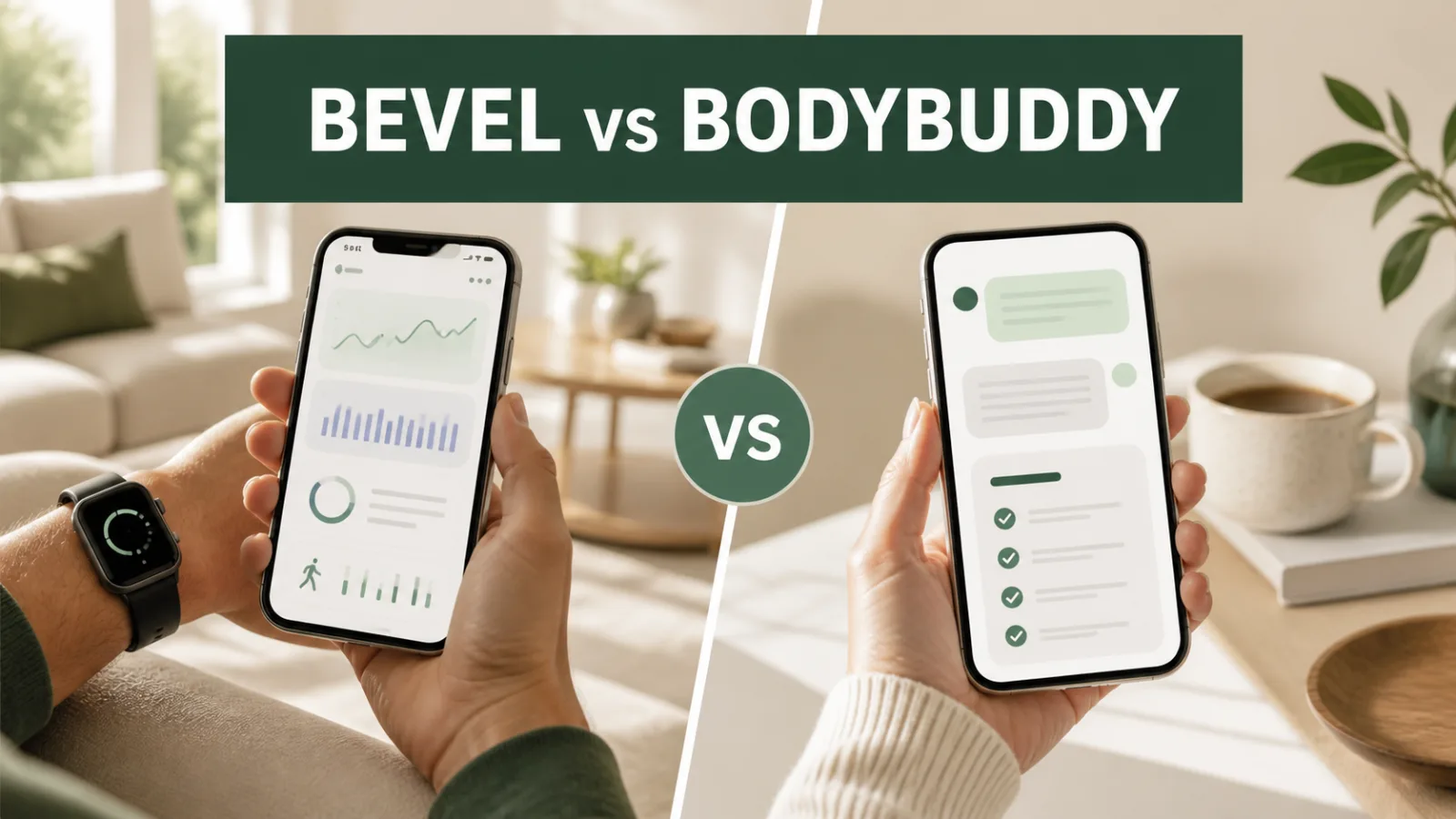
The short answer: choose Bevel if you want deep health, recovery, sleep, strain, and training insights from wearable data. Choose BodyBuddy if you want a coach that texts you, follows up when you go quiet, and helps turn your own plan—or instructions from a doctor, physical therapist, dietitian, or coach—into daily action.
This is no longer a comparison between a health dashboard and a coach. As of August 20, 2026, Bevel offers a capable AI coach, scheduled check-ins, meal and training plans, health-record analysis, and extensive tracking. The real distinction is data-first health intelligence versus iMessage-first daily follow-through.
Disclosure: This comparison is published by the creators of BodyBuddy. We reviewed current public product documentation from both companies and have been explicit about the areas where Bevel is stronger.
Bevel vs BodyBuddy at a glance
Best for | Wearable analytics, recovery, sleep, strain, biomarkers, and detailed training data | Daily text accountability and following through on an existing health plan |
Core experience | A health-data platform with dashboards, scores, tracking, and an in-app AI coach | An AI accountability coach that works primarily through iMessage |
Wearable analytics | Detailed Recovery, Sleep, Strain, Stress, Energy Bank, HRV, and other metrics | Uses data synced through Apple Health to make coaching and check-ins more relevant |
Proactive check-ins | Yes, through scheduled Bevel Intelligence check-ins | Yes, through ongoing text conversations |
Food logging | Images, text, barcodes, recipes, and a large food database | Photos, text, and voice, with calories, protein, and conversational feedback |
Meal planning | Yes | Yes, including shopping lists |
Workout planning | Detailed training plans, workout templates, progression, and recovery analysis | Workout plans, plan imports, logging, and daily accountability |
Bring an existing plan | Can create workout templates from images and build plans with Bevel Intelligence | Can import plans and documents from doctors, PTs, dietitians, coaches, or other sources |
Doctor appointments | Can store and analyze health records; appointment recording is not listed in its public feature documentation | Can record a visit with permission, create a transcript and summary, extract next steps, and carry them into daily coaching |
Where the coach lives | Primarily inside Bevel | Primarily in iMessage |
Platforms | iPhone and Apple Watch | iPhone and iMessage |
Free option | Extensive permanent free tier | Seven-day free trial, followed by a paid subscription |
Paid pricing | Pro: $14.99/month or $99.99/year | Seven-day trial; standard monthly offer $29.99; exact price shown at checkout |
Prices checked August 20, 2026. App Store and regional pricing can change.
What Bevel actually does in 2026
Bevel began with a reputation as a polished way to make Apple Health and wearable data easier to understand. That description is now incomplete.
The free version of Bevel includes:
- Recovery, Sleep, Strain, Stress, and Energy Bank scores
- Nutrition tracking
- Strength Builder
- Fitness and cardio tracking
- Health monitors
- Cycle tracking
- Journaling
- Apple Watch apps, widgets, and complications
Bevel Pro adds Bevel Intelligence, Health Records, and Biological Age.
Bevel Intelligence can answer questions about your health data, create meal and training plans, log food conversationally, build charts, analyze relationships between habits and outcomes, and schedule recurring summaries or reminders. You can also choose coaching personalities ranging from a supportive “Friend” to a more analytical “Data Nerd.”
Bevel can connect directly to Garmin, Oura, and Google Health data in addition to working with Apple Health. The exact metrics available depend on the device. Some features remain Apple Watch-specific; for example, Bevel says its Smart Alarm currently requires an Apple Watch.
This makes Bevel especially strong for someone asking:
- Did poor sleep affect my recovery?
- Is my training strain rising faster than my recovery?
- What habits appear to correlate with better HRV?
- How should today’s workout change based on my recent data?
- What do my blood biomarkers add to the picture?
That type of quantified-health analysis is Bevel’s clearest advantage.
What BodyBuddy is designed to do
BodyBuddy starts from a different problem: people often have enough information and still do not follow through.
A workout plan does not notice when you disappear. An after-visit summary does not ask whether you booked the follow-up. A meal plan does not help when the original dinner falls apart at 7 p.m.
BodyBuddy works primarily through text. You can share what you ate, how you slept, whether you moved, and what got in the way. BodyBuddy can then follow up, help you adjust the day, and keep the plan active after the motivated first week passes.
The current BodyBuddy experience includes:
- Proactive daily coaching through iMessage
- Photo, text, and voice logging
- Nutrition, movement, sleep, hydration, and habit tracking
- Meal and workout planning
- Shopping lists
- A structured 90-day health program
- Plans imported from documents, screenshots, and professional instructions
- Optional appointment recording, transcription, summaries, and next steps
- Health data synced through Apple Health, including supported data originating from Apple Watch, Fitbit, Garmin, Oura, and WHOOP
- Gamified accountability through Future You, missions, badges, and a leaderboard
BodyBuddy is not attempting to reproduce Bevel’s depth of recovery scoring or wearable analysis. Its purpose is to turn a plan into a conversation that keeps happening.
The biggest difference: insight versus execution
Bevel is strongest when your health data is the starting point.
It gathers information from wearables, workouts, food logs, records, and biomarkers, then helps you understand what those signals mean. If you enjoy examining recovery trends, sleep stages, HRV, strain, and relationships between behaviors, Bevel has the richer analytical system.
BodyBuddy is strongest when your plan is the starting point.
That plan might come from:
- Your own goals
- A doctor’s appointment
- A physical therapist’s home-exercise program
- A registered dietitian’s meal structure
- A trainer’s workout routine
- A therapy session
- An after-visit summary
- A program you found or purchased elsewhere
BodyBuddy’s job is to keep that plan present in daily life through text.
The distinction matters because insight and follow-through are separate problems. Knowing that your sleep score dropped does not necessarily get you into bed earlier tonight. Having a rehabilitation worksheet does not guarantee that you will do the exercises. Understanding a nutrition target does not solve the difficult meal at the end of a difficult day.
Where Bevel is better
1. Wearable and recovery analytics
This is Bevel’s clearest win.
Its free dashboards cover sleep, recovery, strain, stress, cardiovascular metrics, training, and more. Bevel Intelligence can then analyze relationships within that history and present more detailed conclusions.
BodyBuddy can use data synced through Apple Health to inform coaching, but it is not a substitute for Bevel’s analytical depth.
2. A highly capable free tier
Bevel made nearly its entire core tracking experience free. Recovery, sleep, strain, stress, nutrition, training, cycle tracking, health monitors, and journaling do not require Pro.
BodyBuddy offers a seven-day trial but is fundamentally a paid accountability service.
If your budget is zero and you mainly want health tracking, Bevel is the obvious choice.
3. Detailed workout tooling
Bevel includes a large exercise library, Strength Builder, muscular-strain feedback, workout history, progressive-overload guidance, and training plans that can respond to recovery data.
BodyBuddy can help create, import, and follow a workout plan, but Bevel is better suited to someone who wants detailed workout execution and analysis inside the same app.
4. Biomarkers and health-data exploration
Bevel Pro can ingest health records and display blood biomarkers alongside its other health data. It also uses wearable and biomarker information for its Biological Age feature.
BodyBuddy can organize professional instructions and use them in coaching, but it does not currently offer an equivalent quantified-self analysis system.
Where BodyBuddy is better
1. Coaching through iMessage
BodyBuddy does not wait for you to remember to open a health app. The coach reaches you through the same messaging interface you already use throughout the day.
That changes the interaction from:
“I should check my health dashboard.”
to:
“My coach asked what happened with the workout I planned.”
Bevel supports scheduled check-ins, but those check-ins remain part of the Bevel product experience. BodyBuddy is designed around the conversation itself.
2. Carrying professional instructions into everyday life
BodyBuddy is built to import plans from the professionals already helping you.
For example, you can bring in:
- A physical therapy exercise sheet
- A doctor’s after-visit summary
- A dietitian’s nutrition plan
- A trainer’s workout program
- A coach’s written instructions
BodyBuddy can organize that material into a plan and use it as context for future conversations. This does not replace the professional. It helps keep their instructions from disappearing between appointments.
3. Recording a visit and following through afterward
With permission, BodyBuddy can record a health or fitness appointment, transcribe it, create a plain-language summary, extract next steps, and give the coach context for daily follow-up.
Bevel’s public documentation describes uploading and analyzing health records, including clinical reports, lab results, medications, and imaging reports. We did not find appointment recording in its documented feature set.
Those are different workflows:
- Bevel helps you understand records and health data.
- BodyBuddy helps capture what was said and carry the instructions into everyday action.
4. Support when the day stops matching the plan
Plans rarely fail in tidy, measurable ways. They fail because work ran late, the planned groceries were unavailable, soreness changed the workout, or one missed action turned into an abandoned week.
A conversational coach is useful in those moments because you can explain what changed and decide what still counts today.
That course correction—not another chart—is often the point of BodyBuddy.
Where Bevel and BodyBuddy overlap
The overlap is larger than it first appears.
Both products can now help with:
- Daily check-ins
- Nutrition logging
- Meal planning
- Workout planning
- Health-data context
- Habit tracking
- Uploaded information
- Long-term memory and personalization
It would therefore be misleading to describe Bevel as passive or to claim that BodyBuddy is the only one offering accountability.
The better question is where you want the center of gravity to be.
With Bevel, the center is your health data.
With BodyBuddy, the center is the ongoing coaching relationship and the plan you are trying to carry out.
Pricing
Bevel pricing
According to Bevel’s current pricing documentation:
- Free: $0
- Pro monthly: $14.99/month
- Pro annual: $99.99/year, or about $8.33/month
An additional 12-month commitment option at $10.99/month exists in eligible markets but is not currently offered in the United States or Singapore.
The free tier includes Bevel’s core tracking features. Pro is required for Bevel Intelligence, Health Records, and Biological Age.
Bevel Pro includes a weekly Bevel Intelligence allowance. Standard tracking, free AI food logging, and workout-template generation do not consume those credits, but direct AI-coach messages and daily check-ins do.
BodyBuddy pricing
BodyBuddy offers a seven-day free trial. The standard monthly offer is currently $29.99, and the exact price for any available plan is displayed during checkout.
BodyBuddy’s subscription is priced more like an ongoing coaching service than a health-data dashboard. It includes unlimited texting with the coach, daily follow-up, logging, plans, and the broader accountability system.
Platforms and integrations
Bevel
Bevel’s official mobile listing supports iPhone and Apple Watch. It can pull data from:
- Apple Health
- Garmin Connect
- Oura
- Google Health, including supported Fitbit data
- Other devices that write compatible data to Apple Health
Available metrics and limitations vary by source. Google Health compatibility should not be confused with a native Android Bevel app.
BodyBuddy
BodyBuddy is available for iPhone and works natively through iMessage. It can use compatible health and fitness data synced through Apple Health, including supported data originating from:
- Apple Watch
- Fitbit
- Garmin
- Oura
- WHOOP
If you use Android, Simple, Zing, Noom, or another cross-platform coach may be a better fit than either of these products.
Can you use Bevel and BodyBuddy together?
Potentially, yes.
There is no documented direct integration between Bevel and BodyBuddy. However, both can operate within the broader Apple Health ecosystem.
A sensible combination would be:
- Use Bevel for recovery, sleep, strain, workout, and health-data analysis.
- Use BodyBuddy for daily accountability and following through on the decisions that come from those insights.
That may be excessive if you want one simple product. But it is a reasonable pairing for someone who values Bevel’s data depth and still wants a coach that reaches out by text.
Choose Bevel if…
Choose Bevel if:
- Your Apple Watch, Garmin, Oura Ring, or other wearable is central to how you manage your health.
- You want detailed recovery, sleep, strain, stress, and training analysis.
- You enjoy looking for relationships across health data.
- You want a robust free health-tracking product.
- Progressive training and workout analytics matter more than text accountability.
- You want to upload biomarkers or health records for broader analysis.
Choose BodyBuddy if…
Choose BodyBuddy if:
- You already have a plan but struggle to follow it consistently.
- You want a coach that proactively texts you.
- You do not want to remember to open another dashboard.
- You want to import instructions from a doctor, PT, dietitian, trainer, or coach.
- You want to record an appointment with permission and carry its next steps into daily life.
- Your goals span meals, movement, sleep, appointments, and habits rather than wearable optimization alone.
- The hard part is recovering after an imperfect day instead of generating more data.
Final verdict
Bevel is the stronger health-data product. Its free tracking tier is unusually comprehensive, its wearable analytics are much deeper, and Bevel Intelligence has become a legitimate AI coaching and planning system.
BodyBuddy is the stronger fit for someone who wants health accountability to feel like an ongoing text relationship. Its clearest advantage is not that it knows more about HRV or recovery. It is that it can take the plan you already have—including instructions from a professional—and keep bringing that plan back into daily life.
Choose Bevel when you want to understand your body.
Choose BodyBuddy when you need help following through.
For a wider market comparison, see The Best AI Health Coaching Apps of 2026.
Frequently asked questions
Is Bevel an AI health coach?
Yes. Bevel Pro includes Bevel Intelligence, which can analyze your health data, answer questions, create nutrition and training plans, schedule check-ins, and generate recurring summaries. Describing Bevel as only an Apple Health dashboard is outdated.
Is Bevel free?
Bevel has an extensive free tier covering recovery, sleep, strain, stress, nutrition, training, health monitors, cycle tracking, and journaling. Bevel Intelligence, Health Records, and Biological Age require Pro.
Can Bevel work without an Apple Watch?
Yes. Bevel documents direct support for Garmin, Oura, and Google Health data in addition to Apple Health. Some metrics are limited depending on the source, and certain features—such as Smart Alarm—still require an Apple Watch.
Does BodyBuddy analyze wearable data?
BodyBuddy can use compatible health data synced through Apple Health to make coaching and accountability more relevant. It does not attempt to match Bevel’s depth of recovery, strain, sleep, HRV, and biomarker analysis.
Can BodyBuddy record a doctor’s appointment?
Yes. With everyone’s permission and in accordance with applicable recording laws, BodyBuddy can record an appointment, transcribe it, summarize it, extract next steps, and use the resulting plan as context for daily coaching.
Can Bevel import an existing workout plan?
Yes. Bevel can create workout templates from an image or description, and Bevel Intelligence can generate plans and files. BodyBuddy also imports workout plans, but focuses more heavily on helping you complete the plan through daily conversation.
Which is better for weight loss?
Choose Bevel if wearable insights, food tracking, recovery, and exercise analytics help you stay engaged. Choose BodyBuddy if your larger problem is consistency and you want proactive daily accountability by text.
Neither product replaces medical care or individualized guidance from a licensed clinician or registered dietitian.
Is either product available on Android?
BodyBuddy is currently iPhone and iMessage-focused. Bevel’s official mobile listing is also for iPhone and Apple Watch. Bevel can read some Google Health and Fitbit data, but that does not mean it provides a native Android app.
Sources
Product features and pricing were checked on August 20, 2026:
Next steps
Related BodyBuddy guides
Everyone gives you a plan.BodyBuddy texts you until it happens.
BodyBuddy keeps you on track—from meals to doctor's appointments and everything in between.