
Fitness|August 12, 2026|BodyBuddy Team
12-3-30 Workout: Benefits, Beginner Plan, and What Research Says
Learn the 12-3-30 treadmill workout, what research actually shows, how to use 12% incline safely, and a practical beginner ramp.
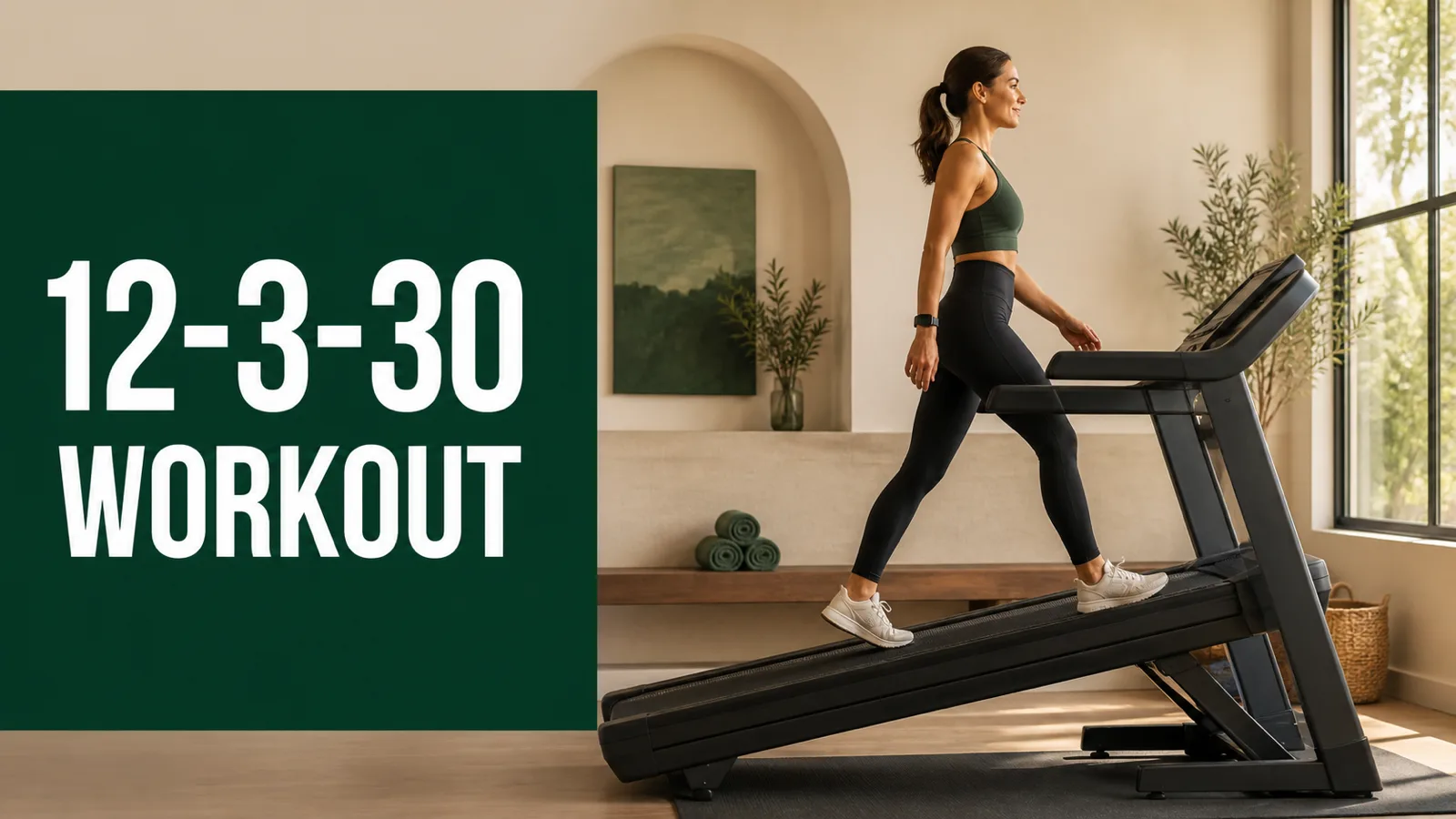
The 12-3-30 workout is simple to remember: set a treadmill to a 12% incline, walk at 3 miles per hour, and continue for 30 minutes. That is 4.8 km/h if your treadmill uses metric units.
Simple does not mean easy. A 12% grade is a steep, sustained hill, and 3 mph can be an aggressive pace at that incline. If you cannot complete the original settings with controlled form, the useful move is not to hang on and suffer through it. Lower the incline, speed, or duration, then build up.
What is the 12-3-30 workout?
The name is the treadmill prescription:
- 12: a 12% incline
- 3: a speed of 3 mph, or about 4.8 km/h
- 30: 30 minutes of continuous walking
Content creator Lauren Giraldo popularized the routine after first sharing it on YouTube in 2019 and later on TikTok. The memorable formula helped turn ordinary incline walking into one of the internet's best-known treadmill workouts.
One technical detail matters: the “12” means a 12% grade, not a 12-degree angle. A 12% grade rises 12 units for every 100 units traveled horizontally. If your machine displays an unlabeled “level 12” instead of a percentage, check the treadmill manual; incline scales are not identical across every machine.
The named 30 minutes also does not include a warm-up or cool-down. Hospital for Special Surgery recommends warming up for 5 to 10 minutes at a low speed and incline before beginning the work interval.
Is 12-3-30 a good workout?
It can be. The routine combines a substantial incline with a brisk walking speed, so it can provide a demanding aerobic session without requiring you to run. It also removes most of the decisions that make gym sessions easy to postpone: the incline, speed, and duration are already chosen.
But there is nothing uniquely perfect about those three numbers. An exercise physiologist at Hospital for Special Surgery notes that the same idea can become 10-3-30, 5-2-30, or 12-3-15. The useful principle is finding a challenging but tolerable workload and improving it over time—not forcing a viral formula before you are ready.
It is steady cardio, not HIIT
At the original settings, 12-3-30 is a continuous, steady treadmill workout. It is not high-intensity interval training because there are no planned work and recovery intervals.
That does not mean it feels easy. Exercise intensity is personal. According to the American College of Sports Medicine, a moderate effort generally allows a steady conversation, while at vigorous intensity you can sustain only a few words. If 12-3-30 leaves you able to say only short phrases, it is vigorous exercise for you even though you are walking.
The incline changes the muscular demand
Walking uphill requires your body to repeatedly lift itself against gravity. Research on inclined treadmill walking has found changes in gait and greater activation in several lower-body muscles compared with level walking. You may especially feel the work in your calves, hamstrings, and glutes.
That does not make 12-3-30 a replacement for strength training. The CDC recommends that adults pair aerobic activity with muscle-strengthening work on at least two days each week. Incline walking can challenge your legs, but it does not progressively train every major muscle group the way a balanced resistance program can.
The fixed format may make consistency easier
The routine's most practical advantage may be its simplicity. You do not need to choose exercises, remember intervals, or follow choreography. You set three numbers and walk.
That can be valuable if uncertainty is what keeps you from starting. A workout does not need to be novel to be useful; it needs to be repeatable enough to become part of your week.
What does research say about 12-3-30?
A 2025 exploratory study directly compared 12-3-30 with self-paced treadmill running. Sixteen recreationally active adults enrolled. One participant could not complete 12-3-30, another did not complete the second visit, and the main comparison included 14 people.
During 12-3-30, those 14 participants expended an average of about 308 calories over 30 minutes. They reached the same total energy expenditure during the self-paced run in about 24 minutes, meaning running expended energy faster. The incline walk used a higher percentage of fat and a lower percentage of carbohydrate during the session than the run.
Those findings need context:
- The sample was small and mostly young, recreationally active adults.
- The study measured one workout, not changes in fitness, weight, or body composition over time.
- The two sessions were intentionally matched for total energy expenditure.
- A higher percentage of fat used during one workout does not prove greater long-term body-fat loss.
The researchers explicitly noted that long-term trials are still needed. The study shows that 12-3-30 creates a real metabolic challenge. It does not show that it is a uniquely effective weight-loss method or that everyone will burn 308 calories.
How to do the 12-3-30 workout
1. Warm up for 5 to 10 minutes
Begin at an easy walking speed and a low incline. Let your breathing rise gradually and notice how your feet, calves, knees, and hips feel.
Do not step directly onto a belt already moving at the full workout settings. Start the treadmill slowly, use the rails while getting situated, attach the safety clip if the machine has one, and increase the settings gradually.
2. Set the incline to 12%
Raise the deck to a 12% grade. If your treadmill stops below 12%, its maximum incline is a valid substitute. Do not improvise by lifting the machine or putting objects under it.
3. Set the speed to 3 mph
Three miles per hour is approximately 4.8 km/h. Treat it as a target, not a test of character. If you must pull yourself forward with the rails to keep pace, lower the speed or incline.
4. Walk for 30 minutes
Keep the effort controlled and your stride comfortable. The goal is not to survive 30 sloppy minutes; it is to maintain a workload you can handle with stable form.
5. Cool down
Lower the incline and speed, then walk easily for several minutes. Let your breathing settle before stopping the belt and stepping off.
Form cues that make steep treadmill walking better
At a steep grade, small form problems become more noticeable. Use these cues:
- Look ahead. Keep your chin level instead of staring down at your feet.
- Stay long through your torso. A slight whole-body lean into the hill is normal, but avoid folding sharply at the waist.
- Use a comfortable stride. Do not reach far forward with every step just to keep up with the belt.
- Let your arms move. Natural arm swing can help with rhythm and balance.
- Use the handrails for getting on, getting off, or regaining balance—not to tow yourself through the workout. If you need continuous support, reduce the settings.
Holding the rails changes the workload and can hide the fact that the speed or grade is too high. Lowering a number is a better modification than using the original display settings with compromised form.
A beginner ramp to 12-3-30
There is no clinically validated “official” beginner progression for this social-media workout. The safest useful rule is to adjust one variable at a time and repeat a level until it feels controlled.

Use the following as a flexible ramp, not a deadline:
Start with 5-2-15
Walk at a 5% incline and 2 mph for 15 minutes after warming up. If that already feels hard, lower any of the three numbers. Your true starting point is the version you can complete without pain, panic, or constant rail support.
Build the duration first
Keep the incline and speed manageable while extending the work interval toward 20, then 25, then 30 minutes. Repeat each duration for multiple sessions before progressing if needed.
Add either incline or speed
Once 30 minutes feels controlled, raise only one setting. For example, move from 5% to 6% incline while keeping the same speed, or increase the speed by 0.1 to 0.2 mph while keeping the grade unchanged.
Approach the full settings gradually
Continue making small changes over multiple sessions. Another valid route is to reach 12% incline at a slower pace, then build the speed toward 3 mph. If your form breaks down, return to the previous setting.
Try the original workout only when the ramp is no longer a struggle
The milestone is 12%, 3 mph, and 30 minutes with controlled form. There is no prize for reaching it in a particular week. HHS guidance emphasizes that people who are not currently active should start slowly and do what they can; even short bouts of activity count.
What if 12-3-30 is too hard?
Change the workout. You are not “failing” it—you are scaling the dose.
Lower the incline
Try 5%, 8%, or 10% while keeping the 30-minute structure. This preserves the simple steady-walk format while reducing the hill.
Lower the speed
Keep some incline but walk at 2 to 2.5 mph. Pace depends on leg length, treadmill familiarity, and current fitness; 3 mph is not universally appropriate.
Shorten the work interval
Try 10 or 15 minutes at the target settings, then finish with easier walking. You can also split the hill into shorter bouts with level recovery between them, although that becomes an interval variation rather than the original continuous routine.
Use effort instead of matching someone else's display
Aim for an effort that feels challenging but sustainable. If you can speak in full sentences, you are likely around moderate intensity. If only a few words are comfortable, ACSM classifies that as vigorous territory. Back off if you cannot regain control of your breathing or maintain your form.
Can you do 12-3-30 without a treadmill?
You cannot reproduce the three exact settings without a treadmill, but you can reproduce the idea: sustained uphill walking at a purposeful effort.
Useful alternatives include:
- Repeating a long outdoor hill
- Walking stadium ramps
- Using a stair-climbing machine at a sustainable pace
- Alternating brisk and easy walking if you have only flat ground
- Using the Japanese walking method, which alternates three-minute easy and brisk intervals and requires no fixed incline
A flat walking pad does not become 12-3-30 simply because you walk for 30 minutes. It can still provide worthwhile activity; it just delivers a different workload. Use the talk test to choose an intensity that fits your goal.
Does 12-3-30 help with weight loss?
It can contribute, but it is not a weight-loss loophole.
The workout expends energy, and regular activity can help create the sustained energy deficit required for weight loss. The direct 2025 study found meaningful energy expenditure during a single session, but it did not test whether doing 12-3-30 causes weight loss over weeks or months.
Your calorie expenditure will vary with body size, fitness, the accuracy of the treadmill's grade, whether you hold the rails, and how closely you maintain the settings. Treadmill and watch estimates should be treated as estimates, not a budget of calories you have “earned” back.
The study's finding of higher fat utilization during 12-3-30 than during running is also easy to misread. Burning a higher percentage of fat during one workout does not automatically mean losing more body fat. Long-term weight change depends on overall energy balance, not which fuel source briefly supplied the larger share of one exercise session.
If weight loss is your goal, consistency across activity, food, sleep, and recovery matters more than protecting the numbers 12, 3, and 30. Our guide to whether walking is enough to lose weight explains the bigger picture.
How often should you do 12-3-30?
There is no research-backed frequency that everyone should follow. The routine's creator described doing it about five times per week, but that is a personal routine—not a clinical recommendation.
Count the session according to how hard it is for you. Federal guidelines recommend at least 150 minutes per week of moderate-intensity aerobic activity, 75 minutes of vigorous activity, or a combination, plus muscle-strengthening activity on two days. A full 12-3-30 session may be moderate for one person and vigorous for another.
If you are new to steep incline walking, begin with one or two modified sessions and easier movement on other days. Increase only if your calves, feet, Achilles tendons, knees, and overall energy are recovering well. More is not automatically better, especially when every session repeats the same steep grade.
A balanced week can include incline walking, easier walks, and strength work rather than five identical treadmill sessions. If you are starting from scratch, this beginner walking routine offers a gentler foundation.
When to stop or get medical guidance
Ordinary exertion can include faster breathing, a higher heart rate, warmth, and muscle fatigue. Sharp pain, instability, or escalating joint or tendon pain is not a cue to keep pushing.
Stop the workout and seek urgent medical help for chest pain or pressure, fainting, or severe or unusual shortness of breath. If you are pregnant, have a known cardiovascular or metabolic condition, experience balance problems, or are returning after injury or surgery, ask a qualified healthcare professional how to adapt the workout to you.
Pain in the Achilles tendon, feet, calves, knees, hips, or back is a reason to reduce the grade or stop—not evidence that the workout is “working.”
Making a simple workout happen consistently
The numbers are easy to remember. Showing up on a busy Tuesday is the harder part.
BodyBuddy can turn a workout intention into a daily accountability loop through text-based check-ins. Tell BodyBuddy which version you plan to do—whether that is 5-2-15 or the full 12-3-30—and the coach can follow up on whether it happened, help you notice patterns, and keep the plan from disappearing after one motivated week. Your activity and progress are also visible in the BodyBuddy app.
That support should not pressure you to ignore pain or force a setting. The goal is consistent follow-through on the right version for you.
Frequently asked questions
Is 12-3-30 good for beginners?
The original settings are not automatically beginner-friendly. A 12% incline at 3 mph is challenging, and one recreationally active participant in the small 2025 laboratory study could not complete the session. Beginners can use the format, but most should start with a lower incline, slower speed, shorter duration, or a combination of all three.
Is the incline 12% or 12 degrees?
It is a 12% grade. That is approximately 6.8 degrees. If your treadmill uses “levels” rather than percentages, check its documentation instead of assuming level 12 equals a 12% grade.
How many miles is the 12-3-30 workout?
At a constant 3 mph for 30 minutes, the treadmill records 1.5 miles, or about 2.4 kilometers.
How many calories does 12-3-30 burn?
In a small 2025 study, 14 recreationally active adults who completed both test conditions averaged about 308 calories during 12-3-30, with substantial variation. That is not a universal estimate. Body size, fitness, treadmill settings, and handrail use all affect energy expenditure.
Is 12-3-30 better than running?
Neither is universally better. In the direct study, self-paced running expended the same total energy in less time, while 12-3-30 used a higher percentage of fat during the session. Incline walking may suit people who dislike running, while running may suit people prioritizing time efficiency. The better choice is one you can perform safely and repeat consistently.
Does 12-3-30 build glutes?
Uphill walking increases demand on several lower-body muscles, including the glutes, compared with level walking. That can improve muscular endurance, but there is no evidence that 12-3-30 alone is an optimal muscle-building program. Progressive resistance training remains the more direct tool for building strength and muscle.
Should you hold the treadmill rails?
Use the rails when mounting, dismounting, or briefly recovering your balance. If you need to hold them continuously to sustain the workout, reduce the incline or speed. Constant support changes your movement and the actual workload.
Is 12-3-30 enough exercise by itself?
It can supply meaningful aerobic activity, but a complete fitness routine also includes strength work and, depending on your needs, balance and mobility. Federal guidelines recommend aerobic activity plus muscle-strengthening work on at least two days each week.
Sources and further reading
Put this into practice
Choose a useful next step
Related BodyBuddy guides
- Japanese Walking Method: How the 3-3 Interval Workout Works
- How to Import a Doctor, PT, Dietitian, or Workout Plan Into the BodyBuddy App
- 7 Best Physical Therapy Apps for Patients in 2026
- How to Stay Consistent With Physical Therapy Exercises at Home
- Why strength training beats cardio for long-term weight loss
Want daily accountability?
BodyBuddy texts you every day.
Build a healthier relationship with food and movement, one text at a time.