May 30, 2026
Beginner HIIT Workout at Home: A Sustainable Plan

You're probably here because HIIT looks useful, but the version you keep seeing online looks miserable.
A lot of beginner workouts get marketed with sweaty before-and-after energy, fast editing, and exercises that seem built for people with great knees, great coordination, and way more confidence than you feel right now. That's where many beginners get stuck. They assume HIIT is only for already-fit people, or that it only “counts” if they finish on the floor gasping.
That's not how good beginner training works.
A beginner HIIT workout at home should feel structured, clear, and manageable. It should push you, but not punish you. It should leave you feeling like you could come back in two days and do it again. That's how a routine lasts.
HIIT Sounds Hard but It Does Not Have to Be
You finish a long workday, open a beginner HIIT video, and within 20 seconds someone is doing jump squats at full speed. That is the moment many beginners decide HIIT is not for them.
The problem is not the method. It is the presentation.
A lot of online HIIT is designed to look extreme. Fast transitions, advanced moves, no clear rest, and plenty of shouting. I have seen beginners blame themselves for struggling with that style, when the core issue is simpler. They started with a workout built for entertainment, not for progression.
What HIIT Is
HIIT means high-intensity interval training. You work for a short period, recover, then repeat. That is the whole framework.
For beginners, "high intensity" does not mean all-out effort, plyometrics, or pushing until you feel sick. It means working hard enough to raise your breathing, then using recovery well enough to do the next round with solid form. In practice, that might be fast sit-to-stands from a chair, step jacks instead of jumping jacks, or incline push-ups instead of burpees.
That makes HIIT useful for people who are short on time, short on space, or rebuilding confidence with exercise.
The version that works for beginners
Beginners do better with repeatable workouts, not dramatic ones.
This is the trade-off many people miss. A harder session can feel productive in the moment. A manageable session you can repeat two or three times a week is what builds fitness.
Motivation improves after action, not before it. If you need help getting started consistently, this guide on how to be motivated to exercise gives practical ways to make follow-through easier.
One more myth needs to go. You do not need supplements to begin HIIT at home. Water, a light meal if you need one, and a sensible workout plan are enough for many beginners. If you are curious about the category and want to understand the options, VitzAi's pre-workout recommendations can help you sort through them without assuming you need one on day one.
Good beginner HIIT is simple, low-drama, and adjustable. It should challenge your lungs a bit, ask your muscles to work, and still leave enough in the tank to come back and do it again. That is how HIIT becomes a habit instead of a one-day test.
What You Need Before Your First Workout
You get home, change clothes, and suddenly the excuses start. No equipment. Not enough space. No clue what setup HIIT requires.
Here is the good news. Your first workout needs very little. A bit of floor space, a timer, and stable footing are enough to start. Beginners usually do better when the setup is plain, because less setup means fewer chances to put the workout off.
Keep your setup boring and easy
Start with three basics:
- A clear floor space: Enough room to squat, step side to side, and reach the floor if an exercise calls for it.
- A timer: Your phone works fine. Interval apps are optional, not required.
- Comfortable clothes and shoes: Support and grip matter more than style. If you train barefoot on a mat for low-impact moves, that can work if the surface feels stable and safe.

Keep a sturdy chair, bench, or countertop nearby if you can.
That one piece of support gives beginners a lot more options. It helps with incline push-ups, balance during squats, step-back modifications, and quick resets when your heart rate climbs faster than expected. I recommend this often because it makes the session more repeatable, especially for anyone returning to exercise, carrying extra weight, or managing knee discomfort.
What you don't need
New exercisers often spend too much time buying things and not enough time training.
You do not need:
- Fancy gear: Good workouts come from effort, control, and consistency.
- Supplements to begin: Water, a light meal if needed, and a realistic plan cover the basics for many people.
- A perfect routine: A simple plan you will do beats an ambitious one you keep postponing.
If you do like training support around energy and timing, it's worth reading VitzAi's pre-workout recommendations because they explain practical considerations without acting like every workout needs a stimulant.
One mental rule before you begin
Start below your ego.
That usually means slower reps, shorter work intervals, longer recovery, or fewer rounds than you feel tempted to choose. This is the trade-off. A harder first session can make you feel tough. A controlled first session with low-impact options is far more likely to build a habit you can keep.
If you want more simple ideas that fit the same low-equipment approach, this list of home workouts for weight loss with no equipment gives you more ways to train without adding complexity.
Understanding the Three Parts of a HIIT Session
A good HIIT session has structure. Without that structure, beginners either go too hard too early or drift through random exercises without enough intensity to make it feel like HIIT.
The cleanest way to think about it is in three parts: warm-up, main set, and cool-down.
Warm up first

A warm-up is not filler. It prepares your joints, raises your heart rate gradually, and helps your first hard interval feel less shocking.
For beginners, dynamic movements work best because they get the body moving through range without asking you to hold long stretches. Good examples include:
- Marching in place: Gets your breathing and rhythm going.
- Arm circles: Loosens shoulders and upper back.
- Hip hinges: Wakes up hamstrings and glutes.
- Bodyweight half-squats: Rehearses a squat pattern before full-depth work.
Think of the warm-up as the on-ramp. If you skip it, the workout starts with a jerk instead of a build.
The main set is intervals
The heart of HIIT is the alternating pattern of work and recovery. One foundational marker of modern HIIT is the 30:30 structure, which means 30 seconds of high-intensity work followed by 30 seconds of lower-intensity recovery. NASM also notes that effective HIIT work time is often kept between 4 and 10 minutes in NASM's HIIT workout plan.
That's important because beginners often assume longer means better. In HIIT, better usually means clearer effort, not endless duration.
Here's a simple way to read work-to-rest ratios:
Ratio | What it feels like | Good for |
1:1 | Work and recovery are balanced | Most beginners |
2:1 | Recovery is shorter than work | People ready for more challenge |
1:2 | More recovery than work | Very new exercisers or rebuilding fitness |
A 30-seconds-on, 30-seconds-off pattern is beginner-friendly because the effort has a clear end point. You can push with intent, then recover before your form falls apart.
This video gives a helpful visual sense of how a beginner HIIT flow can look in practice.
Cool down like you mean it
The cooldown is where you bring your system back down instead of stopping cold and collapsing on the floor.
A simple cooldown might include:
- Slow walking around the room
- Gentle quad stretch
- Chest opener
- Calf stretch
- Easy forward fold or hamstring stretch
Static stretching fits best here because the hard effort is done. You're no longer trying to prepare for speed. You're trying to recover well and leave the session feeling settled.
When beginners understand these three parts, HIIT stops feeling chaotic. It becomes a repeatable format instead of a random blast of effort.
Your First 20-Minute At-Home HIIT Routine
You don't need a huge exercise menu for your first workout. You need a short list of movements you can perform safely while breathing hard enough to feel the effort.
A practical beginner home protocol is 15 to 20 minutes total with a 5-minute warm-up, using intervals such as 30 seconds of work followed by 30 seconds of rest, and it's commonly recommended 2 to 3 times per week with at least one rest day between sessions in this beginner HIIT guide from MudGear.
This routine fits that model. It's low-impact friendly, quiet enough for most home settings, and simple enough to repeat.
The workout format
Start with a 5-minute warm-up:
- March in place
- Arm circles
- Hip hinges
- Half-squats
- Shoulder rolls
Then perform the main set below. Move exercise to exercise with 30 seconds of work and 30 seconds of rest.
Beginner 20-Minute HIIT Workout
Exercise | Work Time | Rest Time |
Squat to chair or bodyweight squat | 30 seconds | 30 seconds |
Incline push-up on countertop or chair | 30 seconds | 30 seconds |
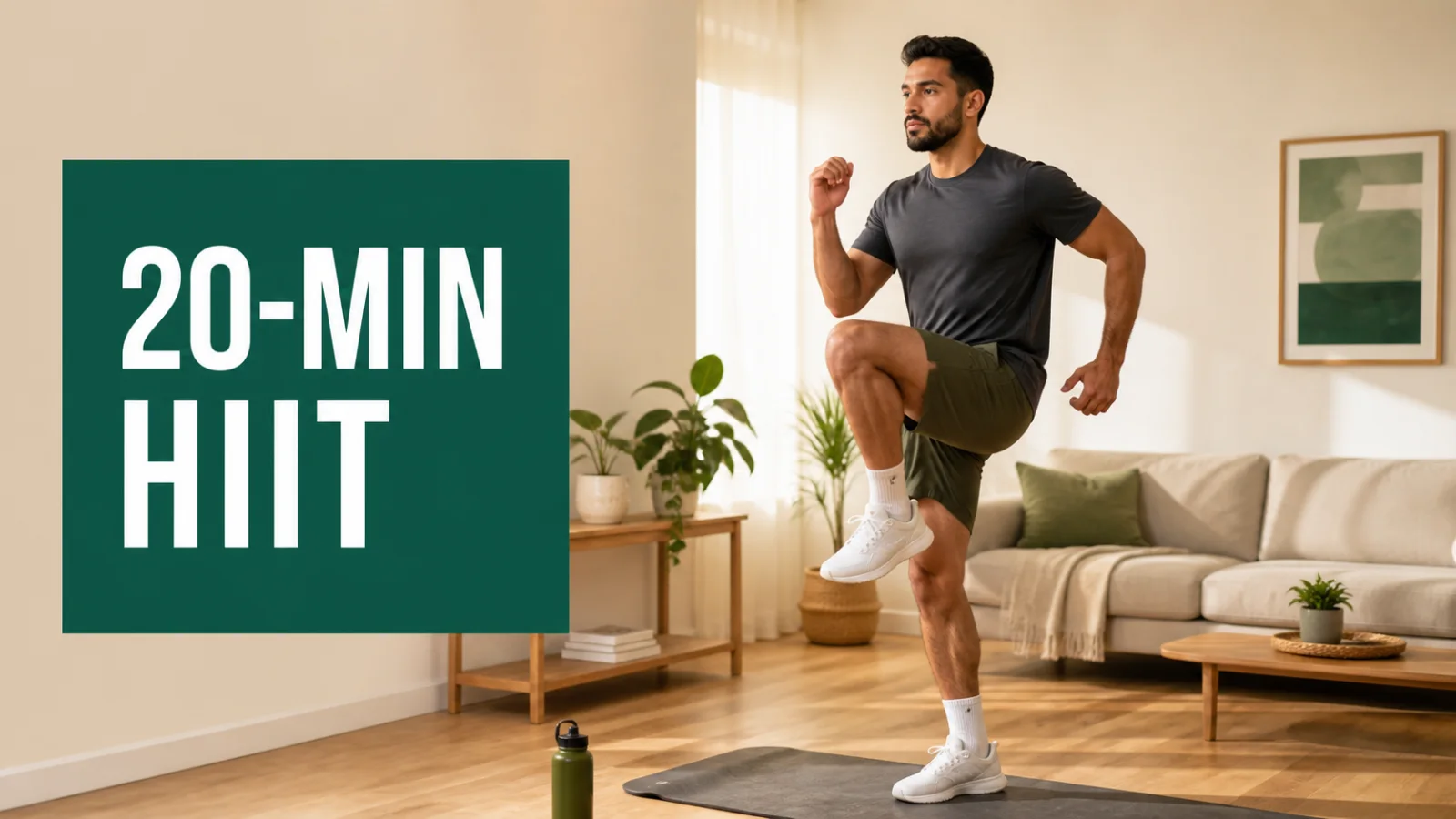
Fast march with high knees | 30 seconds | 30 seconds |
Bird-dog crunch or bird-dog hold | 30 seconds | 30 seconds |
Step jacks | 30 seconds | 30 seconds |
Glute bridge | 30 seconds | 30 seconds |
Complete 3 rounds. Rest briefly between rounds if needed, then finish with an easy cooldown.
How to do each move well
Squat to chair
Stand in front of a chair or couch. Sit back under control, lightly touch the seat, then stand tall.
Your main cue is to keep your chest proud and your knees tracking in line with your feet. If full depth feels rough, shorten the range. Controlled partial squats are still useful.
Incline push-up
Place your hands on a countertop, wall, or sturdy chair. Walk your feet back so your body forms a straight line, then lower your chest toward your hands and press away.
The higher the surface, the easier the exercise. Beginners do much better with clean incline reps than with floor push-ups that collapse into the lower back.
Fast march with high knees
Drive one knee up, then the other, with quick arms and a tall posture. Many beginners can raise intensity with this movement without any jumping.
If balance is an issue, slow down slightly and focus on strong knee lifts. If you want more challenge, pump the arms harder and move with more urgency.
Bird-dog crunch
Start on hands and knees. Extend one arm and the opposite leg, then bring elbow and knee toward each other under the body. Alternate sides.
This gives beginners core work without the strain or frustration of rapid floor-based crunch variations. Move slowly enough to stay stable.
Step jacks
Take one foot out to the side while sweeping your arms overhead, then switch sides. It mimics the pattern of jumping jacks without impact.
Glute bridge
Lie on your back with knees bent and feet flat. Press through your heels, lift your hips, pause briefly, then lower with control.
This is one of the best beginner-friendly finishers because it reinforces hip strength while giving your upper body a break.
How hard should this feel
You should be breathing noticeably harder by the middle of each work interval. You should also feel capable of starting the next exercise with decent form.
If you hit the end of a round and feel like you could do a little more, that's good. The goal of your first week isn't destruction. It's successful repetition.
If you want another structured bodyweight format after you've done this a few times, this circuit workout for beginners is a solid next option.
How to Modify Your Workout and Progress Safely

The biggest mistake beginners make with HIIT isn't laziness. It's copying workouts built for someone else.
A lot of “beginner-friendly” routines still rely on burpees, fast mountain climbers, repeated jumping, and floor transitions that feel awful if you have sore knees, extra bodyweight, limited space, or low confidence. That's why low-impact HIIT matters. Beginner-friendly HIIT does not have to mean high-impact. As shown in this no-jumping beginner HIIT example from Joe Wicks, intensity can come from pace and range of motion, which helps make the workout more accessible and sustainable.
Smart modifications
Here are better swaps when common moves don't suit you:
- Instead of jumping jacks: Do step jacks
- Instead of jump squats: Do regular squats or squat to chair
- Instead of burpees: Do hands-to-chair walkouts
- Instead of mountain climbers: Do standing knee drives
- Instead of full push-ups: Do incline push-ups
These are not watered-down versions. They are better choices when they let you keep moving with control.
Use effort, not ego
Many beginners hear “listen to your body” and assume it means backing off whenever things get uncomfortable. That's not what it means.
It means learning the difference between working hard and working sloppy.
A useful tool is the Rate of Perceived Exertion, or RPE. You don't need a device for it. Just rate how hard the interval feels:
RPE | What it means |
Easy | You could talk comfortably |
Moderate | You can talk in short sentences |
Hard | Talking is difficult, but form is still solid |
Too hard | You're rushing, holding your breath, or losing technique |
For beginner HIIT, your hard intervals should feel challenging, not frantic. If your shoulders shrug up, your squat caves in, or you stop breathing rhythmically, the intensity is too high for that version of the move.
Progress with one change at a time
Once the workout feels manageable, earn the next step. Don't upgrade everything at once.
Use one of these progression options:
- Move faster with the same exercise
- Increase the motion range
- Add another round
- Choose a slightly harder variation
- Shorten rest only after form stays clean
If your knees, back, or feet feel beat up after a session, don't assume you need to “push through.” More often, you need a smarter version, a little less volume, or a cleaner pace.
That mindset keeps people training. The all-or-nothing mindset doesn't.
From One Workout to a Lasting Habit
Most beginners don't fail because the plan was too simple. They fail because they try to live like an advanced trainee by week one.
PureGym's beginner guidance is useful here because it gets specific. It recommends starting with a maximum of 2 HIIT sessions per week and notes that hard intervals should be around 80% of maximum heart rate in PureGym's HIIT advice for beginners. That's the kind of restraint more people need. The bigger risk for beginners is often doing too much too soon, then losing momentum.
Build the habit first
A lasting routine usually looks boring at the start:
- Pick two workout days
- Repeat the same session until it feels familiar
- Leave recovery between hard days
- Stop judging success by soreness
If you like tracking workouts on a smartwatch, comfort is a more important consideration than sometimes acknowledged. A breathable strap can make daily wear easier, especially if you sweat during home training. These nylon bands for smartwatches are one practical option if your current band feels stiff or irritating.
The genuine shift happens when exercise stops being a dramatic event and starts becoming part of the week.
If you want support turning that intention into a routine, BodyBuddy helps with daily accountability through text-based coaching, habit tracking, and structured progression. For beginners, that kind of consistent follow-through often matters more than finding yet another workout.
Your HIIT Questions Answered
How often should I do HIIT as a beginner
Start conservatively. Two sessions per week is enough for many true beginners, especially if the sessions are honest efforts and you're still adapting to the movements.
If recovery is good and your workouts feel steady, you can build from there. If you're still sore, drained, or dreading the next session, hold the frequency where it is.
What if I can't finish the workout
Then the workout was too hard in its current form. That's useful feedback, not failure.
Change one variable next time:
- shorten the range of motion
- use incline or chair support
- slow the pace
- keep the same exercises but reduce intensity
- take a little more rest before the next round
A beginner HIIT workout at home should challenge you without trapping you.
What's the difference between HIIT and regular cardio
Traditional cardio is usually steady effort. HIIT alternates harder bursts with recovery.
That makes HIIT feel more structured and often more engaging for people who get bored doing one long pace. Regular cardio still has value, especially for recovery days, walking, and base fitness. You do not need to choose one forever and reject the other.
Does HIIT burn belly fat specifically
No workout can target fat loss from one body area.
HIIT can be part of a fat-loss plan because it's efficient and demanding, but spot reduction isn't how the body works. What usually matters most is consistency with training, food habits, sleep, and total activity over time.
Is low-impact HIIT still real HIIT
Yes, if the effort is high enough for you.
You can make a no-jumping workout intense through faster stepping, stronger arm drive, deeper ranges that you can control, and disciplined work-rest timing. For many beginners, low-impact HIIT is the better long-term choice because it reduces noise, stress on the joints, and the intimidation factor that makes people quit.
Should I feel exhausted after every workout
No.
You should often feel worked, warm, and satisfied. Some sessions will feel tougher than others, but constant exhaustion is not a badge of honor. It usually means the plan is too aggressive, your recovery is lacking, or you're turning every workout into a test.
Sustainable progress feels almost modest at first. Then it compounds.
Want daily accountability?
BodyBuddy texts you every day.
Build a healthier relationship with food and movement — one text at a time.
Join 500+ usersstaying healthy