
← All posts
FrancisFitness
Best home workouts for weight loss (no equipment needed)
A practical BodyBuddy guide to best home workouts for weight loss (no equipment needed), with useful considerations and next steps.
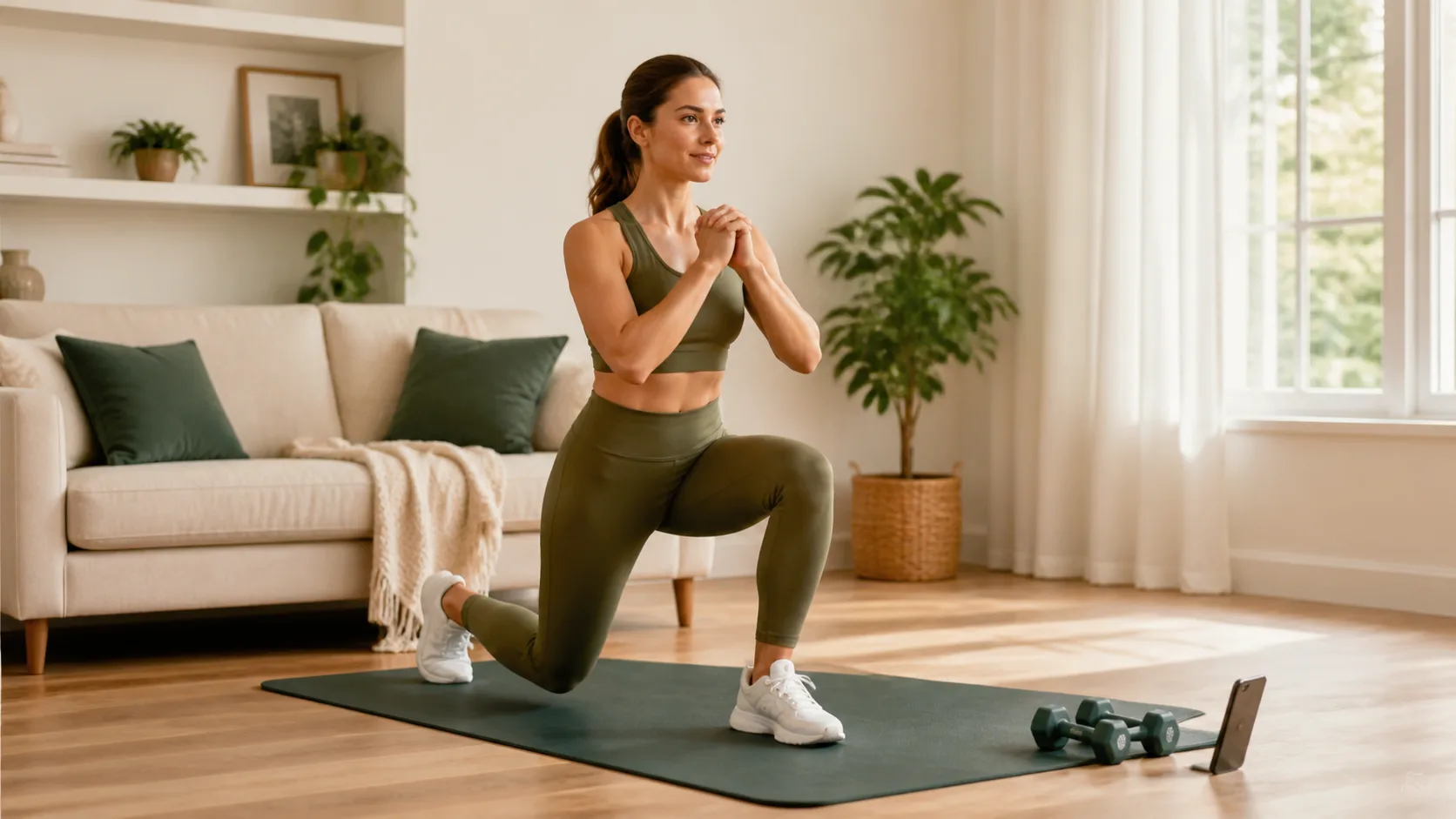
You don't need a gym membership to lose weight. You don't need dumbbells, kettlebells, a pull-up bar, or any of the equipment that fitness influencers swear is essential. You need your body, some floor space, and the willingness to be uncomfortable for 20 to 40 minutes a few times a week.
I'm not saying equipment is bad. I'm saying the belief that you can't get an effective weight loss workout at home without equipment is one of the most persistent and damaging myths in fitness. It gives people an excuse to not start: "I'll work out once I get a gym membership / once I buy some dumbbells / once I set up my garage gym." Meanwhile, months pass.
Your body weighs enough to give you a serious workout. Here's how to use it.
Why bodyweight training works for fat loss
Fat loss comes down to one thing: burning more calories than you consume. Any form of exercise that elevates your heart rate, challenges your muscles, and creates a calorie expenditure contributes to that equation. Bodyweight training does all three.
The misconception is that bodyweight exercises are "easy" or only suitable for beginners. Tell that to anyone who's done five sets of pistol squats or held a plank for three minutes. Bodyweight training is as challenging as you make it — by adjusting tempo, volume, rest periods, and exercise selection, you can create workouts that rival anything you'd do in a gym.
For weight loss specifically, bodyweight training has a unique advantage: it naturally combines strength and cardio. A circuit of squats, push-ups, lunges, and burpees performed with short rest periods keeps your heart rate elevated (cardio benefit) while simultaneously challenging your muscles (strength benefit). This combination produces a metabolic afterburn effect — your body continues burning calories at an elevated rate for hours after the workout while it recovers and repairs muscle tissue.
Research published in the Journal of Strength and Conditioning Research found that high-intensity bodyweight circuits produced similar improvements in cardiovascular fitness and body composition compared to traditional gym-based resistance training in previously sedentary adults. The equipment isn't the variable that matters. The effort is.
The five essential movements
Every effective bodyweight program is built from five fundamental movement patterns. Master these and you can construct unlimited workout variations.
Squats
The squat is the foundation of lower body training. Stand with feet shoulder-width apart, sit your hips back and down like you're sitting into a chair, descend until your thighs are at least parallel to the floor, then drive back up through your heels.
For beginners: start with chair squats, where you actually sit down onto a chair and stand back up. Once that feels easy, move to regular bodyweight squats. From there, progress to tempo squats (3 seconds down, 1 second up), jump squats, or single-leg variations like Bulgarian split squats using a couch.
Push-ups
Push-ups train your chest, shoulders, and triceps while also engaging your core. If you can't do a full push-up yet, that's completely fine. Start with incline push-ups — hands on a countertop, desk, or sturdy chair. As you get stronger, lower the surface until you're on the floor.
The key is keeping your body in a straight line from head to heels. No sagging hips, no piking your butt up. If your form breaks, elevate your hands to an easier angle rather than doing sloppy reps on the floor. Quality always beats quantity.
Progression: incline push-ups, knee push-ups, full push-ups, diamond push-ups, decline push-ups (feet elevated), archer push-ups. There's enough push-up variation to keep you challenged for years.
Lunges
Lunges work your quads, glutes, and hamstrings while also challenging your balance and stability. Step forward, drop your back knee toward the floor until both knees form roughly 90-degree angles, then push back to standing.
Alternating lunges, reverse lunges (stepping backward instead of forward, which is easier on the knees), walking lunges, and lateral lunges all provide variety without any equipment. Slow the tempo down to 3 seconds per rep and suddenly bodyweight lunges become brutally difficult.
Rows or pull variations
This is the one movement that's slightly harder to do with zero equipment. Your back muscles need pulling movements, and those require something to pull against. The solution: find a sturdy table and do inverted rows underneath it, or use a doorframe for doorway rows.
For inverted rows: lie under a sturdy table, grip the edge, and pull your chest up to the table while keeping your body straight. This is essentially a horizontal pull-up and it's surprisingly challenging. Adjust difficulty by bending your knees (easier) or straightening your legs (harder).
If you have a towel and a closed door, you can do towel door rows: loop a towel around a doorknob, close the door, lean back holding the towel ends, and row yourself toward the door. It's not glamorous, but it works.
Core work
Planks, dead bugs, mountain climbers, and hollow body holds form the core training backbone. Don't just do crunches — your core's primary function is stabilization, not spinal flexion.
A front plank held for 30 to 60 seconds is a solid starting point. Side planks, plank shoulder taps, and dead bugs (lying on your back, alternating arm and opposite leg extensions while keeping your lower back pressed to the floor) are all excellent progressions that require nothing but floor space.
Three workouts you can start today
These are structured as circuits. Perform each exercise for the prescribed time or reps, rest briefly, move to the next exercise. Complete all exercises for one round, then rest and repeat.
Workout A: the twenty-minute burner
Perform each exercise for 40 seconds of work followed by 20 seconds of rest. Complete four rounds with one minute of rest between rounds. Total time: about 22 minutes.
Exercises: bodyweight squats, push-ups (any variation appropriate for your level), reverse lunges (alternating legs), plank hold, jumping jacks.
This workout is simple on purpose. Five exercises, no complexity, high density. It's the workout you do when motivation is low because the barrier to starting is almost zero.
Workout B: the strength circuit
Perform each exercise for 10 to 12 reps (per side where applicable) with 30 seconds rest between exercises. Complete three rounds with 90 seconds rest between rounds. Total time: about 30 minutes.
Exercises: tempo squats (3 seconds down), diamond push-ups (or regular if diamond is too hard), walking lunges, inverted rows (using a table), dead bugs (8 per side), glute bridges (15 reps).
This workout prioritizes muscle engagement over cardio. The slower tempos and deliberate movements challenge your muscles more and build strength that translates into better performance in every other workout.
Workout C: the HIIT session
Perform each exercise at maximum effort for 30 seconds followed by 30 seconds of rest. Complete three rounds with two minutes of rest between rounds. Total time: about 25 minutes.
Exercises: jump squats (or fast bodyweight squats if jumping is too much), burpees (or step-back burpees for lower impact), mountain climbers, high knees, lateral shuffles.
This is the most intense of the three and should only be done once or twice per week. HIIT produces a significant afterburn effect but it's also harder to recover from. More isn't better — your body needs time to adapt.
A sample weekly schedule
A solid beginner schedule looks like this: Monday is Workout A, Tuesday is a 30-minute walk, Wednesday is Workout B, Thursday is a rest day or light walk, Friday is Workout C, and the weekend includes one active day (hike, bike ride, sports, whatever you enjoy) and one full rest day.
This gives you three structured workouts per week, two to three days of light activity, and one to two full rest days. It's enough stimulus for meaningful fat loss without overtraining or burning out. As you get fitter, you can add a fourth structured session or increase the difficulty of existing workouts.
The walking days matter. Walking doesn't feel like exercise, but it burns meaningful calories (200 to 300 per hour at a brisk pace), aids recovery from harder sessions, reduces stress, and improves sleep. People who walk regularly on top of their training consistently get better weight loss results than people who only do intense workouts and are sedentary the rest of the time.
Progressive overload without weights
The biggest concern people have about bodyweight training is: "Won't I plateau once it gets easy?" Yes, if you never progress. But there are many ways to make bodyweight exercises harder without adding weight.
Increase reps. If you did 10 push-ups last week, do 12 this week. Simple and effective.
Slow the tempo. A 4-second descent on each squat rep is dramatically harder than a normal-speed squat. Tempo manipulation is arguably the most underused bodyweight progression tool.
Reduce rest periods. Going from 60 seconds rest between rounds to 45 seconds increases workout density and cardiovascular demand without changing anything else.
Progress to harder variations. Squats become Bulgarian split squats. Push-ups become diamond push-ups, then decline push-ups. Lunges become pistol squat progressions. Planks become plank walkouts or ab wheel rollouts (if you get a single, cheap piece of equipment, an ab wheel is the one I'd recommend).
Add pauses. Holding the bottom position of a squat for 2 to 3 seconds before driving up eliminates the stretch reflex and forces your muscles to work harder. Pause reps at the bottom of push-ups are equally brutal.
The idea that bodyweight training has a ceiling is only true if you refuse to get creative. People have built impressive physiques entirely through calisthenics. For weight loss purposes, the ceiling is so far above where most people start that it's effectively irrelevant.
The consistency equation
Here's what actually determines whether home workouts lead to weight loss: consistency over time. A mediocre workout done four times a week for six months will produce dramatically better results than a perfect workout done sporadically for six months.
The advantage of home workouts is that the barrier to starting is almost zero. No commute to the gym, no packing a gym bag, no waiting for equipment. You roll out of bed, put on shorts, and start. This lower friction translates directly into higher consistency, which translates directly into better results.
Set a minimum viable workout. On days when motivation is gone, your minimum might be 10 minutes of squats and push-ups. That's fine. Doing something always beats doing nothing, and maintaining the habit of exercising on your scheduled days matters more than any individual workout's quality.
How BodyBuddy keeps you accountable at home
The biggest challenge with home workouts isn't the exercises — it's the fact that no one is watching. At a gym, there's social accountability. At home, it's just you and the extremely tempting couch.
BodyBuddy replaces that gym accountability with daily check-ins. When you know you'll report your workout (or lack thereof) tomorrow, you're significantly more likely to actually do it. It's not judgment — it's the simple psychological effect of knowing someone (even an AI) is paying attention.
BodyBuddy also tracks your workout consistency over weeks and months, showing you patterns you might miss. Maybe you always skip Friday workouts. Maybe you're consistent for three weeks and then fall off for one. Seeing these patterns helps you design strategies around your actual behavior rather than your idealized version of yourself.
For home exercisers specifically, this accountability layer is the missing piece. The workouts themselves are straightforward. Showing up consistently is the hard part, and that's exactly what daily accountability solves.
Frequently asked questions
Can I really lose weight with just bodyweight exercises?
Yes. Weight loss is driven by a calorie deficit. Bodyweight exercises burn significant calories (a 30-minute bodyweight circuit can burn 250 to 400 calories depending on intensity and body weight), build muscle that increases your resting metabolism, and complement dietary changes. Thousands of people have achieved significant weight loss with bodyweight training alone. Equipment is helpful but absolutely not required.
How often should I work out at home for weight loss?
Three to four structured sessions per week is the sweet spot for most beginners. Combined with daily walking or light activity on non-workout days, this provides enough stimulus for fat loss without overtraining. More isn't necessarily better — recovery is when your body actually adapts and improves. Five or six high-intensity sessions per week will likely lead to burnout or injury before it leads to better results.
What if I can't do push-ups or squats with proper form?
Modify them. Every exercise has an easier variation. Can't do a push-up? Start with wall push-ups (standing, pushing away from a wall). Can't do a full squat? Start with chair-assisted squats or half squats to a comfortable depth. The goal is to find the hardest version you can do with good form and progress from there. Fitness is a spectrum, not a binary.
Are home workouts as effective as gym workouts for weight loss?
For weight loss specifically, yes. The calorie burn from a well-designed bodyweight circuit is comparable to a moderate gym session. Where gym workouts have an advantage is in building maximal strength and muscle, because you can progressively add weight indefinitely. But for the goal of losing fat and getting fit, home bodyweight training is absolutely sufficient and has the added advantage of convenience.
Do I need to warm up before a home workout?
Yes. Five minutes of light movement — arm circles, leg swings, bodyweight squats at an easy pace, jumping jacks — prepares your muscles and joints for the work ahead. Warming up reduces injury risk and improves performance. It's a small time investment with a significant return. Never skip it, especially for higher-intensity sessions.
The bottom line
Your living room, bedroom, or garage has everything you need to lose weight. Bodyweight squats, push-ups, lunges, rows, and core work — performed with intention and consistency — will get you further than an expensive gym membership you use twice a month.
Start simple. Three workouts per week, 20 to 30 minutes each, plus daily walking. Progress by adding reps, slowing tempo, reducing rest, or advancing to harder exercise variations. The plan isn't complicated. Doing it consistently is the challenge, and that's a problem solved by accountability, not equipment.
Try BodyBuddy free — daily accountability coaching that keeps you training consistently, whether you work out at home, at the gym, or anywhere in between.
Next steps
Related BodyBuddy guides
- How to Take Progress Photos for Weight Loss (and Actually Compare Them)
- How to lose belly fat: what the science actually says (not what Instagram tells you)
- 17 high protein snacks for weight loss that actually taste good
- BodyBuddy vs BitePal: which AI weight loss app should you use?
- BodyBuddy vs Lose It: which weight loss app fits your tracking style?
Everyone gives you a plan.BodyBuddy texts you until it happens.
BodyBuddy keeps you on track—from meals to doctor's appointments and everything in between.