May 23, 2026
How to Be Motivated to Exercise: A Guide That Works

Most advice on how to be motivated to exercise is backward. It tells you to wait until you feel inspired, fired up, or ready. That's exactly why so many routines die after a few weeks.
Motivation is unreliable. Work stress shows up. Sleep gets worse. Your schedule blows up. The weather turns bad. If your exercise plan only works when you feel like doing it, you don't have a plan. You have a mood-dependent hobby.
I've seen this pattern too many times. People blame themselves for lacking discipline when the problem is simpler. Their system asks for too much decision-making, too much energy, and too much perfection. A better approach is to stop chasing motivation and start building a setup that keeps you moving even on ordinary, messy days.
Rethinking Motivation From the Ground Up
The common advice is, "Just find your why." That's incomplete.
A strong reason helps, but it won't carry a bad system. You can care a great deal about your health and still skip workouts if every session requires a commute, a full outfit change, an open hour in your calendar, and the mental energy to choose what to do.
The shift is this. Motivation is often the result of action, not the cause of it. When exercise is easy to start, realistic to finish, and tied to your actual life, you do it more often. Then consistency creates momentum. Then momentum feels like motivation.
That changes how you should think about fitness. Stop asking, "How do I get more motivated?" Start asking, "How do I make exercise easier to begin when motivation is low?"
This is also why the motivation-versus-discipline debate gets oversimplified. Discipline matters, but discipline works best when the environment supports it. If you want a deeper breakdown, this guide on why willpower isn't the answer gets at the same core problem.
What bad advice gets wrong
A lot of fitness advice implicitly assumes you're failing because you don't want it enough. That's lazy coaching.
What fails people is:
- All-or-nothing planning. The plan only counts if you do the full workout.
- High startup cost. You need too much time, gear, travel, or mental effort.
- Emotion-based decision-making. You decide each day from scratch.
- No fallback option. If Plan A fails, the whole day becomes a write-off.
You don't need more hype. You need a system that still works on a Tuesday when you're tired and busy.
Find a Motivation That Actually Lasts
A lot of people start exercising for appearance. That's common. It also tends to be fragile.
A stronger base is health, mood, and the way you want to function in daily life. In a UK poll of 2,271 adults, commissioned by ukactive for National Fitness Day, 54% said their main motivation for being physically active was helping their mental health, compared with 49% who said getting in shape. The same survey found 75% underestimated how much exercise adults should do, and 38% believed less than 90 minutes per week was enough, even though UK Chief Medical Officers recommend 150 minutes or more of moderate-intensity activity each week (ukactive survey findings).

Internal motives beat borrowed ones
Research on self-determination theory has stayed useful for a reason. A major review found that more autonomous motives, especially intrinsic motivation, are positively linked with exercise participation and long-term adherence, and competence satisfaction also predicts participation across many settings (self-determination theory review).
In plain English, people stick with exercise better when at least some part of it feels like this:
Driver | What it sounds like | Staying power |
External pressure | "I should do this so I don't feel guilty." | Weak |
Appearance only | "I need to look different fast." | Unstable |
Identity and enjoyment | "I'm someone who trains, walks, lifts, or moves." | Stronger |
Competence | "I like getting better at this." | Stronger |
This doesn't mean appearance goals are forbidden. It means they shouldn't be the whole engine.
Questions that uncover your real reason
Write down answers to these. Don't keep them vague.
- What gets better in your real life when you exercise consistently? Sleep, patience, back pain, focus, stress, energy for your kids, confidence at work.
- What kind of person are you trying to become? Someone strong, steady, calm, capable, mobile, hard to knock off track.
- What form of exercise do you dislike the least, or personally enjoy? That's often your entry point.
- Where do you want to feel progress first? Mood, stamina, strength, routine, or stress relief.
If you need structure for that process, this piece on a practical system for fitness results is useful because it pushes you to track what matters instead of relying on memory and emotion.
A better target
Don't make your main goal "lose weight" and stop there. That's too broad and too easy to emotionally load.
Try something more grounded:
That's the kind of reason that still matters when the scale stalls.
Make Exercise Impossible to Avoid
Motivation is unreliable. Your setup is what carries you on tired Tuesdays, chaotic workdays, and weeks when life gets loud.
If exercise depends on making a fresh decision every day, you have already made it harder than it needs to be. The fix is to build a system that cuts choices, lowers friction, and puts movement in your path before excuses show up.

Reduce the startup cost
The first five minutes decide a lot. Shoes are missing. You need to pick a workout. The gym bag is still in yesterday's corner. That tiny friction is enough to kill the session.
Set things up so starting is boring and obvious.
- Lay out clothes the night before. Shoes, socks, shirt, water bottle. Morning you should not need to search for anything.
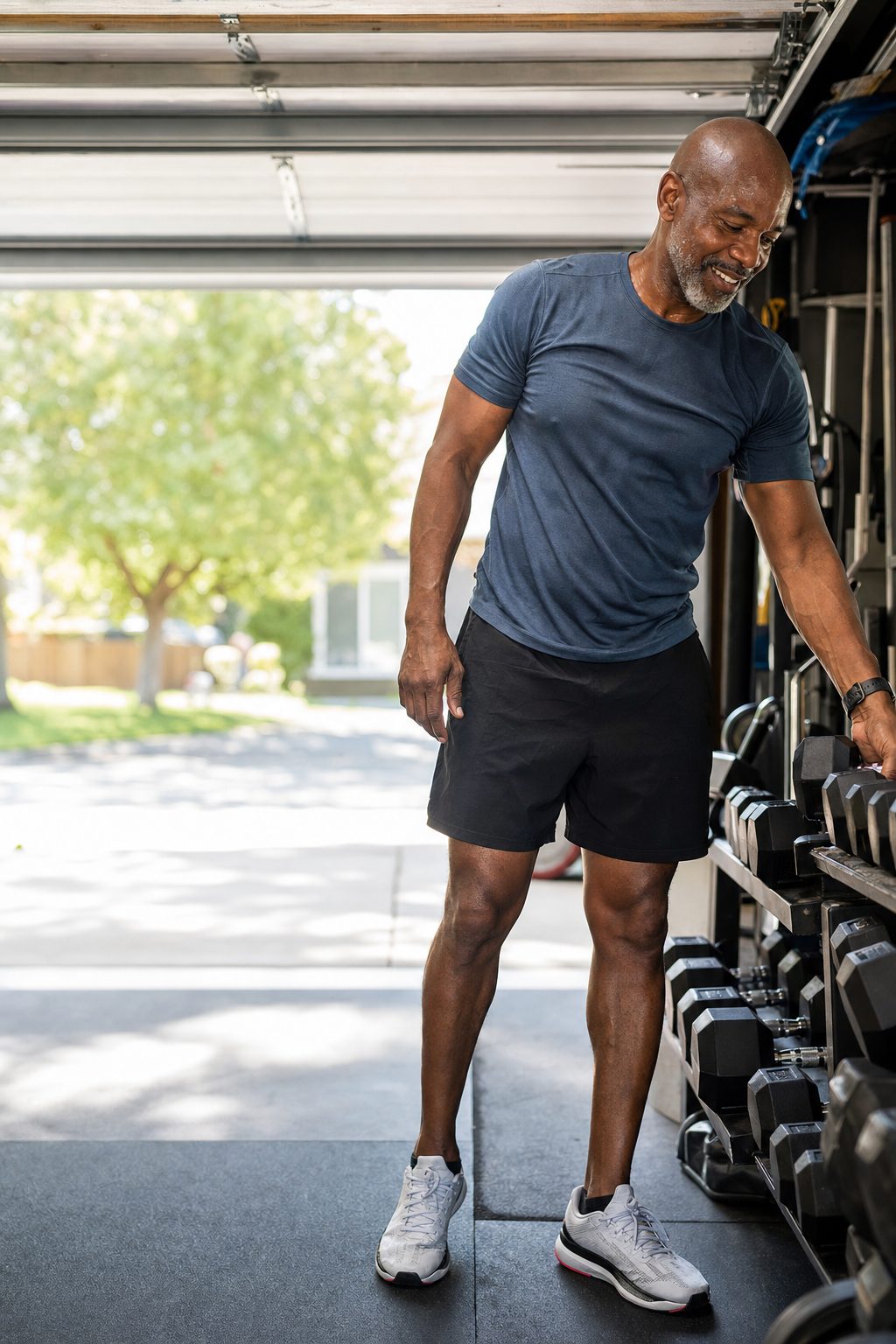
- Keep one training option close. Dumbbells at home, bands in a drawer, a walking route outside your door, or a gym you pass anyway.
- Shrink the entry point. Tell yourself you'll do five minutes. Starting matters more than negotiating with yourself for 20.
- Tie exercise to an existing cue. After coffee. After the school drop-off. After your last meeting. Before your shower.
This works because environment and routine shape behavior more than willpower does. The CDC's guidance on finding time for physical activity addresses the barrier many adults face. Packed schedules and everyday friction, not a mysterious lack of character.
If you want more consistency, use a habit tracking app to build routines that last. Tracking is not magic, but it does make skipped days harder to ignore and repeat days easier to stack.
Make the environment do some of the work
Good systems remove the need to "get motivated" in the moment.
A few examples that hold up in real life:
Situation | Friction-heavy version | Low-friction version |
Workday movement | Promise yourself a hard workout later | Walk during calls or use a treadmill desk if you have one |
Strength training | Build a new session every day | Save one short repeatable routine on your phone |
After-work slump | Decide at 6 p.m. what you feel like doing | Change into training clothes before energy drops |
Nutrition support | Grab whatever is around and fade by late afternoon | Keep ready-to-eat food nearby |
That last row gets ignored too often. A lot of people say they have no motivation, but they are under-recovered, underfed, and trying to train on fumes. Keep easy food around so low energy does not become another fake vote against exercise. If you need ideas, this list of high-protein plant-based gym fuel is practical and easy to use.
Design for your worst day
Many workout plans are built for your most organized, well-rested, highly motivated self. That version of you does not need much help.
Build for the version that is rushed, distracted, and running low on patience. That means shorter defaults, fewer steps, and backup options you can do at home or near work. A 20-minute walk, two sets of lifts, or a quick circuit done consistently beats an elaborate plan you keep postponing.
The goal is not to create perfect conditions. The goal is to make exercise the path of least resistance. When you do that, motivation stops being the gatekeeper.
Adopt the Always Something Mindset
The people who stay active for years are rarely the ones who crush every workout. They are the ones who refuse to let a missed session turn into a missed week.
That is the Always Something mindset.
You stop grading exercise as pass or fail. You start asking a better question. What is the smallest useful action you can complete today? That shift matters because motivation comes and goes, but a low floor keeps the habit alive when your day gets messy.

What counts on a hard day
More than people admit.
- A 10-minute walk after lunch
- Two rounds of squats, push-ups, and rows
- Stretching or mobility while dinner cooks
- A brisk walk during a work call
- Five to ten minutes on a bike, rower, or stairs
- One set of lifts instead of the full workout
Small sessions work because they protect continuity. Public health guidance has emphasized that movement accumulated across the day still matters, and in practice that is often how busy adults stay consistent. A short session may not build peak fitness fast, but it keeps you in motion, keeps the routine familiar, and makes the next session easier to start.
Stop treating small efforts like they do not matter
A lot of exercisers throw away good enough because it does not look impressive. That is how routines die.
A ten-minute session keeps your identity intact. You are still a person who trains. You also avoid the restart tax. Tomorrow feels like a normal continuation, not a rescue mission after three dead days and a pile of guilt.
There is a trade-off here. Small efforts should not become an excuse to stay comfortable forever. If every workout shrinks for weeks, progress slows. But on hard days, the job is not to prove toughness. The job is to keep the pattern unbroken.
Keep score in a way that supports the habit
If you only count full gym sessions, you teach yourself that partial credit is failure. That is a bad scoring system.
Track any intentional movement that supports the routine. Walks. Short strength sessions. Mobility. Bike rides. If you want a simple framework, this guide on habit tracking for routines that last explains how to record behavior without turning the tracker into a guilt machine.
The standard is simple. Do something that keeps the habit alive today. Then repeat tomorrow.
Your Playbook for Low-Motivation Days
Low-motivation days don't mean the system failed. They mean you're human.
The mistake is trying to force the same workout regardless of what kind of resistance you're feeling. That's where people burn out. A better move is to diagnose the problem fast, then choose an option that fits it.

Match the workout to the problem
A 2024 study found that motivation is highly sensitive to context. People exercising alone were more associated with intrinsic motives like enjoyment and stress management, while those with a personal trainer were more driven by health-related accountability. The same study also linked challenge and competition motives more with fitness-club exercise than group exercise (2024 study on exercise motives and context).
That gives you a practical rule. Pick the format that matches the need.
If this is the problem | Do this instead |
You're stressed and mentally cooked | Take a solo walk, do easy cycling, or do light mobility |
You need accountability | Book a trainer session, text a coach, or set a check-in with a friend |
You're bored | Change the modality. Try a different route, machine, class, or rep scheme |
You want a challenge | Use a club setting, a timed circuit, or a benchmark workout |
You're low on confidence | Choose an easy win you know you can finish |
Here's a short video that fits this idea well:
Use if-then rules
Don't negotiate with yourself in the moment. Pre-decide.
- If I'm exhausted, then I do ten minutes of walking or stretching.
- If work runs late, then I do a short home session instead of skipping.
- If I feel restless and stressed, then I train alone.
- If I've skipped a few days, then I restart with the easiest version, not the hardest one.
Use accountability without depending on hype
This is one place where tools can help. A simple accountability layer can interrupt avoidance before it turns into a lost week. For example, why daily accountability works better than motivation alone gets into the value of regular check-ins. Tools like BodyBuddy use daily text-based accountability, streak tracking, and habit summaries to keep the focus on showing up, not chasing perfect motivation.
That only works if the bar stays realistic. Accountability should guide action, not pile on shame.
Motivation Is a Skill Not a Gift
People who exercise consistently aren't a different species. They usually have better systems.
They know why they're doing it. They remove friction. They accept smaller wins. They have a fallback plan for rough days. That's what sustainable how to be motivated to exercise really looks like in practice.
If you're still stuck in the old debate, this breakdown of motivation versus discipline is a helpful reminder that neither works well without structure.
You don't need to become someone who wakes up excited to train every day. You need to become someone who can keep moving even when excitement is absent. That's a skill. You can build it. And once you do, motivation stops being the gatekeeper.
Want daily accountability?
BodyBuddy texts you every day.
Build a healthier relationship with food and movement — one text at a time.
Join 500+ usersstaying healthy