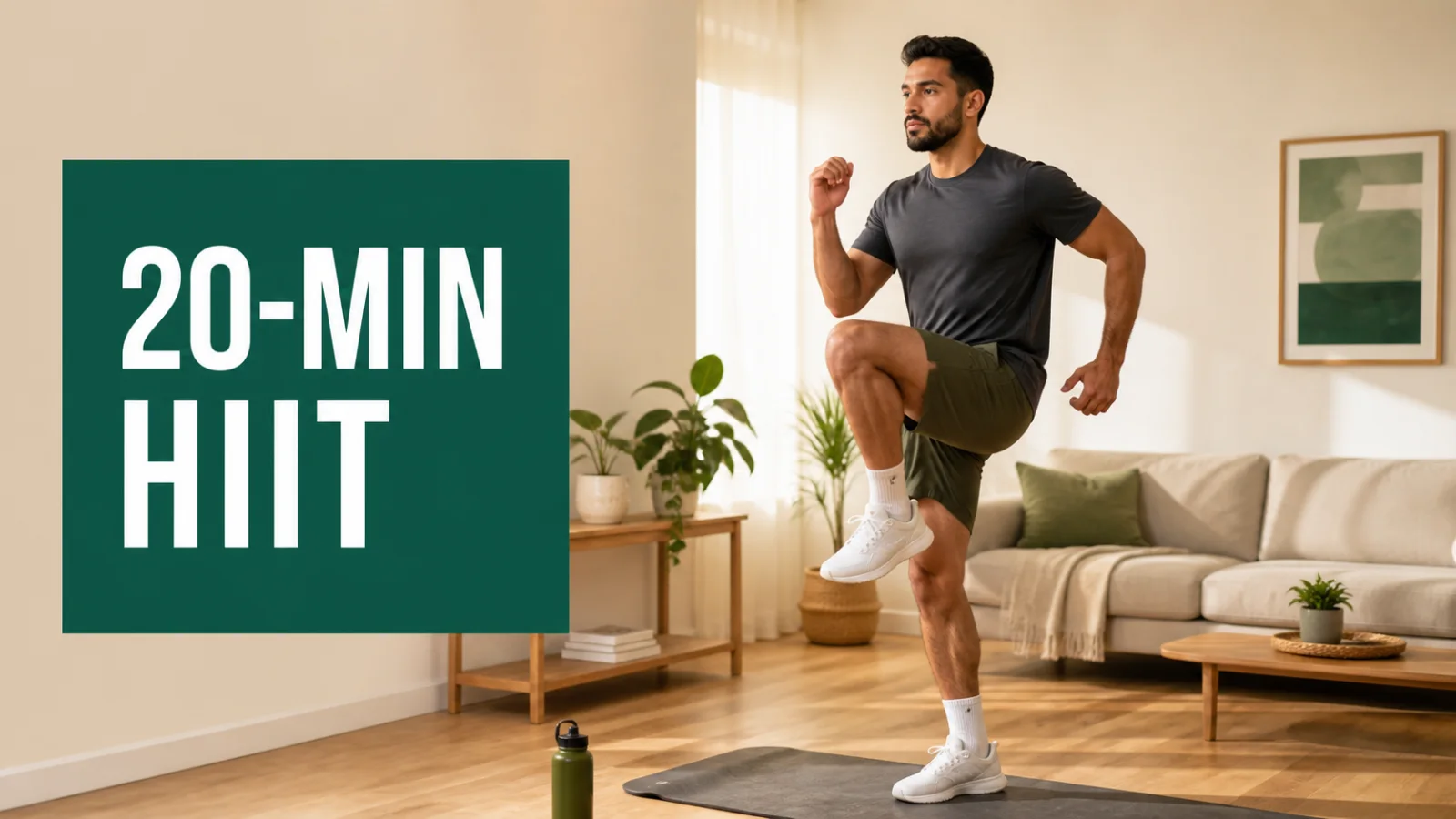
May 30, 2026

Beginner HIIT Workout at Home: 20-Minute No-Equipment Guide

Beginner HIIT Workout at Home: 20-Minute No-Equipment Guide

Beginner HIIT Workout at Home: 20-Minute No-Equipment Guide
Those looking up a beginner HIIT workout at home are not typically trying to become a fitness influencer. They're standing in their living room, already tired, unsure what to do, and hoping they can find something that fits real life.
Maybe you've started and stopped before. Maybe every “beginner” workout you found still had burpees, squat jumps, and fast floor transitions that felt rough on your knees or left you discouraged in the first few minutes. That's common. It's also why many people quit before they ever build momentum.
HIIT can help, but only when it's taught the right way. For a true beginner, that means short sessions, simple moves, enough rest, and zero pressure to perform like an advanced exerciser on day one.

Your Guide to a Beginner HIIT Workout at Home

A lot of home fitness advice misses the person who needs it most. It assumes you already know exercise names, already trust your body, and already feel comfortable getting out of breath. Many beginners don't.
The usual pattern looks like this. You search for a quick workout, find a video labeled “beginner,” and within minutes you're told to jump, plank, twist, and move fast with almost no explanation. That doesn't build confidence. It builds hesitation.
A beginner HIIT workout at home should feel clear and manageable. It should fit into a normal day, work in a small space, and give you room to scale the intensity without feeling like you failed.

What HIIT actually means for a beginner

HIIT stands for high-intensity interval training. At home, that usually means short bursts of effort followed by short recovery periods, repeated for several rounds. The key word for beginners is not “high.” It's interval.
Intervals let you work, recover, and start again without needing a long workout block. That's why so many people do better with HIIT than with the idea of a long cardio session they keep putting off.
A practical starting point is often short and simple. Some home routines use only bodyweight moves, a timer, and an exercise mat. If you also want another straightforward format that keeps things simple, this circuit workout for beginners starter plan is a useful next read.

Who this approach is for

This article is written for the person who wants results without beating up their joints or confidence.
That includes:
  • Busy adults who need something they can finish before work or between meetings
  • Deconditioned beginners who get winded quickly and need more recovery
  • People with extra body weight who want lower-impact movement options
  • Anyone with knee or joint concerns who doesn't want jumping to be the price of entry
If that sounds like you, good. You do not need the hardest version. You need the version you'll continue doing.

Why HIIT Is Perfect for Busy Beginners

HIIT became popular for a reason. It respects time.
A 2021 review in PMC noted that low-volume HIIT involves less than 15 minutes of active high-intensity work per session and is a time-efficient strategy to improve cardiometabolic health and cardiovascular endurance. The same review also noted that HIIT ranked first in 2018 in worldwide exercise trends, which helps explain why it moved from athlete-focused training into mainstream fitness.
notion image

The real benefit isn't suffering more

Beginners often think HIIT works only if it feels extreme. That's not what makes it useful.
What makes it useful is the structure. You put in a focused effort, recover, and repeat. That setup makes short workouts feel purposeful. For someone with a crowded schedule, that matters more than chasing a perfect training plan you never follow.
A good beginner routine can help you build:
  • Cardiovascular endurance so stairs and brisk walking feel easier
  • Better exercise tolerance so effort feels less intimidating over time
  • Consistency because the session is short enough to fit a real week
  • Confidence from finishing workouts instead of abandoning them halfway

Why busy people often do better with HIIT than long cardio

Long steady workouts can work. They also create friction. You need more time, more patience, and often more motivation just to get started.
HIIT lowers that barrier. When you know the session is contained, it's easier to begin. For a lot of working adults, that's the difference between “I should work out” and “I can do this now.”
There's also a mindset advantage. Short intervals give you frequent reset points. If one round feels hard, you don't have to wonder whether you can survive the next half hour. You only need to get through the current effort, take the rest, and continue.

What busy beginners should stop expecting

Stop expecting every workout to feel impressive.
A beginner HIIT session done well may look modest from the outside. Marching in place, wall push-ups, chair squats, and controlled core work won't win points on social media. But they train the habits and movement control that many beginners are missing.
That's the part that works.

Setting Up for Success at Home

The setup matters more than people think. Most beginners don't quit because they lack willpower. They quit because the workout feels inconvenient, confusing, or physically uncomfortable before it even starts.
notion image

Keep the gear minimal

You don't need a home gym. For most beginners, this is enough:
  • A timer on your phone or watch
  • A mat if floor work feels better with cushioning
  • Water nearby so you don't interrupt the session
  • A sturdy chair or wall for support and modifications
That's it. The simpler the setup, the fewer excuses your brain can build.
If you train early and like a little extra energy, some people look through best pre-workout supplement picks to understand ingredients and timing. Beginners don't need supplements to start, but clear guidance can help if you're curious and want to avoid random product choices.

Create a space that makes movement easier

Your workout area doesn't need to be big. It does need to be safe.
Check these basics before you begin:
  • Clear the floor so you aren't stepping around shoes, cords, or bags
  • Wear stable shoes if barefoot movement doesn't feel secure
  • Choose a surface where you won't slip during squats or marching
  • Make the room easy to enter so setup doesn't become a task of its own
The best home workout spot is usually the one you can access in under a minute.

Warm up like it matters

Many beginners treat the warm-up like filler. It isn't. It's the part that tells your joints, muscles, and breathing that work is coming.
A good warm-up for home HIIT includes controlled movement, not static stretching alone. Think arm circles, slow marching, bodyweight good mornings, supported squats, and gentle torso rotation. The goal is to move from “stiff and distracted” to “ready.”
If you like accountability tools, this is one place where structure helps. Some people use a notes app, some use reminders, and some use tools like BodyBuddy to text in their planned session and track whether they did it. The useful part is not the app itself. It's removing the daily decision.

Your First 20-Minute No-Jumping HIIT Workout

This workout is built for the person who wants a beginner HIIT workout at home without impact-heavy moves. No jumping. No complicated transitions. No equipment needed.
A practical beginner session often lands in the 20 to 30 minute range. Harvard Health's HIIT overview describes a beginner-friendly format with a 5-minute warm-up, rounds of 30 seconds of work and 15 seconds of recovery, plus a 5 to 10 minute cool-down. For true beginners worried about joint stress, a slightly gentler work-rest balance can be even more manageable.
Here's the visual version of the routine first.
notion image

The workout structure

Use this timing:
That gives you a session that feels like HIIT without rushing your recovery.
Phase
Duration
Example Activities
Warm-up
5 minutes
March in place, arm circles, hip hinges, shoulder rolls, sit-to-stand practice
Main circuit round 1
6 minutes
Six exercises, 30 seconds work and 30 seconds rest
Main circuit round 2
6 minutes
Repeat the same six exercises
Cool-down
3 minutes
Slow walking, chest stretch, calf stretch, gentle quad and hamstring stretch

Warm up for five minutes

Don't skip this. Move steadily and keep the effort low.
Try this sequence:
  • March in place with relaxed arms
  • Shoulder rolls forward and backward
  • Arm circles small to larger
  • Hip hinges with hands on thighs
  • Sit-to-stand practice from a chair
  • Gentle side steps to wake up the hips
You should feel warmer, looser, and a little more alert. You should not feel tired yet.
A follow-along option can help if you prefer visual guidance before doing the written routine yourself.

The six exercises

Marching in place

Lift one knee, then the other, at a pace you can control. Swing your arms naturally.
If balance feels shaky, hold the back of a chair lightly or keep the knee lift lower. The goal is to raise your heart rate, not force a dramatic movement.

Wall push-ups

Stand facing a wall with your hands placed around shoulder width. Walk your feet back a little, bend your elbows, bring your chest toward the wall, then press back.
The closer you stand to the wall, the easier it feels. Keep your body straight rather than letting your hips sag.

Squat to chair

Stand in front of a chair with feet about hip width apart. Push your hips back, lower with control until you lightly touch the chair, then stand up.
If needed, use your hands on your thighs for support. If the chair feels too low, reduce the depth and focus on smooth movement.

Standing knee drives

Stand tall and bring one knee up toward your midsection, then switch sides. Add a small arm pull if you want a little more effort.
This is a strong option for beginners who want cardio without impact. It also helps you practice balance and trunk control.

Modified plank

Use your knees on the floor, or place your hands on a sturdy raised surface if getting down to the floor feels like too much right now. Brace your stomach gently and hold a straight line from shoulders through hips.
If holding still feels too intense, shorten the hold and rest sooner. Quality matters more than proving toughness.

Step-back reach

Step one foot back lightly, return to center, then switch sides while reaching your arms forward or overhead in a controlled way. Keep the movement deliberate.
This adds a little coordination and gets the hips working without the pounding of jumps.

Cool down and bring your body back down

Spend the last few minutes easing out of work:
  • Slow march or easy walking
  • Chest stretch
  • Calf stretch
  • Front-of-thigh stretch with support
  • Gentle hamstring stretch
  • Deep relaxed breathing
The cool-down is where many beginners notice a small but important shift. You finish feeling worked, not wrecked.
If you want another simple routine after this one, especially with a fat-loss focus and no equipment, these best home workouts for weight loss give you more options without making things overly complex.

Smart HIIT Rules for Real Beginners

A beginner usually struggles with HIIT for one simple reason. The workout is built for someone fitter, lighter, or more confident than they are right now.
That mismatch shows up fast at home. Too much jumping, rushed transitions, and hard intervals stacked too close together can turn a good plan into sore knees, sloppy reps, and a week of avoidance. For people who are deconditioned, carrying extra weight, or nervous about pain, the smartest version of HIIT is the one that feels manageable enough to repeat.
notion image

Start with the version your joints can tolerate

A PureGym beginner guide recommends standing-only exercises, balanced work-rest intervals, and fewer sessions per week at the start. That is the right call for many real beginners, especially if getting up and down from the floor feels awkward or your knees complain during faster movement.
Use low-impact options if you:
  • Carry extra body weight and want less pounding through the ankles, knees, and hips
  • Are returning after a long break and need time to rebuild coordination
  • Feel unsure about balance or fast direction changes
  • Get out of breath quickly and need recovery that feels under control
Low impact still counts. In many cases, it is the safer and more sustainable training choice.

Build a week you can recover from

Beginners do better with a simple rhythm than an aggressive one. The Mayo Clinic guide to interval training describes intervals as alternating short bouts of harder effort with easier recovery, which is exactly why they work well for new exercisers. You get a conditioning effect without having to push hard for long stretches.
For most beginners, that means keeping HIIT to a few days each week and giving your body time to settle between sessions. A schedule like Monday and Thursday works well. If recovery is good, a third session can fit later. If your legs still feel heavy or your joints feel irritated, hold at two.
A few rules make this easier:
  • Finish with something left in the tank
  • Repeat the same workout long enough to learn it
  • Judge success by sessions completed, not by how wrecked you feel
  • Use easy walking, mobility work, or full rest on non-HIIT days

Progress by making the workout cleaner

Beginners often assume progress means going faster. It often means moving better.
A better squat, steadier breathing, and less need to pause are all real signs that your fitness is improving. I would rather see a beginner keep good form at a moderate pace for three weeks than force harder intervals in week two and lose confidence.
Pain changes the equation. Muscle effort is expected. Sharp joint pain, pinching, and pain that builds during every round are signs to reduce range, slow down, or swap the move. If you have old injuries or recurring aches, reading about preventing injuries with physical therapy can help you sort out what needs modification versus what only needs patience.
If your bigger battle is showing up regularly, the habit side matters as much as the exercise choice. This guide on building a workout habit when you hate the gym can help you set a routine that feels realistic at home.

Frequently Asked Questions for HIIT Newcomers

What if I can't finish the full work interval

Shorten the interval and keep moving with control.
A beginner HIIT workout does not stop being effective because you work for less time. If 30 seconds leaves you gasping or your form falls apart, drop to 15 or 20 seconds, slow the pace, and take a longer recovery. For many true beginners, especially those who are deconditioned or carrying extra weight, that is the right starting point.
The goal is repeatable effort, not surviving a timer.

Can I do HIIT every day

Most beginners do better with two or three HIIT sessions per week.
That schedule gives your legs, joints, and cardio system time to recover, which matters even more if you are new to exercise, sore for more than a day, or dealing with knee discomfort. On the days between sessions, easy walking or gentle mobility work usually fits better than another hard workout.
If you wake up still heavy, sore, and tired, take that seriously. More is not better if it makes the next session harder to start.

How do I know when I'm ready to make it harder

Use control as your checkpoint.
You are ready to progress when you can finish the session with steady form, recover your breathing within a reasonable time, and come back for the next workout without dread. Then change one thing at a time. Add a few seconds of work, trim a little rest, increase your range of motion, or move slightly faster.
Keep the change small. Beginners get in trouble when they increase everything at once.

What's the best time of day to do HIIT

The best time is the one you can keep.
Morning works well for some people because the day has not started pulling at them yet. Others feel stiff in the morning and move better later. If you are worried about energy or joint comfort, test a few time slots and notice when your body feels safest and most willing.
Convenience beats perfection here.

What if I'm overweight or worried about my knees

Start with standing, low-impact moves and support where needed. A wall, chair, countertop, or sturdy railing can make a home workout feel much more manageable.
That is not a lesser version of HIIT. It is often the smartest version for a beginner body. The American Council on Exercise explains that interval training can be adjusted by changing work time, rest time, and exercise selection, which is exactly how beginners can make it safer and more sustainable at home in this interval training guide from ACE Fitness.
If a move causes sharp knee pain, switch it. March instead of jog. Sit to stand from a chair instead of squat deep. Step out one foot at a time instead of jumping. Good HIIT for beginners should feel challenging in your muscles and breathing, not punishing on your joints.

Want daily accountability?

BodyBuddy texts you every day.

Build a healthier relationship with food and movement — one text at a time.

Join 500+ usersstaying healthy