

Weight Loss,Women's Health|March 27, 2026|Francis

Weight loss after menopause: why it feels impossible and what actually works

Weight loss after menopause: why it feels impossible and what actually works

Weight loss after menopause: why it feels impossible and what actually works
You hit menopause and suddenly the rules changed. The strategies that worked in your 30s and 40s — cutting carbs for a week, adding a few extra gym sessions — stopped producing results. Your body started holding onto weight in places it never did before. And every article you read either tells you to "just eat less and move more" or tries to sell you a hormone supplement.
Here's what's actually happening, why weight loss after menopause is legitimately harder (you're not imagining it), and what the research says about working with your body instead of against it.

What menopause actually does to your metabolism

Let's start with the biology, because understanding it makes the rest of this article click.
During menopause, estrogen levels drop significantly. Estrogen does more than regulate your cycle — it influences where your body stores fat, how sensitive your cells are to insulin, and how efficiently you build and maintain muscle. When estrogen declines, several things happen at once:
  • Fat storage shifts from hips and thighs to the abdomen. Visceral fat (the kind around your organs) increases, which is why your waistline changes even if the scale doesn't move much.
  • Muscle mass declines faster. After 50, women lose muscle at roughly 1-2% per year without intervention. Less muscle means a lower resting metabolic rate — your body burns fewer calories doing nothing.
  • Insulin sensitivity drops. Your body becomes less efficient at processing carbohydrates, making blood sugar spikes more likely and fat storage easier.
  • Sleep quality tanks. Hot flashes, night sweats, and general hormonal disruption mess with your sleep, which raises cortisol and ghrelin (your hunger hormone). You wake up tired and hungry. Great combo.
A 2021 study in the journal Obesity Reviews found that postmenopausal women have a resting metabolic rate roughly 100-200 calories lower per day compared to premenopausal women of the same weight. That doesn't sound like much until you do the math: 150 fewer calories burned daily adds up to about 15 pounds per year if nothing else changes.
So no, you're not failing. The game literally changed.

Why the standard advice falls short

Most weight loss advice was designed for 30-year-olds. Aggressive calorie restriction? That accelerates muscle loss in postmenopausal women, which is the opposite of what you need. Hours of cardio? Running on a treadmill for 45 minutes burns some calories, but it does almost nothing to preserve the lean mass that keeps your metabolism from cratering further.
The biggest mistake I see women make after menopause is slashing calories too hard. When you go from eating 2,000 calories to 1,200, your body doesn't just burn fat. It breaks down muscle for energy. You lose weight on the scale, sure, but a disproportionate amount of that weight is muscle — the very tissue you need to keep your metabolism running.
Then when you inevitably return to normal eating (because 1,200 calories is miserable), you regain the weight — but mostly as fat. Your metabolism is now slower than before you started dieting. This is the classic yo-yo pattern, and it hits postmenopausal women especially hard.

What actually works: the evidence-based approach

The research on weight loss after menopause points to a few strategies that consistently produce results. None of them are sexy or novel. All of them work.

Strength training is non-negotiable

This is the single most important change you can make. Resistance training — using weights, bands, or bodyweight exercises — directly counteracts the muscle loss that tanks your metabolism after menopause.
A 2020 meta-analysis in Sports Medicine found that postmenopausal women who did resistance training 2-3 times per week for 12+ weeks gained lean mass, reduced visceral fat, and improved insulin sensitivity — even without significant weight loss on the scale. The body composition changes matter more than the number.
You don't need to become a powerlifter. Start with two sessions per week focusing on compound movements: squats, deadlifts, rows, presses. If you've never lifted, a few sessions with a trainer to learn form is worth the investment. The goal is progressive overload — gradually increasing the challenge over time.
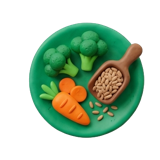
A balanced plate with lean protein, vegetables, and whole grains supports metabolic health after menopause

Protein needs go up, not down

Most women over 50 don't eat enough protein. The current RDA (0.36 grams per pound of body weight) is a minimum to prevent deficiency, not an amount optimized for preserving muscle during menopause.
Research suggests postmenopausal women benefit from 0.5-0.7 grams of protein per pound of body weight daily. For a 160-pound woman, that's 80-112 grams of protein per day. Spread it across meals — your body can only use so much at once for muscle synthesis.
Practical protein targets per meal: 25-35 grams. A palm-sized portion of chicken is about 30 grams. A cup of Greek yogurt is 15-20. Two eggs are about 12. You don't need protein shakes unless you genuinely struggle to hit your numbers through food.

A moderate calorie deficit beats a crash diet

For postmenopausal weight loss, a deficit of 300-500 calories per day is the sweet spot. Aggressive enough to produce fat loss (about 0.5-1 pound per week), but gentle enough to preserve muscle mass when combined with strength training and adequate protein.
Going lower than 1,400-1,500 calories is rarely a good idea for women in this age group. You need enough fuel to support your training, your daily activities, and the thermic effect of the higher protein intake that's protecting your muscle.
Weight loss will be slower than it was in your 30s. Accepting that upfront saves you from the frustration spiral that leads to quitting. Half a pound per week for 6 months is 13 pounds. That's real, sustainable progress.

Sleep is a weight loss tool, not a luxury

Menopause wrecks sleep for a lot of women. And poor sleep directly sabotages weight loss — it increases hunger hormones, tanks willpower, and makes your body preferentially store fat instead of burning it.
If hot flashes are disrupting your sleep, talk to your doctor about treatment options. Hormone replacement therapy (HRT) has been shown to improve both sleep quality and body composition in postmenopausal women. The risks are lower than the 2002 WHI scare suggested, especially for women under 60 who start within 10 years of menopause onset.
Beyond medical options: keep your bedroom cold (65-68 degrees), avoid alcohol within 3 hours of bed (it triggers hot flashes), and be ruthless about a consistent sleep schedule. These aren't groundbreaking tips, but consistency with basics matters more than any supplement.

The mental game nobody talks about

Menopause doesn't just change your body. It changes your relationship with your body. Many women I've spoken to describe a grief process — mourning the metabolism they used to have, the body that used to respond predictably to effort.
That grief is real and valid. But staying stuck in "my body is broken" thinking keeps you from engaging with what actually works now. The strategies above work. They just work differently than what you're used to — slower, more focused on body composition than the scale number, more dependent on consistency than intensity.
Two mindset shifts that help:
  1. Stop comparing to your 35-year-old self. Your baseline has changed. Measure progress against where you are now, not where you were 20 years ago.
  1. Track more than weight. Waist measurements, how your clothes fit, energy levels, strength gains in the gym — these tell a more accurate story of what's happening in your body than the scale alone.

How BodyBuddy helps with weight loss after menopause

Losing weight after menopause requires consistency over months, not perfection over days. That's where daily accountability makes a measurable difference.
BodyBuddy coaches you through iMessage with a companion app that tracks your progress and shows your Future You — an AI-generated avatar of what you'll look like when you hit your goal. The daily check-ins through iMessage keep you on track with protein targets and meal timing without requiring you to open yet another app or log every gram of food in a database.
You can text a photo of your meal and get instant feedback. You can tell your AI coach that you had a rough night of sleep and get adjusted guidance for the day. The companion iOS app lets you see your tracked meals and nutrition data, monitor your progress over time, and complete daily missions that make your Future You avatar more visible as you stay consistent.
At $29.99/month, it costs a fraction of what a personal nutritionist charges, and it's available at 10 PM when you're debating whether to eat the leftover pasta or go to bed. Learn more at bodybuddy.app.

Frequently asked questions

Is it harder to lose weight after menopause?

Yes, measurably so. Lower estrogen levels reduce your resting metabolic rate by 100-200 calories per day, accelerate muscle loss, shift fat storage to the abdomen, and decrease insulin sensitivity. Weight loss is still possible — it just requires a different approach than what worked before.

What is the best diet for postmenopausal weight loss?

There's no single best diet, but the principles are consistent across research: prioritize protein (0.5-0.7g per pound of body weight), maintain a moderate calorie deficit (300-500 calories below maintenance), eat plenty of fiber-rich vegetables, and don't drop below 1,400-1,500 calories. Mediterranean-style eating patterns perform well in studies on postmenopausal women.

Does hormone replacement therapy help with weight loss?

HRT doesn't directly cause weight loss, but it can help. Studies show it reduces the shift to visceral fat storage, improves insulin sensitivity, and — perhaps most importantly — improves sleep quality. Better sleep means lower cortisol, less hunger, and more energy for exercise. Talk to your doctor about whether HRT is appropriate for your situation.

How much exercise do I need after menopause to lose weight?

Aim for 2-3 strength training sessions per week (the most important piece) plus 150+ minutes of moderate activity like walking. You don't need to spend two hours in the gym. A 30-minute strength session and a daily 20-minute walk will do more for your body composition than an hour of cardio five days a week.

The bottom line

Weight loss after menopause is harder. It's not impossible. The women who succeed at it tend to do four things: lift weights consistently, eat more protein than they think they need, accept a slower rate of loss, and find a system that keeps them accountable day after day.
The last part is where most people fall off. Knowing what to do isn't the hard part. Doing it on a random Tuesday when you're tired and unmotivated — that's the hard part. Whether you use BodyBuddy, a friend, or a sticky note on your fridge, build accountability into your daily routine. Your postmenopausal body can still change. It just needs a different playbook.

Want daily accountability?

BodyBuddy texts you every day.

Build a healthier relationship with food and movement — one text at a time.

Designed by anAccountability Coach
5.0
App Store Rating