Nutrition|March 13, 2026|Francis
How to build healthy eating habits that actually stick
How to build healthy eating habits that actually stick
You already know what you should eat. More vegetables, less processed food, reasonable portions. This isn't new information. Yet knowing what to eat and actually doing it consistently are completely different problems. If you've ever started a diet on Monday and abandoned it by Thursday, you're not weak-willed. You're human. The real question isn't what to eat. It's how to build healthy eating habits that survive your real life.
Why most eating habits fail
The default advice is to use willpower. Decide to eat better, then just do it. This advice fails because it misunderstands how behavior works.
Roy Baumeister's research at Florida State University showed that willpower functions like a muscle: it fatigues with use. By the end of a long workday, the mental energy you need to choose grilled chicken over pizza is genuinely depleted. You're not making a character judgment. You're running on empty.
Motivation has the same problem. It's high on Sunday night when you're meal prepping, and gone by Wednesday when you're staring at a drive-through menu. Habits that depend on motivation are habits that won't last.
What actually works is environment design and systems. Your surroundings shape your decisions far more than your intentions do. Brian Wansink's research at Cornell demonstrated that people eat 70% more food when it's visible and accessible. The reverse is also true: when healthy food is easy to grab and junk food requires effort, your default behavior shifts without requiring any willpower at all.
The science behind habit loops
Every habit follows the same neurological pattern, described by Charles Duhigg as the cue-routine-reward loop:
- Cue: a trigger that initiates the behavior (time of day, location, emotional state)
- Routine: the behavior itself (what you eat)
- Reward: the payoff your brain registers (taste, fullness, stress relief)
To build a new eating habit, you need to identify or create each piece. "Eat healthier" is too vague for your brain to act on. "When I sit down for lunch at my desk, I eat the salad I prepped this morning, and then I have a square of dark chocolate" gives your brain a clear cue, a specific routine, and a concrete reward.
Psychologist Peter Gollwitzer calls this an "implementation intention." His research found that people who specify when, where, and how they'll perform a behavior are two to three times more likely to follow through than people who simply state a goal.
Some practical implementation intentions for eating:
- "When I get home from work, I'll drink a glass of water before opening the fridge."
- "At the grocery store, I'll shop the perimeter first and only go down aisles for items on my list."
- "When I feel like snacking after 8pm, I'll make herbal tea instead."
The specificity matters. Vague plans produce vague results.

Designing your environment for better eating
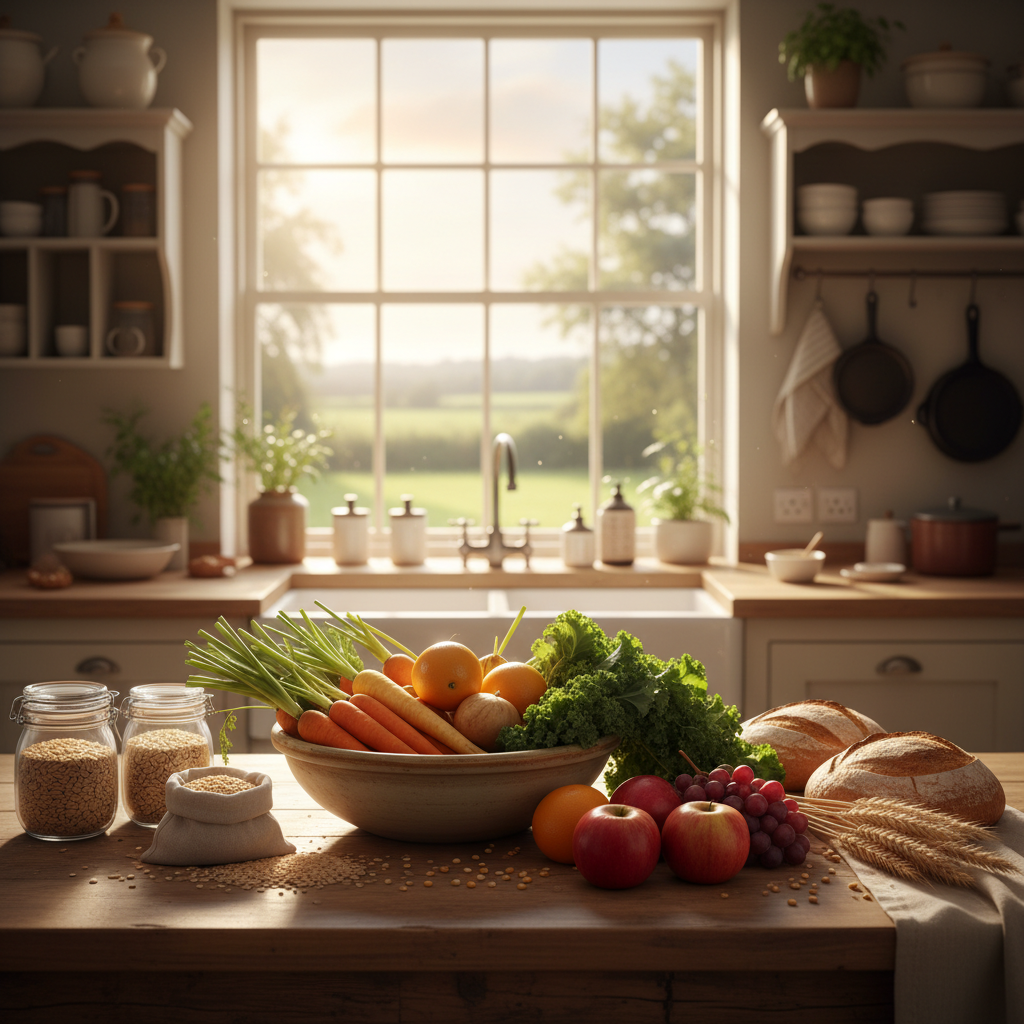
Your kitchen layout has more influence on your eating than your nutrition knowledge does. Here's how to set it up:
Make healthy food visible and accessible. Put fruit on the counter. Keep cut vegetables at eye level in the fridge. Store nuts and seeds in clear containers on the shelf you reach first.
Add friction to unhealthy choices. Move chips to a high cabinet. Don't keep ice cream in the house; if you want it, you have to go out and get a single serving. Wrap leftovers from indulgent meals in aluminum foil so you can't see them.
Prep once, eat all week. Spend an hour on Sunday washing and cutting vegetables, cooking a batch of grains, and preparing two or three protein sources. When healthy food is already made, it becomes the easiest option.
- Wash and chop vegetables the day you buy them
- Cook grains in bulk (rice, quinoa, oats)
- Portion snacks into grab-and-go containers
- Keep a few go-to recipes that take under 15 minutes
The goal isn't perfection. It's making the healthy choice the path of least resistance.
Starting small with the two-minute rule
James Clear popularized the idea that new habits should take less than two minutes to start. Applied to eating, this means you don't overhaul your entire diet on day one. You start with something so small it feels almost trivial.
Instead of "I'm going to meal prep every Sunday for three hours," try "I'll cut up one vegetable after I unpack the groceries." Instead of "I'm cutting out all sugar," try "I'll eat one piece of fruit with breakfast."
Habit stacking is another useful technique. You attach a new behavior to something you already do every day:
- After I pour my morning coffee, I'll eat a handful of almonds.
- Before I start cooking dinner, I'll set out a vegetable to include.
- When I pack my work bag, I'll add a healthy snack.
These feel small because they are. That's the point. Small behaviors performed consistently build identity. After a few weeks of eating fruit with breakfast, you start thinking of yourself as "someone who eats fruit with breakfast." That identity shift is where lasting change lives.
Tracking and accountability: why they work
Self-monitoring is one of the most consistently supported strategies in behavioral research. A study published in the Journal of the Academy of Nutrition and Dietetics found that people who tracked their food intake lost twice as much weight as those who didn't.
But traditional food tracking is tedious. Logging every calorie in an app requires time and mental energy that most people can't sustain. The alternative is lighter-touch tracking: snapping a photo of your meals, writing down what you ate in a sentence or two, or simply noting whether you hit your daily target.
External accountability adds another layer. When someone else is paying attention to your habits, you're more likely to follow through. The best accountability is consistent (daily check-ins beat weekly reviews), low-friction (a text message, not a formal report), and supportive rather than punitive.
How BodyBuddy helps you build healthy eating habits
This is where the gap between knowing and doing gets bridged. BodyBuddy is an AI coach that works through iMessage, with a companion app that tracks your progress and shows your Future You -- an AI-generated avatar of what you'll look like when you hit your goal.
Every day, BodyBuddy sends you a check-in through iMessage. You can track meals by sending a photo or a quick text description. No calorie counting, no barcode scanning. You text a picture of your lunch, and you're done.
The AI coach provides accountability nudges, answers nutrition questions, and helps you troubleshoot when things go off track. Because it's in iMessage, it fits into your existing routine rather than demanding you build a new one.
The companion iOS app lets you view your tracked meals and nutrition data, complete daily missions for gamification, and watch your Future You avatar become more visible as you stay consistent. Complete your daily missions, and your Future You becomes more present. Skip them, and it fades.
At $29.99/month, it's built for people who want ongoing coaching without scheduling calls or showing up to appointments.
Frequently asked questions
How long does it take to build a healthy eating habit?
The commonly cited "21 days" figure comes from a misreading of Maxwell Maltz's work. Research by Phillippa Lally at University College London found the actual average is 66 days, with a range of 18 to 254 days depending on the complexity of the behavior. Simpler habits form faster than complex ones. Focus on consistency rather than counting days.
What's the best diet to follow for building healthy habits?
There isn't one. The best eating pattern is the one you can maintain. Mediterranean, whole-food plant-based, and balanced macro approaches all work when followed consistently. Pick an approach that fits your preferences, budget, and lifestyle. The habit framework matters more than the specific diet.
How do I get back on track after falling off my eating habits?
Missing one day doesn't reset your progress. The research on habit formation shows that occasional misses don't significantly impact long-term habit strength. What matters is that you don't miss twice in a row. If you had a bad food day, your only job is to make the next meal a good one.
Can I build healthy eating habits without meal prepping?
Yes. Meal prepping is one strategy, not a requirement. You can build healthy habits by keeping simple staples on hand (eggs, frozen vegetables, canned beans, rice), choosing restaurants with healthier options, or using a framework like "protein + vegetable + grain" to guide quick decisions.
How does accountability help with eating habits?
Accountability works because it adds a social cost to skipping your habit. When you know someone will ask about your meals, you're more likely to follow through. Tools like BodyBuddy provide this through daily iMessage check-ins, so you get the benefit without needing to recruit a friend.
What to do right now
You don't need to overhaul everything. Pick one eating habit you want to build. Write an implementation intention for it: when, where, and what. Set up your environment to make it easier. Track it for a week in whatever way requires the least effort.
If you want AI-powered coaching that meets you where you already are -- in your text messages -- check out BodyBuddy. It's designed to do exactly what this article describes: build healthy eating habits through daily accountability, smart tracking, and a system that works with your life instead of against it.
Want daily accountability?
BodyBuddy texts you every day.
Build a healthier relationship with food and movement — one text at a time.
Join 500+ usersstaying healthy